



Sunday, October 25, 2026 Paksha:Shukla Tithi:Purnima

Sunday, October 25, 2026 Paksha:Shukla Tithi:Purnima

Monday, October 26, 2026 Paksha:Krishna Tithi:Prathama
Monday, October 26, 2026 Paksha:Krishna Tithi:Prathama

Monday, October 26, 2026 Paksha:Krishna Tithi:Prathama
Wednesday, October 28, 2026 Paksha:Krishna Tithi:Tritiiya


Thursday, October 29, 2026 Paksha:Krishna Tithi:Chaturthi
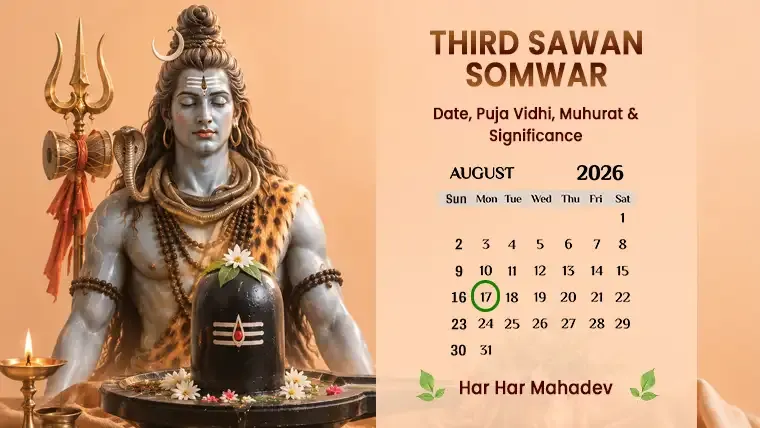
Three Mondays into Sawan, and it may seem that the devotion of the first two Somwars cannot be surpassed. Yet, the Third Sawan Somwar 2026 holds its own special significance. Falling on a unique date, it brings together regional traditions and auspicious astrological influences, making it one of the most important Mondays of the holy month.
Shrawan (Sawan) Third Somwar 2026 Date And Tithi
The third Sawan Somvar falls on a different date depending on your region's calendar system. Here's a quick reference:
| 🌍 Region | 📅 Calendar System | 🕉️ Third Sawan Somwar Date | 🌙 Tithi |
|---|---|---|---|
| 🏛️ North India (Delhi, Uttar Pradesh, Bihar, Rajasthan, Madhya Pradesh, etc.) | Purnimanta | 📅 17 August 2026 (Monday) | 🌙 Krishna Paksha Dwitiya / Tritiya* |
| 🌴 Maharashtra, Gujarat & South India | Amanta | 📅 31 August 2026 (Monday) | 🌙 Shukla Paksha Navami / Dashami* |
To check dates for the other Somwars in Sawan:
Sawan First Somwar | Sawan Second Somwar | Sawan Fourth Somwar
🕉️ Shubh Muhurat for Third Sawan Somwar 2026
Timing is everything when it comes to Shiva Puja. Here are the best times to perform your rituals:
| ⏰ Muhurat / Period | 🕒 Approx. Time (New Delhi) | 🙏 Best For |
|---|---|---|
| 🌅 Brahma Muhurat | About 04:00 AM – 05:00 AM | The most auspicious time for snan, Somwar Vrat Sankalp, the first jalabhishek, and mantra-jap in a peaceful atmosphere. |
| 🌄 Pratah / Morning Puja | From sunrise (~5:40 AM) to about 9:00 AM | Ideal for a complete Shiva Puja with water, milk, bel-patra, and flowers, especially if you are unable to wake during Brahma Muhurat. |
| ☀️ Daytime (General) | After morning puja until before sunset | Suitable for jalabhishek, temple darshan, and chanting "Om Namah Shivaya" or the Maha Mrityunjaya Mantra at your convenience. |
| 🕛 Abhijit Muhurat | Around 12:00 PM – 12:45 PM | A highly auspicious midday period for a short Shiva Puja, abhishek, or meditation, especially for working devotees. |
| 🌇 Pradosh Kaal (Evening) | Roughly 6:45 PM – 8:15 PM | One of the most sacred times for the main Shiva Puja, deepak, aarti, and the final jalabhishek of the day. |
Note: Because sunrise times shift slightly by location, check a local Panchang or consult an astrologer for the exact minute-by-minute abhishek timings in your specific city.
Sawan Third Somwar Puja Vidhi and Rituals
This is the heart of the day, and getting the puja vidhi right can make all the difference in how connected you feel to the ritual. Let's break it down step by step.
1. Start with a clean slate.
Start with a clean slate. Wake up during Brahma Muhurta, take a bath in water containing a few drops of Ganga Jal, and put on clean clothes. Clean your home temple or head to the nearest Shiva temple. It's not just your body that gets purified here; your soul does too.
2. Take your sankalpa.
Hold water, rice, and flowers in your right hand and silently make your resolve with a pure heart and mind to observe the vrat. State your name and your intent, just as you would with any other vow.
3. Perform the Shiva Abhishek.
The main thing is the abhishek of the Shivling at certain levels of the ritual. Wash the Shivling with water first, followed by washing with milk, curd, honey, and ghee while chanting "Om Namah Shivaya." It really evokes a meditative feeling through the act of pouring water and chanting.
4. Offer leaves and sacred items.
Bel Patra must not be missed here, as its leaves are three-leaved, representing the three Gunas (Sattva, Rajas, and Tamas) and the Holy Trinity of Brahma, Vishnu, and Shiva. The offerings like Dhatura and Bhaang symbolize egolessness. End the ritual with a layer of white Chandan on the top of the Shivling.
5. Chant your mantras.
Chant Panchakshari Mantra, “Om Namah Shivaya,” or Maha Mrityunjaya Mantra without any pause. Sound vibrations will help bring your inner vibrations in line with cosmic vibrations, similar to retuning a musical instrument.
6. Follow the fasting rules.
Some people strictly observe Nirjala Vrat, while others choose a less strict Phalahar Vrat that involves eating fruits, milk, and nuts. Fasting excludes grains, salt, onions, and garlic in general; instead, Sendha Namak is used whenever necessary.
7. Close with Aarti and Prasad.
With the arrival of Pradosh Kaal in the evening, end your ritual with camphor aarti and distribute prasad to your family and community.
Sawan Somvar Vrat: Diet and Fasting Rules
Devotees follow distinct levels of fasting based on physical endurance and personal choice. Regardless of style, devotees strictly adhere to a Sattvic lifestyle.
Fasting Classifications
Nirjala Vrat: A complete fast observed without consuming a single drop of water or food from dawn to dusk or the next day morning.
Phalahar Vrat: A partial fast allowing water, milk, and fresh fruit consumption throughout the day.
Single Sattvic Meal: Some choose to consume just one wholesome vegetarian meal after sunset once the final evening prayers are finished.
🍎 Sawan Somwar Vrat Guide
Follow these dietary guidelines to observe the fast with purity and devotion.
| ✅ Permitted Foods (Do's) | ❌ Prohibited Foods (Don'ts) |
|---|---|
| 🍌 Fresh fruits (Banana, Apple, Pomegranate, etc.) | 🌾 All grains (Wheat, Rice, Lentils, Corn, etc.) |
| 🥛 Dairy products (Milk, Fresh Curd, Buttermilk, Paneer) | 🧂 Regular table salt (Sodium Chloride) |
| 🪨 Rock Salt (Sendha Namak) for savory dishes | 🧅 Onion, Garlic, and pungent spices |
| 🌰 Sabudana (Tapioca Pearls), Makhana (Foxnuts), Kuttu (Buckwheat Flour) | 🍟 Packaged junk food and deep-fried snacks |
| 🥥 Coconut water and herbal, caffeine-free teas | 🍺 Alcohol, Tobacco, and Non-vegetarian food |
Have questions about your Sawan Somwar fast or puja muhurat? Connect with an Astroyogi astrologer for expert clarity and personalized vrat details.
Importance of Sawan Third Somwar
Why does this particular Monday carry so much weight? Let's break it down.
A Rare Convergence with Nag Panchami
On 17th August 2026, the Sawan Third Somwar doesn't arrive by itself; it lands exactly on Nag Panchami, the day set aside for serpent worship. Vedic iconography has always placed Vasuki coiled around Lord Shiva's neck, a serpent wrapped around a God, standing in for cosmic energy and the movement of time itself. Two threads, two symbols, one date.
When the Third Somwar and Nag Panchami overlap like this, the worship of Shiva and Vasuki together is said to double the spiritual weight of that day's rituals. Not just prayer for prayer's sake, but something aimed at healing ancestors and addressing Kaal Sarp Dosha in astrology, the kind of affliction people spend years trying to correct.
Some overlaps are just calendar coincidences. This one isn't treated that way.
A Pan-Indian Calendar Bridge
Since the Purnimanta calendar of Northern India and the Amavasyant calendar of Southern/Western India generally do not coincide due to differences between them, it is quite uncommon to find the same dates holding importance in both calendars.
This very rare occurrence comes about on 17th August 2026. It functions as a geographical and calendrical nexus point, celebrated as the Third Somwar in the North and the First Somwar across states like Maharashtra, Gujarat, and Karnataka, bringing millions of devotees together on a single shared date of devotion.
Ideal for Planetary Remedies
If you're looking to go a step further, this day is also considered ideal for:
Balancing Rahu-Ketu energies, since Nag Panchami is astrologically tied to these shadow planets
Addressing mental anxiety through targeted Upayas (remedies)
Performing rituals aimed at neutralizing Kaal Sarp Dosha and similar planetary constraints
Three aspects make this Monday unique compared to all other Somwars that you will be fasting this year: the unusual conjunction of Somwar and Nag Panchami, the rare occurrence of Purnimanta and Amavasyant months falling together, and the birth chart that cries out for a cure for Rahu-Ketu dosha. This is quite a heavy spiritual load placed on a single day. If you prepare for it accordingly, 17th August 2026 may become your most spiritual Somwar of the year.
Festival List
- Nag Panchami
- Raksha Bandhan
- Janmashtami
- Ganesh Chaturthi
- Onam
- Pitru Paksha
- Shardiya Navratri
- Durga Puja
- Dussehra
- Karwa Chauth
- Dhanteras
- Diwali
- Govardhan Puja
- Bhai Dooj
- Chhath Puja
- Tulsi Vivah
- Guru Nanak Jayanti
- Christmas
- New year
- Lohri
- Pongal
- Makar Sankranti
- Vasant Panchami
- Shivratri
- Ramadan
- Holi
- Good Friday
- Navratri
- Gudi Padwa
- Ugadi
- Vaisakhi
- Ram Navami
- Mahavir Jayanti
- Hanuman Jayanati
- Buddha Purnima
- Akshay Tritiya
- Shani Jayanti
- Guru Purnima
- Hariyali Teej