


Sunday, October 25, 2026 Paksha:Shukla Tithi:Purnima

Sunday, October 25, 2026 Paksha:Shukla Tithi:Purnima

Monday, October 26, 2026 Paksha:Krishna Tithi:Prathama
Monday, October 26, 2026 Paksha:Krishna Tithi:Prathama

Monday, October 26, 2026 Paksha:Krishna Tithi:Prathama
Wednesday, October 28, 2026 Paksha:Krishna Tithi:Tritiiya


Thursday, October 29, 2026 Paksha:Krishna Tithi:Chaturthi
Thursday, October 29, 2026 Paksha:Krishna Tithi:Chaturthi
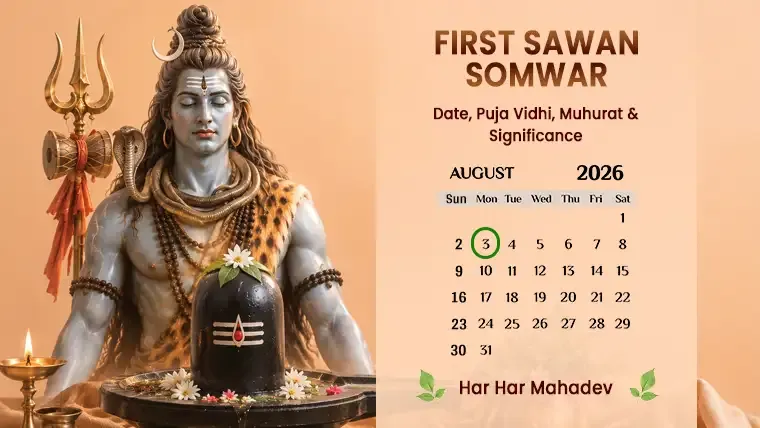
The first Monday (Somwar) of Sawan holds immense significance, marking the official beginning of a devotee's holy pledges to Lord Shiva for an entire month. This sacred day establishes a spiritual tone for the remaining period.
Shrawan (Sawan) First Somwar 2026 Date And Tithi
📍 Quick Reference: The date of the First Sawan Somwar varies across India depending on the lunar calendar followed in your region.
| 🌍 Region | 📅 Calendar System | 🕉️ First Sawan Somwar | 🌙 Tithi |
|---|---|---|---|
| 🏛️ North India (Delhi, Uttar Pradesh, Bihar, Rajasthan, Madhya Pradesh, etc.) | Purnimanta | 📅 3 August 2026 (Monday) | 🌙 Krishna Paksha Panchami |
| 🌴 Maharashtra, Gujarat & South India | Amanta | 📅 17 August 2026 (Monday) | 🌙 Shukla Paksha Panchami (🐍 Nag Panchami) |
To check dates for the other Somwars in Sawan:
Sawan Second Somwar | Sawan Third Somwar | Sawan Fourth Somwar
🕉️ Shubh Muhurat for First Sawan Somwar
Time plays a major role in Hindu traditions, and the first Sawan Somwar is not an exception to this rule. If you are keeping the vrat on August 3, 2026, remember the following timings:
| ⏰ Muhurat / Period | 🕒 Approx. Time (Local) | 🙏 Best For |
|---|---|---|
| 🌅 Brahma Muhurta | 04:19 AM – 05:01 AM | Early morning snan, sankalp, and the first jalabhishek. |
| 🌄 Pratah Sandhya | 04:40 AM – 05:44 AM | Morning Shiva Puja, Om Namah Shivaya mantra chanting, and simple abhishek. |
| ☀️ Daytime (General) | After sunrise – Before sunset | Regular darshan, puja, and offerings if you cannot worship early in the morning. |
| 🌇 Pradosh Kaal (Evening) | Around sunset (approximately 7:00–8:00 PM in Delhi) | One of the most auspicious periods for Sawan Somwar Shiva Puja and abhishek. |
Note: Exact clock times can shift slightly city to city, but for New Delhi they will be extremely close to the above. If you want to get an appropriate/exact muhurat according to your location, please check your local panchang.
The Two Dates of Sawan's First Somwar
Here is where things get interesting, and honestly, a little confusing for first-timers. India does not follow one single lunar calendar. Depending on where you live, you might celebrate the first Sawan Somwar on a completely different day than your friend in another state. Why? Because of two calendar systems.
North India practices the Purnimanta system, wherein its lunar month concludes at the full moon stage. West and South India practice the Amanta system, wherein the month concludes at the new moon stage.
According to the Purnimanta system (which applies to North India), Sawan falls between July 30 and August 28, 2026. Therefore, August 3, 2026 (Monday), becomes the first Sawan Somwar.
According to the Amanta system (applicable in West and South India), Sawan spans from August 13 to September 11, 2026. This makes August 17, 2026 (Monday), the first Sawan Somwar according to this calendar system.
Therefore, on this particular date, the devotees of the Amanta calendar system will celebrate two traditions simultaneously—the first Somvar of Sawan and the worship of serpent gods. Since Lord Shiva is frequently referred to as Nageshwar (Lord of snakes), this coincidence takes on more significance to devotees.
First Sawan Somwar: Puja Vidhi and Rituals
So, how exactly do you conduct the puja during this very important day? In contrast to the other days of Sawan, this first Monday of Sawan comes with a particular process of initialization referred to as Sankalpa. Here is the full ritual flow, broken down simply.
Snana (Purification): Begin the day with an ablution ritual, preferably before dawn. Most people prefer adding a few drops of Gangajal to their bathing water.
Sankalpa (The Vow): This is a very crucial part of the first Monday when you hold water, rice, and a coin in your right hand while making an official declaration that you want to observe the Vrat for one month, giving your name and lineage. This can be seen as entering into a personal agreement with the divine, which focuses on discipline.
Jalabhishek and Panchamrit Snan: Pour water on the Shivling and pour Panchamrit—a mixture of milk, curd, honey, ghee, and sugar.
Offerings: Offer Belpatra (which is trifoliate in form), Dhatura, Bhaang, and white flowers. Each of these holds symbolic meaning tied to Lord Shiva's ascetic nature.
Mantra Chanting: Chant the Maha Mrityunjaya Mantra or the simpler “Om Namah Shivaya” mantra, followed by the Sawan Somwar Vrat Katha.
Sawan Somvar Vrat: Diet and Fasting Rules
Devotees follow distinct levels of fasting based on physical endurance and personal choice. Regardless of style, devotees strictly adhere to a Sattvic lifestyle.
Fasting Classifications
Nirjala Vrat: A complete fast observed without consuming a single drop of water or food from dawn to dusk or the next day morning.
Phalahar Vrat: A partial fast allowing water, milk, and fresh fruit consumption throughout the day.
Single Sattvic Meal: Some choose to consume just one wholesome vegetarian meal after sunset once the final evening prayers are finished.
🍎 Sawan Somwar Vrat Guide
Follow these dietary guidelines to observe the fast with purity and devotion.
| ✅ Permitted Foods (Do's) | ❌ Prohibited Foods (Don'ts) |
|---|---|
| 🍌 Fresh fruits (Banana, Apple, Pomegranate, etc.) | 🌾 All grains (Wheat, Rice, Lentils, Corn, etc.) |
| 🥛 Dairy products (Milk, Fresh Curd, Buttermilk, Paneer) | 🧂 Regular table salt (Sodium Chloride) |
| 🪨 Rock Salt (Sendha Namak) for savory dishes | 🧅 Onion, Garlic, and pungent spices |
| 🌰 Sabudana (Tapioca Pearls), Makhana (Foxnuts), Kuttu (Buckwheat Flour) | 🍟 Packaged junk food and deep-fried snacks |
| 🥥 Coconut water and herbal, caffeine-free teas | 🍺 Alcohol, Tobacco, and Non-vegetarian food |
Have questions about your Sawan Somwar fast or puja muhurat? Connect with an Astroyogi astrologer for expert clarity and personalized vrat details.
Why Is the First Sawan Somwar So Important?
Ever wonder why an entire nation seems to pause for this one day? There are three big reasons.
First, there is the tale of Samudra Manthan, in which Lord Shiva drinks the poison that threatens to destroy the universe to save everyone, thereby turning his throat blue and earning him the name Neelkanth. Devotees bathe the Shivling with water in Sawan to cool Lord Shiva, to comfort him after saving the world from disaster, for no other reason but out of love and devotion.
Second, it is also celebrated as the marriage between Lord Shiva and Goddess Parvati, who underwent years of penance before marrying him.
Third, this is also the time when the Kanwar Yatra reaches its peak. Devotees take holy water from the river Ganga by walking barefoot.
Message of Sawan: Sincerity Over Practice
Irrespective of whether you observe the first Sawan Somwar on August 3 or August 17, 2026, it ultimately comes down to the sincerity of your Sankalpa.
All rituals, muhurats, and fasting guidelines are there only to help you connect with Lord Shiva with a pure mind and soul. So light your diya and sing with devotion to usher in the first Monday of Sawan with faith and discipline.
Festival List
- Nag Panchami
- Raksha Bandhan
- Janmashtami
- Ganesh Chaturthi
- Onam
- Pitru Paksha
- Shardiya Navratri
- Durga Puja
- Dussehra
- Karwa Chauth
- Dhanteras
- Diwali
- Govardhan Puja
- Bhai Dooj
- Chhath Puja
- Tulsi Vivah
- Guru Nanak Jayanti
- Christmas
- New year
- Lohri
- Pongal
- Makar Sankranti
- Vasant Panchami
- Shivratri
- Ramadan
- Holi
- Good Friday
- Navratri
- Gudi Padwa
- Ugadi
- Vaisakhi
- Ram Navami
- Mahavir Jayanti
- Hanuman Jayanati
- Buddha Purnima
- Akshay Tritiya
- Shani Jayanti
- Guru Purnima
- Hariyali Teej