


Monday, October 26, 2026 Paksha:Krishna Tithi:Prathama
Monday, October 26, 2026 Paksha:Krishna Tithi:Prathama
Monday, October 26, 2026 Paksha:Krishna Tithi:Prathama
Wednesday, October 28, 2026 Paksha:Krishna Tithi:Tritiiya
Thursday, October 29, 2026 Paksha:Krishna Tithi:Chaturthi
Thursday, October 29, 2026 Paksha:Krishna Tithi:Chaturthi
Thursday, October 1, 2026 Paksha:Krishna Tithi:Panchami
Thursday, October 1, 2026 Paksha:Krishna Tithi:Panchami
Friday, October 2, 2026 Paksha:Krishna Tithi:Saptami
Pitru Paksha, also known as Shraddh, is a significant period in the Hindu calendar dedicated to remembering and honoring departed ancestors. In 2026, Pitru Paksha begins on September 26 and concludes with Sarva Pitru Amavasya on October 10. During this period, families traditionally perform Shraddha, Tarpan, Pind Daan, prayers, and acts of charity for their ancestors.
Pitru Paksha 2026 Date & Time
Duration - 00 Hours 48 Mins
Aparahna Kaal - 01:30 PM to 03:55 PM Duration - 02 Hours 25 Mins
Purnima Tithi Begins - 11:06 PM on Sep 25, 2026
Purnima Tithi Ends - 10:18 PM on Sep 26, 2026
Depending on how the days are counted, the period is described as either 15 lunar days (tithis) or a roughly 16-day civil window. This period is significant for families across India, who use it to honor departed ancestors through prayer, ritual, and charity.
Pitru Paksha 2026 Calendar
Check the complete Pitru Paksha 2026 calendar with dates, days, and important Shraddha Tithis.
| Date | Day | Shraddha Tithi |
|---|---|---|
| 26 September 2026 | Saturday | Purnima Shraddha |
| 27 September 2026 | Sunday | Pratipada Shraddha |
| 28 September 2026 | Monday | Dwitiya Shraddha |
| 29 September 2026 | Tuesday | Tritiya Shraddha |
| 30 September 2026 | Wednesday | Chaturthi Shraddha |
| 30 September 2026 | Wednesday | Panchami Shraddha |
| 1 October 2026 | Thursday | Shashthi Shraddha |
| 2 October 2026 | Friday | Saptami Shraddha |
| 3 October 2026 | Saturday | Ashtami Shraddha |
| 4 October 2026 | Sunday | Navami Shraddha |
| 5 October 2026 | Monday | Dashami Shraddha |
| 6 October 2026 | Tuesday | Ekadashi Shraddha |
| 7 October 2026 | Wednesday | Dwadashi Shraddha |
| 8 October 2026 | Thursday | Trayodashi Shraddha |
| 9 October 2026 | Friday | Chaturdashi Shraddha |
| 10 October 2026 | Saturday | Sarva Pitru Amavasya |
Important Notes
Chaturthi Shraddha and Panchami Shraddha are observed on 30 September 2026.
Shraddha rituals are generally performed according to the Hindu lunar tithi, so the Gregorian date may vary by location.
The exact Shraddha Muhurat and Aparahna timings may differ based on the city. Check the local Panchang timings before performing the ritual.
Sarva Pitru Amavasya on 10 October 2026 marks the concluding day of Pitru Paksha.
What Is Pitru Paksha?
Pitru Paksha falls in the Ashwina month during the Krishna Paksha (the waning phase of the moon). According to Hindu scripture, this is believed to be a time when the souls of departed ancestors return to the earthly realm in search of peace and liberation.
To help these souls find rest and, in turn, receive their blessings, Hindus observe rituals of remembering and offering during this period. It is regarded as a time of quiet mourning and reflection rather than a celebratory festival and is often described as a religious observance rather than a "festival" in the usual sense.
How Shraddh Is Performed
Rituals during Pitru Paksha are generally performed on the tithi (lunar day) corresponding to the date of the ancestor's death, though certain days are set aside for specific circumstances. The core rituals typically include the following steps:
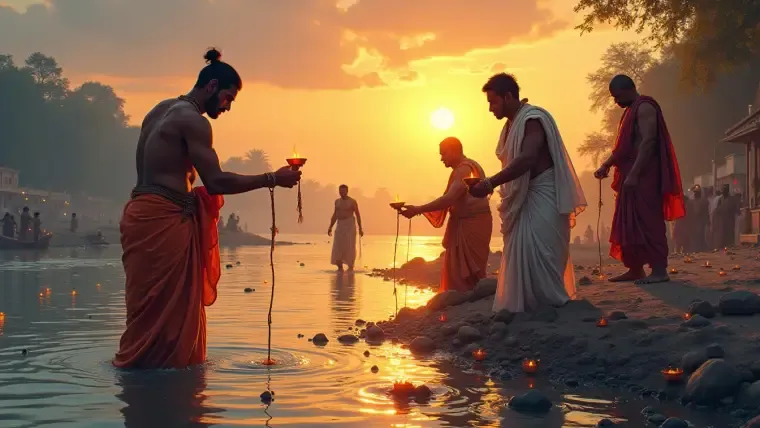
The person performing the rites — known as the karta, traditionally the eldest son of the family, or another male relative from the paternal line if the eldest son is unavailable (in some traditions, the eldest daughter may perform the rites when no male member is available) — rises early and bathes.
The karta wears a ring made of darbha grass and a sacred thread, whose position is adjusted at different points in the ritual.
Seated in a calm, dedicated space, the karta invokes the ancestors and performs Tarpan — offering water, along with sesame seeds and barley, with both hands.
Pind Daan is performed: balls of cooked rice and other offerings are presented to help the ancestors' souls attain liberation (moksha).
A meal prepared using satvic (simple, vegetarian) recipes is offered to cows, dogs, crows, and ants, and a portion is offered into the sacred fire (havan kund).
Brahmins are invited to the home, offered food and dakshina (a customary donation), and their blessings are sought.
The family prays together for the ancestors' liberation and for their blessings on the living.
Acts of charity performed during this period are considered especially meaningful.
Specific Tithis for Special Cases
While most Shraddh rites are performed on the tithi of death, certain days are set aside for particular circumstances:
Chaturthi Shradh (fourth lunar day) and Panchami Shradh (fifth lunar day) are observed for those who died within the past year.
Navami Shradh, also called Avidhava Navami (ninth lunar day), is observed for women who died before marriage.
Dwadashi (twelfth lunar day) is set aside for children and ascetics.
Chaturdashi Shradh, also called Ghata Chaturdashi (fourteenth lunar day), is observed for those who died unnatural deaths.
If the date of an ancestor's death is unknown, Shraddh is performed on Sarvapitri Amavasya, the final day of the period.
Significance
Pitru Paksha is rooted in the belief that our ancestors continue to have a bearing on the well-being of the living, and that offering them comfort and nourishment helps free their souls from any lingering attachment to the material world.
Devotees from across the country travel to the banks of the Falgu River in Gaya to perform Pind Daan, considered one of the most sacred sites for this ritual. On Sarvapitri Amavasya, the karta recites the names of forefathers across three generations, a practice intended to reinforce familial continuity and memory.
In astrology, an occurrence known as Pitru Dosha is sometimes associated with unresolved responsibilities to one's ancestors, believed to come up when past generations may have mistakenly done wrongs that carry forward as a kind of inherited debt. Some believe this can create difficulties in a person's life until it is addressed.
The rituals performed during Pitru Paksha are considered one traditional way of easing this influence, though interpretations vary, and those concerned about it often consult a verified astrologer for guidance specific to their situation.
The Legend of Karna
According to the Mahabharata, Karna died on the seventeenth day of the Kurukshetra war and ascended to heaven, where he was offered gold and jewels as food. Confused, he asked Lord Indra why he had not been offered actual food.
Lord Indra explained that although Karna had been generous with material wealth throughout his life, he had never made food offerings to his ancestors. Forgiven, Karna asked how he might correct this. He was granted a period of time to return to Earth, during which he offered food and water to his ancestors.
After completing these rites, he returned to heaven — and this period has since been observed by Hindus as a time to honor one's forebears. The underlying belief is that life continues in some form beyond death and that these rituals help ancestors move beyond the cycle of birth and death toward lasting peace.
Festival List
- Nag Panchami
- Raksha Bandhan
- Janmashtami
- Ganesh Chaturthi
- Onam
- Pitru Paksha
- Shardiya Navratri
- Durga Puja
- Dussehra
- Karwa Chauth
- Dhanteras
- Diwali
- Govardhan Puja
- Bhai Dooj
- Chhath Puja
- Tulsi Vivah
- Guru Nanak Jayanti
- Christmas
- New year
- Lohri
- Pongal
- Makar Sankranti
- Vasant Panchami
- Shivratri
- Ramadan
- Holi
- Good Friday
- Navratri
- Gudi Padwa
- Ugadi
- Vaisakhi
- Ram Navami
- Mahavir Jayanti
- Hanuman Jayanati
- Buddha Purnima
- Akshay Tritiya
- Shani Jayanti
- Guru Purnima
- Hariyali Teej