

Vastu Directions
Vastu directions play a vital role in creating a harmonious living and working space. By aligning your home or office with the right energies, you can enhance positivity, productivity, and overall well-being.
Every direction in your home tells a story. According to Vastu Shastra, each one carries a unique energy that shapes how peace, prosperity, and positivity flow through your space. When your rooms, entrances, and corners align with these directions, your home feels balanced, like everything just “fits.”
What are Vastu Directions?
Vastu Shastra, the ancient Indian science of architecture and spatial arrangement, holds that every structure exists within a cosmic energy grid defined by the cardinal directions. These directions are not merely geographic — each one carries a distinct vibrational quality governed by a ruling deity, a natural element, and a specific type of energy that influences the well-being, prosperity, and health of the occupants inside.
Why Directions Matter in Vastu
The logic behind Vastu directions draws from astronomy, geography, and cosmology:
Solar energy flow. The sun rises in the East and sets in the West. The East receives the morning sun — considered the most beneficial, life-giving light — while the West receives harsh afternoon rays. A structure oriented to capture eastern sunlight naturally aligns with this energy.
Earth's magnetic field. The planet's geomagnetic lines run broadly North-South. Vastu holds that sleeping, sitting, or placing key rooms in alignment with these lines promotes physical health and mental calm.
Elemental balance. Each direction is associated with one of the five Pancha Bhutas (elements): Earth, Water, Fire, Air, and Space (Akasha). Placing rooms or activities in harmony with the relevant elemental direction is believed to enhance that quality of life — for example, the kitchen in the Southeast (ruled by Agni/Fire) supports the act of cooking.
Deity governance. Eight directional deities (Ashta-Dikpalas) are believed to preside over and energise each direction. Respecting their zones through correct placement of rooms, entrances, and activities is said to invite their blessings.
The 8 primary directions and their significance
DirectionDeityElementAssociated qualityNorth (Uttara)KuberaWaterWealth, prosperity, careerNortheast (Ishanya)Ishana (Shiva)SpaceDivinity, wisdom, spiritual growthEast (Purva)IndraAir/WoodHealth, new beginnings, solar energySoutheast (Agneya)AgniFireVitality, food, transformationSouth
(Dakshina)YamaEarthStability, ancestors, endingsSouthwest (Nairuti)NairritiEarthStrength, relationship, groundingWest (Paschima)VarunaWaterProfits, children, gainsNorthwest (Vayavya)VayuAirMovement, communication, support
The centre of any structure — the Brahmasthana — is governed by Brahma (the creator) and is sacred to open space. It should ideally be kept free, light, and uncluttered.
8 Directions vs. 16 Directions — What's the Difference?
The 8-direction system (Ashtadisha) is the foundational grid. It divides the compass into four cardinal points (N, S, E, W) and four intercardinal points (NE, SE, SW, NW). This is the framework used for major decisions: which direction the main entrance faces, where to place the master bedroom, kitchen, pooja room, or staircase. The 16-direction system (Shodasha Disha) subdivides each of the eight sectors in half, adding eight more sub-directions: NNE, ENE, ESE, SSE, SSW, WSW, WNW, NNW. These finer divisions are used for:
Precise door placement — the exact pada (unit) within a wall where an entrance falls determines whether it is auspicious or inauspicious. Interior room zoning — for larger properties where a single broad direction is too coarse.
**Plot analysis — **when evaluating extensions, cuts, or irregular land shapes that fall into these sub-zones. Energy gradient reading — each sub-direction carries a slightly modified energy flavour from its parent sector, allowing more nuanced design decisions.
In practical terms: use the 8-direction system for overall layout planning, and the 16-direction system when fine-tuning entry points, extensions, and room positioning within a large plot.
Vastu Directions Chart
Understanding the primary Vastu directions helps in aligning different spaces of your home with their natural energies. Each direction is associated with a ruling deity, governing energy, and ideal room placement according to Vastu principles.
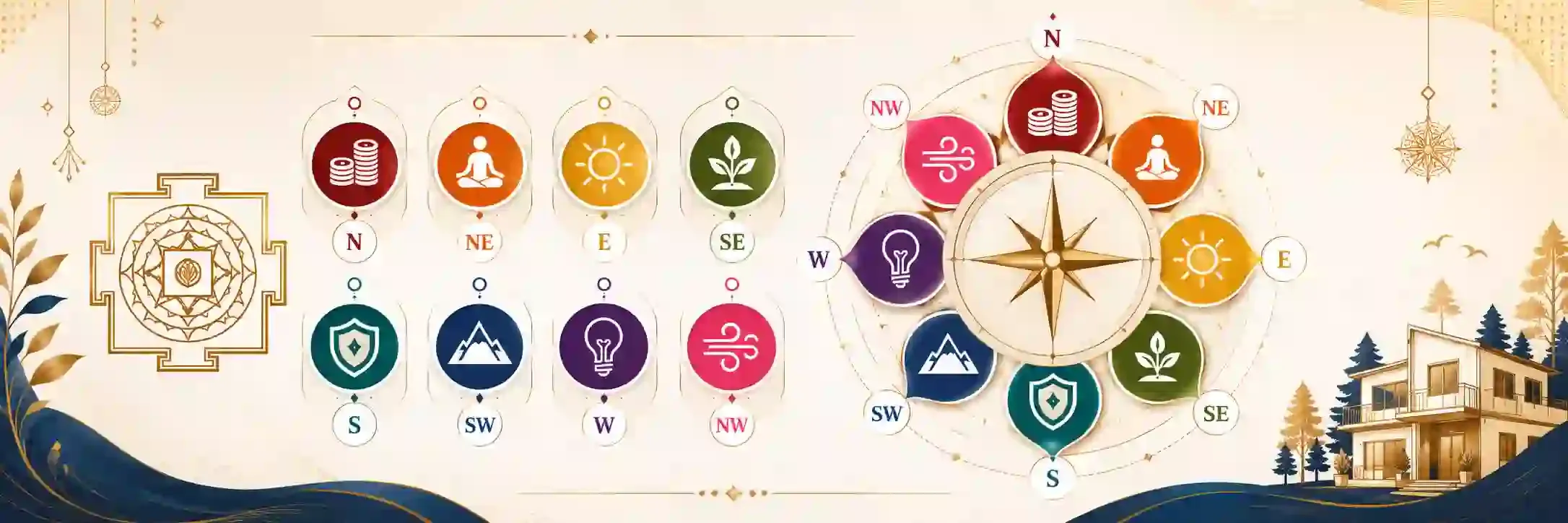
| Direction | Deity | Governing Energy | Best Placement |
|---|---|---|---|
| East | Surya | Growth & positivity | Main entrance, study |
| West | Varuna | Stability | Dining room |
| North | Kubera | Wealth | Locker, office |
| South | Yama | Security | Master bedroom |
| Northeast | Shiva | Spirituality | Puja room |
| Southeast | Agni | Fire & vitality | Kitchen |
| Southwest | Nairuti | Stability & grounding | Master bedroom |
| Northwest | Vayu | Relationships & movement | Guest room |
Apart from the main 8 directions, Vastu Shastra also recognizes 8 sub-directions, making a total of 16 Vastu directions. These additional zones provide deeper insights into energy flow and help determine ideal placements for rooms, entrances, and activities within a home.
Attributes of 16 Directions in Vastu Shastra
Whether you’re designing a new home or fine-tuning your current one, understanding the 16 Vastu directions () helps you create a space that supports your goals, enhances well-being, and invites good energy every single day.
1. East Direction
The east is where the sun rises and brings fresh, life-giving energy. It’s all about new beginnings and a dose of optimism every morning. It represents new beginnings, clarity, and vitality. Keeping this side open and bright invites optimism and growth.
Ruling Deity: Surya (Sun God)
Governing Energy: Prosperity and clarity
Ideal Placement: Main entrance, study area, or large windows that bring in natural sunlight
2. West Direction
The west direction is for people who like things steady; it’s about consistency, hard work, and grounded success. Homes that utilize this zone well experience consistency in efforts and steady results.
Ruling Deity: Varuna (God of Water)
Governing Energy: Strength, dependability, and focus
Ideal Placement: Dining area, kids’ room, or storage spaces
3. North Direction
Among all the Vastu directions, North is the money magnet of your home. It’s linked to growth, opportunities, and that steady upward curve everyone wants in life. When kept clean and open, it supports financial growth and mental peace.
Ruling Deity: Kubera (God of Wealth)
Governing Energy: Wealth and success
Ideal Placement: Cash locker, study, or living room
4. South Direction
South energy is all about strength and protection. It gives your home a solid backbone, but it needs balance. Too heavy or dark, and it can feel dull.
Ruling Deity: Yama (Lord of Justice)
Governing Energy: Security and discipline
Ideal Placement: Master bedroom, staircase, or heavy storage units
5. Northeast (Ishanya)
The northeast is the most spiritual zone, known for purity and enlightenment. You can call it the calmest, purest part of your home. Keeping it open and clutter-free enhances calmness and clarity.
Ruling Deity: Shiva (as Ishana)
Governing Energy: Spiritual awakening and harmony
Ideal Placement: Puja room, meditation area, or a small water feature
6. Northwest (Vayavya)
This zone keeps life moving: literally and emotionally. It affects your relationships, social circle, and communication. Balanced northwest spaces encourage healthy connections and dynamic energy flow.
Ruling Deity: Vayu (God of Wind)
Governing Energy: Movement and social bonding
Ideal Placement: Guest room, living room, or open ventilation spaces
7. Southeast (Agneya)
The fire zone, where energy, drive, and transformation live. If you want that spark in your life (and kitchen), this is your spot. Also, it symbolizes transformation and vitality. Using this area for cooking or light sources helps channel strong, active energy.
Ruling Deity: Agni (God of Fire)
Governing Energy: Energy, passion, and nourishment
Ideal Placement: Kitchen or pantry
8. Southwest (Nairutya)
Don’t underestimate Southwest if you already are; it is the most powerful zone for strength and stability. When this corner is balanced, it brings financial security and emotional grounding.
Ruling Deity: Nairuti (Guardian of Stability)
Governing Energy: Control and permanence
Ideal Placement: Master bedroom, safe, or family photo wall
9. East-Northeast (Eeshanya)
Feeling shy or underconfident? This zone helps you grow creatively. While it anchors the family emotionally and financially, it’s great for students, artists, and anyone who wants to stay motivated.
Ruling Deity: Shiva
Governing Energy: Awareness and learning
Ideal Placement: Study room, children’s study corner, or prayer area
10. East-Southeast (Aagneya)
Among other Vastu directions, this one is tied to enthusiasm and physical health. Keeping it clean and lively improves digestion and overall vitality. It’s connected with physical energy and the drive to get things done.
Ruling Deity: Agni
Governing Energy: Vitality and enthusiasm
Ideal Placement: Kitchen or workout space
11. South-Southeast (Dakshin-Aagneya)
This direction helps balance emotional and physical strength. Proper use supports determination and the courage to take action.
Ruling Deity: Agni-Yama
Governing Energy: Determination and confidence
Ideal Placement: Gym area or utility room
12. South-Southwest (Dakshin-Nairutya)
Known as the zone of skill and expertise, this direction influences how we use our talents. Balanced design here brings recognition and mastery.
Ruling Deity: Pitru (Ancestral Energy)
Governing Energy: Skill, wisdom, and reputation
Ideal Placement: Study, office, or achievement wall
13. West-Southwest (Paschim-Nairutya)
This zone governs relationships and partnerships. It promotes trust and understanding between family members and business associates.
Ruling Deity: Varuna
Governing Energy: Bonding and reliability
Ideal Placement: Family area, meeting space, or seating corner
14. West-Northwest (Paschim-Vayavya)
A direction that keeps life balanced between ambition and happiness. It enhances communication and helps in maintaining healthy social ties.
Ruling Deity: Vayu
Governing Energy: Movement and adaptability
Ideal Placement: Guest room, hallway, or networking zone
15. North-Northwest (Uttara-Vayavya)
This area encourages goal setting and clear thinking. Balanced use strengthens motivation and decision-making.
Ruling Deity: Vayu-Kubera
Governing Energy: Motivation and progress
Ideal Placement: Study, home office, or workspace
16. North-Northeast (Uttara-Eeshanya)
This Vastu direction represents wisdom and healing. It supports mental peace and personal growth, creating a balanced emotional atmosphere.
Ruling Deity: Kubera-Shiva
Governing Energy: Healing and tranquility
Ideal Placement: Puja room, library, or quiet relaxation space
Five Elements and Their Role in Vastu Directions
According to Vastu Shastra, every direction in a home is connected to one of the five natural elements (Panch Mahabhutas). These elements influence the flow of energy, balance, and functionality within a space. Understanding their relationship with directions helps create harmony in room placement and home design.
| Element (Panch Mahabhuta) | Associated Direction | Symbolism & Energy | Ideal Usage in Home |
|---|---|---|---|
| Water | North, Northeast | Prosperity, healing, emotional balance, spiritual clarity | Water features, puja room, meditation area, open spaces |
| Fire | Southeast | Energy, passion, transformation, nourishment | Kitchen, electrical appliances, cooking zone |
| Earth | Southwest | Stability, grounding, strength, security | Master bedroom, heavy furniture, lockers |
| Air | Northwest | Movement, communication, social connections | Guest room, windows, ventilation, sitting area |
| Space (Akasha) | Center (Brahmasthan) | Openness, peace, universal energy flow | Keep open, clutter-free central area |
Why Do the Five Elements Matter in Vastu?
The balance of these five elements plays an important role in Vastu planning. For example, placing the kitchen in the southeast aligns with the fire element, while keeping the northeast open and clutter-free supports the water element and spiritual calm. Similarly, the southwest direction is associated with the earth element, making it ideal for stability-focused spaces like the master bedroom.
When rooms align with their elemental energy, a home is believed to feel more balanced, peaceful, and functional. Understanding the connection between Vastu directions and Panch Mahabhutas also helps create stronger topical relevance for users searching for complete guidance on Vastu principles. make this faqs in faq schema code "FAQs
Which direction is best in Vastu for money? North is traditionally associated with wealth and prosperity.
Which direction is best for a bedroom? Southwest is commonly recommended for the master bedroom.
Which direction should kitchen face? Southeast is considered ideal.
Can south-facing homes be good in Vastu? Yes, layout and room placement matter more than direction alone.
Which direction is not good for a toilet? Northeast is generally avoided.
What are the 16 directions in Vastu? They include 8 main directions and 8 sub-directions.
Which direction attracts positive energy? East and northeast are traditionally linked with positivity.
What is the most powerful direction in Vastu? Southwest is associated with stability, while northeast is spiritually important."
Do’s and Don’ts for Vastu Directions
A few smart tweaks around your entrance can completely change the way energy flows into your home. Think of these tips as your personal “Vastu 101” checklist for keeping good vibes on your side.
Do’s As Per Vastu Directions
Face the right direction: Keep your main door facing North, East, or Northeast. These directions are blessed by deities like Kuber, Indra, and Shiva and are believed to bring prosperity, peace, and success.
Choose solid wood: Use a high-quality wooden door that feels sturdy and welcoming. It should open clockwise and be slightly bigger than the other doors in the house.
Light it up: Brighten your entrance with warm lighting to make guests (and energy) feel instantly welcome. Good lighting also keeps the space cheerful and positive.
Add a welcome mat: A red or earthy-toned doormat attracts positive energy and symbolizes prosperity stepping into your home.
Don’ts As Per Vastu Directions
Skip black doors: Dark shades like black or deep gray can feel heavy and restrict the natural flow of positive energy. Choose lighter, earthy hues instead.
No clutter near the door: Avoid placing shoe racks or old furniture outside your entrance. They block the movement of energy and make the area look crowded.
Keep water elements away: Fountains or water decor near the main door may look pretty but can disturb the balance of Vastu energies if not placed properly.
Got your home’s directions sorted but still feel something’s off? Talk to a Vastu Expert on Astroyogi
Read also:
Final Words
Each vastu direction in your home holds a story, from money and success to peace and connection. When you align your rooms with these energies, your space feels more balanced and alive.
Whether you’re building, renovating, or just curious, use these insights to help your home feel right: calm, happy, and full of good vibes every day.
Explore Vastu Tips for Every Need
- Vastu for Home
- Vastu for New House
- Main Door House Entrance
- Vastu for Factory
- Vastu for Office
- Vastu for Dining Room
- Vastu for Bathroom
- Vastu Kitchen
- Children Room
- Guest Room
- Study Room
- Colors for Home
- Pooja Room
- Shop
- Career
- Marriage Life
- Health
- Positive Energy
- Business
- Plants
- Bedroom
- Happiness
- Peace
- Wealth
- Pyramid
- Compass
- Vastu Dosh
- North Facing House
- South Facing House
- East Facing House
- West Facing House
- Earth
- Air
- Fire
- Water
- Directions
- North Direction
- South Direction
- East Direction
- West Direction
- North-East Direction
- North-West Direction
- South-West Direction
- South-East Direction
FAQs - Directions in Vastu
East and North are considered the best directions in Vastu, bringing sunlight, prosperity, and positivity into your home while supporting health and harmony.
The nine Vastu directions are North, South, East, West, Northeast, Northwest, Southeast, Southwest, and the center, each carrying unique energy that influences your home.
Stand in the center of your home with a compass. The direction you face shows your main orientation, helping you plan rooms as per Vastu.
Numbers like 13, 14, 16, and 19 are considered inauspicious as per Vastu.
North is traditionally associated with wealth and prosperity.
Southwest is commonly recommended for the master bedroom.
Southeast is considered ideal.
Yes, layout and room placement matter more than direction alone.
Northeast is generally avoided.
East and northeast are traditionally linked with positivity.
Southwest is associated with stability, while northeast is spiritually important.