
Lord Vishwakarma: The Divine Architect, His Story, Creations And Worship
Lord Vishwakarma is one of the most respected deities in Hindu tradition. He is known as the divine architect and the master craftsman of the universe. Unlike many other Hindu gods, he is not worshipped for wealth or protection alone but for skill, creativity, and honest labor.
He is credited with designing celestial cities, divine weapons, and the tools that made creation possible. Artisans, engineers, carpenters, blacksmiths, and architects consider him their guiding deity.
Here is more about Lord Vishwakarma.
Who is Lord Vishwakarma?
Lord Vishwakarma is called the maker of everything. The word "Vishwakarma" comes from two parts: "Vishwa," meaning "universe," and "Karma," meaning "action" or "creation." Together, the name points to a deity who gives shape and structure to the world.
In the Rig Veda, he appears as a supreme creative force who measured and structured the cosmos for gods, humans, and other beings. In later Puranic texts, he is described as the chief architect of the gods, responsible for designing palaces, aircraft, and cities for the Devas. He is also credited with forging powerful weapons used by gods and heroes in various legends.
Father of Lord Vishwakarma
Hindu texts do not agree on a single account of his origin, and different traditions describe his parentage in different ways.
The most common belief holds that Lord Brahma, the creator god, is the father of Lord Vishwakarma. In this version, Vishwakarma assists Brahma directly in planning and building the universe, acting as the executor of his father's vision.
Other Puranic accounts describe him as the son of Prabhasa, one of the eight Vasu deities, and a mother named Yogasiddha. A few regional traditions instead name Vastu and Angisri as his parents, connecting him more directly to architecture and design. These differences come from regional and textual variety rather than conflict, and all versions point to the same idea of a divine figure born to build and create.
Tradition also speaks of Vishwakarma as a father himself. He is said to have had five sons, named Manu, Maya, Tvastar, Shilpi, and Visvajna. These five sons became the ancestors of five traditional artisan groups, namely carpenters, blacksmiths, metalsmiths, goldsmiths, and stonemasons. Communities that trace their lineage to these five sons still honor Vishwakarma as their divine forefather today.
Divine Creations of Lord Vishwakarma
Hindu mythology credits Lord Vishwakarma with some of its most famous cities, palaces, and weapons.
He is said to have built the golden city of Lanka, later ruled by Ravana.
He designed Dwarka, the city where Lord Krishna made his home after leaving Mathura.
He built Indraprastha, the capital of the Pandavas in the Mahabharata, known for its dazzling floors and pools.
He is credited with Hastinapur and with Swarg Loka, the heavenly abode of the gods ruled by Indra.
He forged powerful weapons for the gods, including Lord Vishnu's Sudarshan Chakra, Lord Shiva's Trishul, and Indra's Vajra.
He is also said to have designed the Pushpak Vimana, the flying chariot used by the gods.
These stories are part of why he is remembered less as a distant deity and more as a hands-on maker whose work shaped both heaven and earth.
Iconography and Symbolism of Lord Vishwakarma
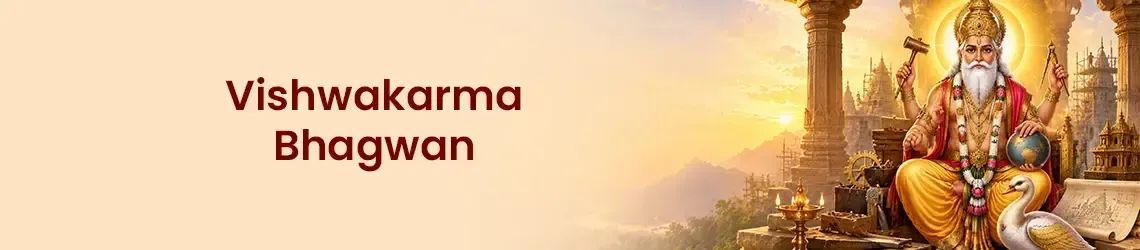
Lord Vishwakarma is usually shown as a four-armed figure with a fair complexion, wearing a crown and layers of gold jewelry, which reflect his divine and royal standing. Some depictions also show him holding a mace or club, along with rings and a necklace, reinforcing his image as both a scholar and a builder.
Everything about this deity is symbolic of something or another.
One hand holds a water pot, symbolizing purity and creative potential.
Another hand holds a book or the Vedas, representing knowledge and design.
A third hand holds a noose, symbolizing discipline and order in the process of creation.
The fourth hand generally holds a craft tool, such as a saw, axe, or measuring scale, symbolizing the skill and labor behind creation.
The pairing of the book and the tool sums up his core idea: that knowledge and skilled action must go together, since without skill, little comes to pass.
His four arms reflect his creative power and capacity to manage multiple aspects of creation at once.
Being regarded as the deity who measured and counted everything in the cosmos makes him a symbol of cosmic structure, balance, and discipline.
His crown and jewelry reflect the idea that skilled work carries its own dignity and status.
Why is Lord Vishwakarma Worshipped?
Lord Vishwakarma is worshipped because he represents the divine side of work itself, not just the tools used to do it.
Craftsmen, engineers, and business owners pray to him for smooth and safe operation of their machines, tools, and vehicles, and for steady progress in their trade. Since he is regarded as the one who measured and structured the entire cosmos, devotees also see him as a source of order, precision, and discipline in their own work.
He is worshipped at the start of new ventures, when new machinery or tools are purchased, and whenever people want their skills and equipment to be blessed for continued success. This practice reflects the wider belief that honest labor, when carried out with care, holds the same value as prayer.
Vishwakarma Mantra
Chanting a mantra is a common part of Vishwakarma worship, especially during Vishwakarma Jayanti.
The most commonly recited mantra is "Om Vishwakarmane Namaha," repeated while offering prayers to the deity and to one's tools and machines. Some devotees also recite the Vishwakarma Chalisa, a longer devotional hymn dedicated to the deity, believed to bring blessings of skill and success to artisans, engineers, and craftsmen who recite it with devotion.
How To Worship Lord Vishwakarma?
Vishwakarma Puja can be organized anywhere, including homes, temples, or workplaces such as factories.
The main occasion is Vishwakarma Jayanti. People also perform small pujas when starting any new work or project and when buying new tools or machines.
The basic ritual consists of cleaning the worship area and all the machines and tools associated with it, then setting an image or painting of Lord Vishwakarma facing east or north and decorating it with flowers.
A kalash filled with water and topped with mango leaves and a coconut is placed near the altar, along with fruits, sweets, agarbatti, and a burning lamp.
Devotees offer prayers and chant mantras such as Om Vishwakarmane Namaha, then clean, polish, and mark their tools and machines with sandalwood paste and kumkum.
The ritual usually ends with an aarti, followed by prasad distribution among family members or coworkers.
Vishwakarma Jayanti
Amongst many festivals held throughout the year celebrating various aspects of Vishwakarma, one is dedicated explicitly to him—Vishwakarma Jayanti. It is celebrated primarily in September; however, some communities hold celebrations for this festival at the end of December and early January, depending on the region within India. This day marks the transition of the Sun from Leo to Virgo as per the Hindu Calendar.
Workshops clean up, decorate, and worship machinery, vehicles, and any tool used in business activities. Business organizations shut down as an expression of reverence for labor itself, and the day is often followed by the flying of kites, marking the start of the festive season that leads into Diwali.
Famous Vishwakarma Temples
One can find many famous Vishwakarma temples spread across India, such as the Vishwakarma temple of Machilipatnam in Andhra Pradesh, popular for its carved stone; the Vishwakarma temple of Aurangabad in Maharashtra; the Vishwakarma temples of Phagwara in Punjab; and the Vishwakarma temples in Bettiah of Bihar, amongst others.
Industrial belts also house Vishwakarma temples, which devotees visit daily to offer their prayers. There is even a Vishwakarma temple in Jinja, Uganda, built by Indians residing there, thus demonstrating how far Lord Vishwakarma's worship has travelled.
Universal Message
There are several messages embedded in Lord Vishwakarma's biography for people everywhere, irrespective of faith and profession. The first lesson lies in Lord Vishwakarma's personality itself: he is the creator who devoted his whole life to constructive endeavors. Ideas take on importance once implemented in practice through practical wisdom gained through learning.
Further, his teachings include reverence for machinery and tools, which act as extensions of Man himself in the creation of objects. Finally, he taught humanity to treat constructors and artisans equally, like scholars and philosophers, elevating them to high ranks.
Hindu Gods
- God Kartikeya
- God Annamalaiyar
- God Murugan
- God Dattatreya
- God Vishnu
- God Krishna
- God Jagannath
- God Hanuman
- God Ganesha
- God Surya
- Goddess Lakshmi
- God Shiva
- Goddess Tulsi
- Goddess Shakambhari
- Goddess Saraswati
- God Agni
- God Indra
- God Nandi
- God Ayyappa
- Goddess Durga
- God Kaal Bhairav
- Goddess Annapurna
- Maa Shailputri
- Maa Brahmacharini
- Maa Chandraghanta
- Maa Kushmanda
- Maa Skandamata
- Maa Katyayani
- Maa Kalaratri
- Maa Mahagauri
- Maa Siddhidatri