
God Agni
Agni is one of the most ancient and important deities in Hindu tradition. He is worshiped as the god of fire.
The name "Agni" literally means "fire" in Sanskrit, making him the living form of one of nature's most powerful elements.
Unlike many other Hindu gods who came into worship later, Agni has been around since the Vedic period.
The Agni, the god, is also present everywhere fire exists, in the sun, in lightning, in your kitchen stove, and in cremation grounds. He witnesses everything, which is why he's called on during weddings and important ceremonies.
Agni God: What He Looks Like and What It Means
Every depiction of Agni, the god of fire, has its own meaning. Let’s break it down.
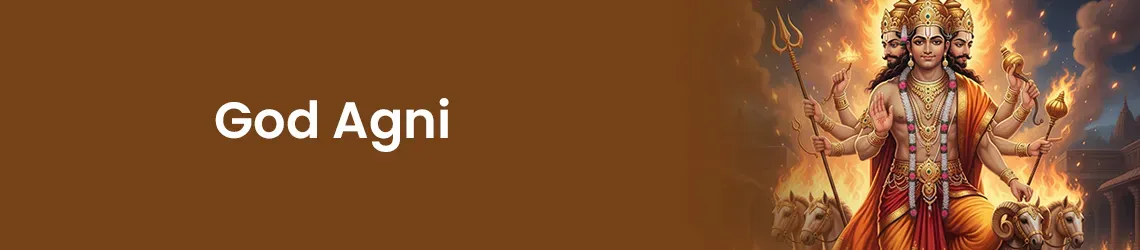
- Red or Golden Skin: His complexion is always fiery, either red or golden. The colour represents energy and transformation.
- Seven Tongues of Flame: Ancient texts say Agni has seven tongues (called Sapta Jihva). These represent the seven flames that consume offerings during rituals. Each tongue has a name and a specific function.
- Two or Four Faces: Sometimes shown with two faces, sometimes four. This represents his ability to see in all directions. He witnesses every action, every ritual, every truth and lie.
- Smoke Coming from His Body: He's often shown with smoke billowing from his form, reminding us that fire always produces smoke.
- Riding a Ram (Goat): His vehicle is a ram, which symbolizes determination and the ability to push through obstacles. Rams charge forward fearlessly, just like fire spreads relentlessly.
- Holding a Flame: Usually carries a flaming torch in one hand. It shows his control over fire and his role in bringing light to darkness.
- Wearing Sacred Thread: Like a proper Vedic deity, he wears the sacred thread (yajnopavita), marking him as a participant in sacred rituals and keeper of ancient traditions.
- Carrying an Axe or Javelin: These weapons show he's not just about warmth and light. Fire can also destroy. He cuts through ignorance and burns away impurities.
The Stories About the Agni God
Agni, the god of fire, appears in countless Vedic hymns and tales. His stories reveal his complex nature and relationship with both gods and humans. Let’s take a look:
Agni Hides from the Gods
One famous story tells how the gods once asked Agni to help them in a difficult task that would require him to burn something he didn't want to burn. Witnessing his brothers' deaths while performing sacrificial duties and fearing his own mortality, Agni declined the gods' request and disappeared.
He hid himself everywhere: in water (where he became the fire within aquatic plants), in trees (where he lives as the fire inside wood), in plants, and in every living being. The gods searched everywhere, getting increasingly desperate because without Agni, no rituals could be performed, and no offerings could reach them.
Finally, a frog revealed Agni's hiding spot. The gods found him and asked him to come back. They promised he'd receive first offerings in every ritual and be honored above many others. Agni agreed, but on the condition that he demand respect for his role and proper treatment.
This story explains why fire exists in all things and why Agni must be honored first in rituals.
The Birth from Brahma's Mouth
Another creation story says Agni was born from Brahma's mouth. When the creator god Brahma was bringing the universe into being, he needed a way to maintain order and facilitate communication between realms. So fire emerged from his mouth; speech and fire connected, and words and flames intertwined.
This explains Agni's role in mantras. When you chant sacred words into fire, you're combining Brahma's two creations, which are speech and flame.
Agni and Soma's Friendship
The Rig Veda often pairs Agni with Soma (the moon god and divine nectar). They represent opposites that complement each other. Fire and liquid, heat and coolness, earth and sky.
Together, they maintain cosmic balance. Many rituals invoke both, acknowledging that transformation needs both burning away and nurturing growth.
How to Worship the God Agni?
Worshiping the Agni Hindu god is actually built into daily Hindu life, often without people even realizing it.
Everyday Worship at Home
- Light a lamp (diya) before your home altar. It means you are honoring Agni.
- Cook food with intention and respect, because you're working with Agni directly
- Don't blow out flames with your mouth (disrespectful to the fire god). Wave them out instead
- Keep your kitchen clean. It's Agni's dwelling place in your home
- Burn incense during prayers. As the smoke carries your intentions through Agni
Simple Agni Mantras:
"Om Agni Devaya Namaha" (I bow to the god Agni)
"Agni Meele Purohitam" (first line of the Rig Veda, which means "I praise Agni, the household priest")
Traditional Fire Rituals (Havan/Yajya)
For proper fire worship, especially during special occasions:
- Set up your havan kund in a clean space, preferably facing east.
- Place wood pieces in the kund, arranging them properly
- Apply ghee and camphor to help ignite
- Light the fire while chanting Agni mantras
- Once fire is established, begin offerings
- Pour ghee into flames while chanting "Swaha" (offering accepted)
- Toss samagri into the fire after each mantra
- Continue feeding the fire. Never let it die during the ritual
- Complete with final prayers and aarti
- Let the fire go out naturally. Collect ash for blessings
Important: Havan should ideally be learned from someone experienced. Fire rituals require proper knowledge of mantras, timing, and safety precautions.
When to Worship
- Daily: Morning lighting of lamps
- Tuesdays: Considered auspicious for Agni
- Havan Days: New moon (Amavasya), full moon (Purnima) and other occasions and events.
- Weddings: The Fire ceremony is central to Hindu marriage
- Housewarmings: Griha Pravesh ceremony involves Agni worship
- Birth Ceremonies: Fire rituals bless newborns
- Last Rites: Cremation is returning the body to Agni
Festivals Related to Agni God
While Agni doesn't have exclusive festivals dedicated only to him, he plays an important role in several major Hindu celebrations.
- Agni Utsav / Agira Purnima (Odisha): Celebrated during the lunar month of Magha (January/February), this is a straight-up farmer's festival for Agni.
After harvest, farmers gather all the leftover straw and burn it in massive heaps. They believe Agni's fire purifies the entire environment, shields their crops from diseases, and even predicts the outcome of the next harvest.
It marks the official exit of winter and the entrance of spring.
- Lohri (North India): This January harvest festival is the peak of Agni worship. People light huge bonfires after sunset and gather around them with their families. They toss popcorn, sesame seeds, peanuts, and jaggery into the flames while singing traditional folk songs.
People express gratitude to the sun through Agni for the harvest and ask Agni to burn away all negativity so prosperity can flow in.
Holi - Holika Dahan: The night before, everyone plays with colours, and communities light enormous bonfires for Holika Dahan. This bonfire is Agni; people circle the Agni, make offerings, and celebrate good triumphing over evil. Agni literally clears out the bad vibrations so spring and fresh starts can happen.
Wedding Season: Not a festival per se, but the Hindu wedding season is basically one long Agni appreciation event. Every ceremony circles that sacred fire with Agni as the main witness. We're talking millions of marriages annually where Agni holds the ultimate front-row seat.
Makar Sankranti: This harvest festival marking the sun's northward journey involves fire rituals across India. People cook traditional foods over open fires and make offerings into flames, giving thanks through Agni for successful crops and asking for blessings for the coming season.
Want to know which fire rituals are most auspicious for you based on your birth chart? Curious about the best times to perform Agni pujas for your specific goals? Talk to an astrologer on Astroyogi today.
Why Agni God Matters Today
Every time you light a candle during meditation, you're invoking Agni's presence. When you cook a meal with care and love, you're working with his energy. People light candles worldwide during moments of remembrance, prayer, or celebration. This is Agni's universal appeal, transcending religious boundaries.
He reminds us that transformation requires heat. Even when a raw food is cooked for nourishment, when metals are forged into tools, or burning away of old patterns to create space for growth.
Agni doesn't just destroy; it transforms, purifies, and makes things stronger. That's the real power Agni represents in our lives.
Jai Agni Dev
Hindu Gods
- God Kartikeya
- God Annamalaiyar
- God Murugan
- God Dattatreya
- God Vishnu
- God Krishna
- God Jagannath
- God Hanuman
- God Ganesha
- God Surya
- Goddess Lakshmi
- God Shiva
- Goddess Tulsi
- Goddess Shakambhari
- Goddess Saraswati
- God Agni
- God Indra
- God Nandi
- God Ayyappa
- Goddess Durga
- God Kaal Bhairav
- Goddess Annapurna
- Maa Shailputri
- Maa Brahmacharini
- Maa Chandraghanta
- Maa Kushmanda
- Maa Skandamata
- Maa Katyayani
- Maa Kalaratri
- Maa Mahagauri
- Maa Siddhidatri