

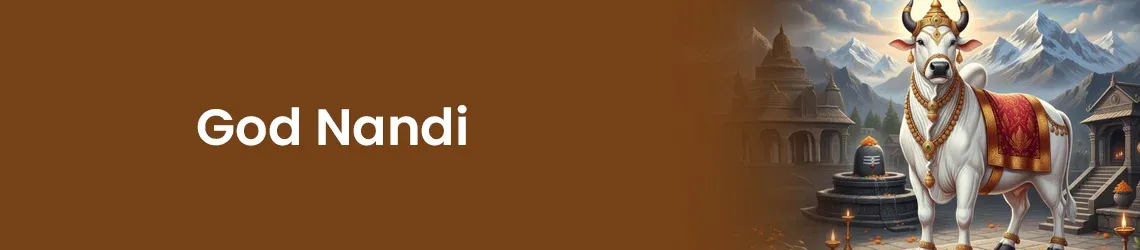
God Nandi
Nandi is the sacred bull who serves as the vehicle (vahana) and gatekeeper of Lord Shiva. But calling him just a "vehicle" is like calling the ocean "some water body". He's not just transportation; he's Shiva's most devoted follower, his chief attendant, the leader of Shiva's armies (ganas), and Shiva's right-hand bull.
The name "Nandi" comes from the Sanskrit word meaning "giving delight" or "one who grants joy.” In Hindu tradition, Nandi represents the soul (jivatma) that's eternally devoted to the divine (paramatma).
Nandi god is always shown sitting directly in front of every Shiva temple, facing the main shrine. Nandi is the guardian who decides who's worthy to approach Shiva, the intermediary who carries devotees' prayers to the lord, and the first one you must acknowledge before entering a Shiva temple. Respect Nandi first, then proceed to Shiva.
Nandi God: What He Looks Like and What It Means
Every statue or image of Nandi carries deep symbolism about devotion, strength, and spiritual qualities.
- Bull Form: He's depicted as a massive, powerful bull, which is usually white or black in color. The bull represents strength, spirit, righteousness (dharma), and the animalistic instincts that must be controlled and directed toward the divine.
- Seated Posture: Nandi is always shown sitting in a calm, composed posture. This represents the controlled power of a true devotee. All that strength is there, but it's disciplined and directed.
- Facing the Deity: In temples, the Nandi’s statue always faces directly toward the main Shiva lingam or idol. His gaze is eternally fixed on his lord, symbolizing constant focus, unwavering devotion, and single-minded dedication.
- Large Hump: The prominent hump on his back represents stored energy and power. In spiritual terms, it symbolizes the accumulated merit (punya) from devotion and service.
- Bell Around Neck: Many Nandi statues have bells around their necks. The bell represents the divine sound (Nada Brahma) and the announcement of a devotee's presence.
- Decorated with Ornaments: Nandi is often adorned with jewels, garlands, and decorative cloths, showing that a true devotee is honored and cherished by the divine.
Stories About Shiv Nandi
The legends surrounding Nandi reveal his unique position and relationship with Shiva. Let’s explore some stories revolving around Nandi.
Nandi's Birth Story and Bonding With Shiva
Different texts tell slightly different versions, but here's a popular one: Nandi was born to the sage Shilada, who performed intense penance wanting a child. Pleased with his devotion, Shiva blessed him with a son who emerged from the ground, Nandi.
From childhood, Nandi showed extraordinary devotion to Shiva. When he grew up, his penance and dedication were so intense that Shiva himself appeared and asked what Nandi wanted. Nandi's response? "I want nothing except to serve you forever." Impressed by this selfless devotion, Shiva made Nandi his vehicle, gatekeeper, and eternal companion.
Another version says Nandi was originally divine and took bull form specifically to serve Shiva. Either way, Nandi chose devotion over everything else.
Nandi God and the Demons
There are stories where demons try to attack Shiva's abode on Mount Kailash. Every single time, they first have to get past Nandi. And every single time, Nandi defeats them before they even get close to Shiva.
One tale involves a demon army that figured they could easily push past a "mere bull." Big mistake. Nandi transformed into his fierce form, grew enormous, and single-handedly destroyed the entire demon force.
The message? Never underestimate the power of a true devotee. The strength you gain from devotion is greater than any physical power.
Nandi Teaching Spiritual Knowledge
In the Tamil Shaiva tradition, Nandi is revered as one of the first gurus who received wisdom directly from Shiva. When Shiva performed the cosmic dance (Tandava) and taught yoga and spiritual truths, Nandi was right there, absorbing everything.
He then passed this knowledge to the great sages. This establishes him not just as a devotee but as a teacher. Someone who embodies knowledge and shares it with worthy students.
Nandi's Unwavering Focus
One popular tale shows just how focused Shiv Nandi is. Once, the sage Narada visited Mount Kailash and saw Nandi sitting outside, as always, staring at Shiva inside. Narada tried to distract him, make conversation, and ask questions
Nandi didn't even blink. His eyes remained fixed on Shiva. Narada finally gave up and praised Nandi's incredible devotion. This story is told to teach that true bhakti means maintaining focus on the divine despite all distractions.
How to Worship Nandi?
Worshiping Nandi is actually an essential part of worshiping Shiva. You can't really do one without acknowledging the other.
At Shiva Temples
The traditional way to honor Nandi:
- Enter the temple and first approach Nandi
- Circumambulate (walk around) Nandi once
- Stand in front of him and look through his horns toward the Shiva lingam (this alignment is intentional; you're seeing Shiva through Nandi's perspective)
- Whisper your prayers and wishes into Nandi's ear (traditionally the right ear)
- Touch his back or hump respectfully
- Offer flowers if you have them
- Then proceed to the main shrine for Shiva darshan
This sequence honors the principle that devotion (Nandi) is the path to the divine (Shiva).
Home Worship
If you want to worship Nandi at home:
- Keep a small Nandi statue or image
- Place it facing east or toward your Shiva shrine
- Light incense and a lamp
- Offer fresh flowers and bilva leaves
- Apply kumkum or sandalwood paste
- Chant Nandi mantras
- Meditate on the qualities of devotion he represents
Nandi Mantras
- "Om Nandishwaraya Namaha" (Salutation to Lord Nandi)
- "Om Nandi Bhagavate Namaha" (Honoring Nandi as divine)
- "Nandikeshwaraya Namaha" (Another form of his name)
- "Om Vrushabhaya Namaha" (Om, salutations to the bull)
Festivals Related to Shiv Nandi
While Nandi doesn't have exclusive festivals, he's prominently featured during Shiva celebrations.
Maha Shivaratri: The grand Shiva festival, where Nandi statues are specially decorated and worshiped alongside Shiva. Devotees fast and perform elaborate pujas.
Pradosh Vrat: On the 13th day after every new and full moon, special evening prayers are offered to Shiv with Nandi together.
Karthigai Deepam (South India): During this light festival, Nandi statues in temples receive special worship and decoration.
Sacred Temples with Nandi
Every Shiva temple has a Nandi statue, but some are particularly famous for their massive or unique Nandi installations.
Chamundi Hills, Mysore, Karnataka: Home to a giant monolithic Nandi statue—15 feet tall and 24 feet long, carved from a single black granite rock in 1659. It's one of the largest Nandi statues in India and attracts thousands of devotees.
Lepakshi Temple, Andhra Pradesh: Features a massive Nandi carved from a single stone, measuring about 27 feet long and 15 feet high. Local legend says this Nandi keeps growing!
Bhojpur Temple, Madhya Pradesh: Has an enormous incomplete Shiva temple with a huge Nandi statue guarding it, showcasing ancient sculptural ambitions.
Why Nandi Matters Today
In a world obsessed with achievements, recognition, and personal glory, Nandi represents something radical: selfless service and ego-less devotion. He doesn't demand his own temples or festivals. He doesn't ask for the spotlight. He sits quietly, eternally focused on Shiva, content in his service.
That's a powerful message for modern times. How often do we do something without expecting credit? How often do we serve without keeping score? Nandi demonstrates that the highest achievement is losing oneself in something greater than oneself.
The image of Shiv with Nandi also represents the inseparable connection between the divine and devotion. You can't have one without the other. God exists, but without devotees, there's no worship. Devotees exist, but without the divine, there's no purpose. They need each other. Shiva and Nandi together are complete.
For anyone struggling with faith or feeling disconnected from spirituality, Nandi offers a simple path: just show up. Sit. Focus. Be present. That's it. You don't need fancy rituals or complex philosophy.
Hindu Gods
- God Kartikeya
- God Annamalaiyar
- God Murugan
- God Dattatreya
- God Vishnu
- God Krishna
- God Jagannath
- God Hanuman
- God Ganesha
- God Surya
- Goddess Lakshmi
- God Shiva
- Goddess Tulsi
- Goddess Shakambhari
- Goddess Saraswati
- God Agni
- God Indra
- God Nandi
- God Ayyappa
- Goddess Durga
- God Kaal Bhairav
- Goddess Annapurna
- Maa Shailputri
- Maa Brahmacharini
- Maa Chandraghanta
- Maa Kushmanda
- Maa Skandamata
- Maa Katyayani
- Maa Kalaratri
- Maa Mahagauri
- Maa Siddhidatri