
Goddess Maa Durga
Goddess Durga is one of the most powerful and beloved deities in Hinduism. She represents the divine feminine energy known as Shakti. The raw and divine force that moves the universe itself.
The name, "Durga," rooted in Sanskrit, is understood as "the invincible" or "one who cannot be defeated."
Most devotees think of her as the fierce warrior goddess, but that's not the complete picture. She's also a compassionate mother who nurtures and protects the universe.
Widely worshiped across India and far beyond, Maa Durga holds a place in everyone’s heart and prayers.
To know more about her, let's discuss what she symbolizes and how we can worship her.
Maa Durga: Iconography and Symbolism
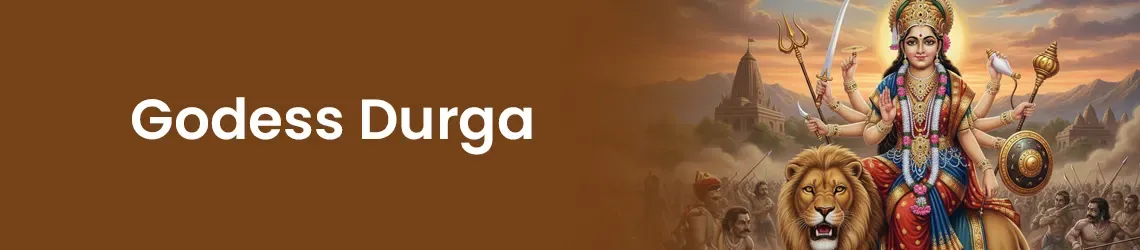
Every picture of Durga Devi is rich with symbolism. Here's what it all means.
Lion or Tiger: She rides a lion or tiger, basically showing she's fearless and commands serious power. Ten Arms: You'll see her with ten arms, each holding weapons like a trident, sword, and lotus. Think of it as being ready to handle anything from any direction.
Defeating Mahishasura: Most images show her taking down this buffalo demon called Mahishasura. The whole point? Good beats evil, always.
Red Colour: The red outfit represents fierce energy and strength. It's also got this protective vibe, like a mother who'd fight the world for her kids.
Third Eye: That third eye on her forehead is all about seeing beyond the obvious wisdom, truth, and stuff most people miss.
Beyond Maa Durga’s symbols and weapons, let’s see how she appears in her different yet unique forms.
Different Forms of Goddess Durga
The nine forms of Maa Durga show us how divine feminine energy can manifest in different ways to guide and protect us. Here’s a look at each of them.
- Shailaputri: The first form, meaning "Daughter of the Mountains." Shailputri represents nature's power and also marks the beginning of Navaratri.
- Brahmacharini: This form symbolizes devotion, penance, and the pursuit of knowledge, teaching the value of dedication and self-discipline.
- Chandraghanta: She’s named for the crescent moon on her forehead. This divine form brings peace to devotees while warding off evil spirits and negative energies.
- Kushmanda: She’s known as the creator of the universe. Kushmanda Devi blesses devotees with health, strength, and the energy needed to overcome life's challenges.
- Skandamata: The mother of Lord Kartikeya, this form combines nurturing motherhood with divine strength, protecting children and blessing families with harmony.
- Katyayani: One of the fiercest forms, she represents courage and the warrior spirit, helping devotees overcome obstacles and enemies.
- Kalaratri: The darkest and most fearsome form, yet she destroys ignorance and fear, protecting devotees from negative energies.
- Mahagauri: With her radiant white complexion, she represents purity and peace, washing away sins and blessing devotees with a fresh start.
- Siddhidatri: The final form grants supernatural powers and spiritual accomplishments, fulfilling wishes and bestowing wisdom and success.
Mythology & Stories Related to Maa Durga
The stories of Maa Durga show her power and compassion. Let's look at some of the most famous ones.
1. The Battle with Mahishasura The devil Mahishasura’s strength came from a boon that made him fearless and proud. As chaos spread and the gods fell silent, their combined energy took form as Goddess Durga.
Riding her lion and carrying weapons, she fought for nine long nights. On the tenth day, she restored balance, reminding the world that arrogance always meets its end.
2. The Fall of Shumbha and Nishumbha When Shumbha and Nishumbha seized power, darkness grew louder than peace. Durga appeared in many forms, calm yet fierce, joined by Kali and the seven mother goddesses. Through relentless battles, she dissolved their pride and power, proving that divine strength rises wherever injustice lives.
3. Lord Rama and the Autumn Awakening
There's also a beautiful story about how Durga came to be worshiped on Sharad Navratri. When Lord Rama needed divine strength to defeat Ravana and save Sita, he performed an "Akal Bodhan,” waking up the goddess at an unusual time, and worshiped her with 108 blue lotuses.
Happy with his prayers, Durga Devi blessed him with the power to win, and this started the tradition of autumn Durga Puja.
Now that you know her stories and what she stands for, let's see how devotees worship Maa Durga.
How to Worship Goddess Durga? - Mantras and Puja Vidhi
Goddess Durga can be worshiped daily, though the most auspicious time to honor her is during Navratri, which is observed twice a year. Chaitra Navratri in spring and Sharad Navratri in autumn.
The autumn celebration is especially significant, leading to Durga Puja and Vijayadashami.
- For everyday worship, you can keep it simple: light a lamp or incense, offer red flowers (especially hibiscus), and recite prayers with a sincere heart.
While praying, you can chant these powerful Durga mantras:
Om Dum Durgayei Namaha
(Om Doom Dur-ga-yei Na-ma-ha)
Invokes Durga’s protection and strength.
Sarva Mangala Mangalye Shive Sarvartha Sadhike, Sharanye Tryambake Gauri Narayani Namostute
(Sar-va Man-ga-la Man-gal-ye Shi-ve Sar-var-tha Sa-dhi-ke, Sha-ran-ye Tryam-ba-ke Gau-ri Na-ra-ya-ni Na-mo-stu-te)
Praises Durga as the giver of abundance and growth.
During Navratri: devotees observe fasts, perform elaborate pujas, and recite the Durga Saptashati (700 verses in praise of the goddess).
For a proper Durga Puja, you'll need several items. A basic puja setup includes a puja thali, uncooked rice, betel leaves and nuts, mango leaves, a coconut, a kalash filled with water, kumkum and turmeric, ghee lamps, incense, red flowers (especially hibiscus and marigolds), sweets, fruits, and if possible, an idol or picture of Goddess Durga.
A red cloth is traditionally used as the base, along with the main Durga idol and sometimes Lord Ganesha beside her.
The puja steps are:
- Place a clean red cloth on a raised platform and position the kalash at the centre with mango leaves and a coconut on top.
- Place the Durga idol or picture near the kalash, with Ganesha positioned first for removing obstacles.
- Light the ghee lamp and incense, apply kumkum and turmeric tilak to the idols, offer red flowers and rice, and chant Durga mantras with complete devotion.
- Offer fruits, sweets, and traditional items like kheer, halwa, or sundal as prasad.
- Perform aarti with the lamp while singing Durga aarti.
Many devotees also recite the Durga Chalisa or read from the Durga Saptashati during the puja.
Temples Dedicated to Goddess Durga
Across India, Goddess Durga is worshiped in countless temples where devotees seek protection, strength, and blessings. Some of the most revered ones are:
- Vaishno Devi Temple in Jammu: One of the holiest shrines, where devotees trek through mountains to reach the sacred cave where the goddess resides in the form of three natural rock formations.
- Kamakhya Temple in Guwahati: A major Shakti Peetha where the goddess is worshiped in her most primal form. The temple celebrates the divine feminine creative power and is especially significant during the Ambubachi Mela.
- Kalighat Temple in Kolkata: While dedicated to Kali (a fierce form of Durga), this temple holds immense significance in Bengali culture and attracts millions during Durga Puja.
- Vindhyavasini Temple in Uttar Pradesh: Located in Vindhyachal, this temple is dedicated to Durga as Vindhyavasini, the goddess of the Vindhya mountains. Devotees believe prayers here grant protection and fulfil wishes.
- Chamundeshwari Temple in Mysore: Perched atop Chamundi Hills, this temple honors the form of Durga who slew the demons Chanda and Munda, showcasing her warrior aspect.
Goddess Durga: Modern Relevance
Maa Durga’s message hits different in today's world. She's basically telling us that inner strength comes from balancing compassion with determination, and true power lies in standing up for what's right, and the feminine force is not weak but rather the source of all creation and destruction, too.
Also, just like she destroyed Mahishasura after nine days of battle, Maa Durga reminds us that some fights take time, patience, and unwavering determination.
And when she sits on a lion with such grace and power. It's a lesson in itself that you can be in control without being aggressive, and you can be loving without being weak.
That's exactly what modern times need: people who know when to be nurturing and when to draw the line and fight back.
Jai Maa Durga!
Hindu Gods
- God Kartikeya
- God Annamalaiyar
- God Murugan
- God Dattatreya
- God Vishnu
- God Krishna
- God Jagannath
- God Hanuman
- God Ganesha
- God Surya
- Goddess Lakshmi
- God Shiva
- Goddess Tulsi
- Goddess Shakambhari
- Goddess Saraswati
- God Agni
- God Indra
- God Nandi
- God Ayyappa
- Goddess Durga
- God Kaal Bhairav
- Goddess Annapurna
- Maa Shailputri
- Maa Brahmacharini
- Maa Chandraghanta
- Maa Kushmanda
- Maa Skandamata
- Maa Katyayani
- Maa Kalaratri
- Maa Mahagauri
- Maa Siddhidatri