
Lord Indra
Lord Indra is one of the oldest and most important deities in Hindu tradition, especially in the ancient Vedic texts.
He's the god of rain, thunder, lightning, storms, and war. Indra, the god, is also the king of the heavens (Swarga) and the ruler of all other gods (Devas). The Hindu god Indra represents power, strength, courage, and the forces of nature that sustain life.
Without rain, nothing grows. Without Indra releasing the waters from the clouds, the world would be a desert.
Indra God: What He Looks Like and What It Means
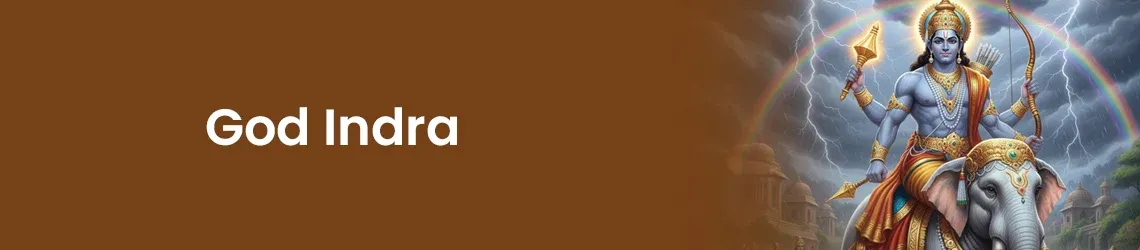
Every depiction of Lord Indra is rich in symbolism, representing his powers and position.
- Golden or Fair Complexion: He's usually shown with golden or fair skin, representing the brightness of lightning.
- Four Arms: Like many major deities, Indra has four arms showing his divine powers and ability to handle multiple cosmic functions simultaneously.
- Vajra (Thunderbolt) in Hand: His main weapon is the Vajra, a powerful thunderbolt weapon that never misses its target. It represents his control over lightning and his role as the ultimate warrior who destroys demons.
- Wearing a Crown: As king of the heavens, he wears an elaborate crown studded with jewels, showing his royal status among the gods.
- Riding Airavata: Lord Indra's elephant, named Airavata, is a magnificent white elephant in imperial attire.
- Sometimes shown with His Consort Shachi: Indra's wife, also called Indrani, represents power and beauty,
- Holding Other Weapons: Besides the Vajra, he carries a bow, arrows, a hook (ankusha), and sometimes a conch shell, all symbols of his warrior nature and authority.
- Rainbow as His Bow: His bow is said to be the rainbow itself (called Indradhanush in Hindi, literally meaning "Indra's bow").
- Dressed in Royal Garments: He wears fine silk clothes and ornaments.
Lord Indra's Story
The ancient texts tell stories about Indra god’s adventures, victories, and his mistakes too.
Vritra - The Greatest Victory
The most famous Lord Indra story involves the demon Vritra. This wasn't just any demon; Vritra was a massive serpent or dragon who had swallowed all the waters of the world. Rivers dried out, rain stopped, and drought spread everywhere. People and animals were dying of thirst.
The gods tried to defeat Vritra but failed. He was too powerful. Then Lord Indra stepped up. But Vritra had a special boon, where he couldn't be killed by any weapon made of metal, wood, or stone, nor could he be killed during day or night.
Lord Indra felt stuck. He meditated and prayed to Vishnu for help. God Vishnu gave him the Vajra, a special weapon made from the bones of the sage Dadhichi (who sacrificed himself for this purpose). The Vajra was neither metal, wood, nor stone.
Indra waited for the twilight hour, neither day nor night, and attacked Vritra with the Vajra. The thunderbolt struck true, killing the demon and splitting him open. All the waters he had swallowed came rushing out, filling rivers and lakes and bringing rain back to earth. Indra became the hero who saved the world from drought.
This story symbolizes the breaking of clouds (Vritra) to release rain, and Indra's thunderbolt, representing lightning that accompanies storms.
Indra and the Mountain
Once, Lord Krishna lifted an entire mountain (Govardhan) on his little finger to protect villagers from Indra's wrathful rainstorm.
What happened was this: the villagers of Vrindavan traditionally worshiped Indra to ensure good rains. But young Krishna convinced them to worship the mountain and their cows instead, since those directly sustained them. Indra was furious at this disrespect and sent devastating storms to destroy the village.
Krishna simply lifted the Govardhan mountain like an umbrella, and everyone took shelter under it for seven days while Indra raged. Finally, Indra realized he couldn't touch them and, more importantly, realized his own pride was the problem. He came down, apologized to Krishna (who was Vishnu's avatar), and learnt humility.
This story is told to show that even powerful gods can have ego problems and that divine power should come with humility.
Lord Indra Names
Indra is known by many names, each highlighting different aspects of his nature and powers:
- Shakra – The Powerful One
- Surendra – Lord of the Gods
- Devendra – King of the Devas
- Vajri – Wielder of the Vajra
- Maghavan – The Generous One
- Vasava – Leader of the Vasus
- Purandara – Destroyer of Cities (Fortress Destroyer)
- Meghavahana – Rider of Clouds
- Sahasraksha – The Thousand-Eyed One (representing his all-seeing nature)
- Sachipati – Husband of Shachi (Indrani)
- Amarpati – Lord of the Immortals
These names are used in prayers, hymns, and when invoking his blessings for rain and protection.
How to Worship Lord Indra?
While Indra isn't as commonly worshiped in temples today compared to Vedic times, people still seek his blessings, especially for rain.
When and Why to Worship Indra
- For rainfall during drought
- Before the monsoon season
- For success in battles or competitions
- For courage and strength
- For overcoming powerful enemies
- For prosperity and abundance
Simple Home Worship
If you want to honor Lord Indra:
- Set up his image facing east (his direction)
- Offer white flowers, especially jasmine
- Light incense and a ghee lamp
- Offer milk, honey, and fruits
- Pray for rain, protection, or victory
- Chant Indra mantra
Lord Indra Mantras
Here are powerful mantras for worshiping the Indra god:
- "Om Indraaya Namaha" (A simple salutation to Lord Indra for daily prayer.)
- "Om Sahasrakshaya Vidmahe Vajrahastaya Dheemahi, Tanno Indrah Prachodayaat" (The Indra Gayatri Mantra: "We meditate upon the Thousand-Eyed One, we pray to the one who holds the Thunderbolt in his hand. May Lord Indra enlighten our intellect.") - "Om Shatakrataye Vidmahe Sahasra Netraya Dheemahi, Tanno Indrah Prachodayaat" (Another variation of the Gayatri Mantra: "We meditate upon the one who has performed a hundred sacrifices (Shatakratu), we pray to the Thousand-Eyed One. May Indra guide us.")
- "Indram Vayam Mahadhane Indram Arbhé Havamahe" (From the Rig Veda: "We call upon Indra for great wealth; we call upon Indra for protection in battle.")
Rain Prayer Ritual
During drought, communities traditionally perform:
- Gather people for collective prayer
- Set up Indra's image or symbol
- Chant rain-bringing mantras
- Offer water, milk, and flowers
- Perform havan (fire ritual) invoking Indra
- Feed Brahmins and donate to charity
Festivals Related to Lord Indra
Unlike other major gods, Indra doesn't have many dedicated festivals today, but he's honored during certain occasions.
- Indra Jatra (Nepal): A major festival in Kathmandu Valley celebrating Indra as the rain god. People carry his image through the streets, perform dances, and pray for good harvests.
- Pre-Monsoon Prayers: In various parts of India, farmers perform special pujas to Indra before the monsoon season, asking for adequate rainfall.
- Govardhan Puja: While this celebrates Krishna's victory, it also remembers Indra's humbling and his acceptance of Krishna's supremacy. It's celebrated the day after Diwali.
Sacred Connection to Lord Indra
While Indra once commanded the most hymns and devotion in Vedic times, finding a temple dedicated to him today is pretty rare.
- Indra Temple, Koh Ker, Cambodia: An ancient temple dedicated to Indra in Cambodia, showing how his worship spread across Southeast Asia in earlier times.
- Thai and Cambodian Temples: Many temples in Thailand and Cambodia have shrines or statues of Indra (called Phra In in Thai), where he's still actively worshiped.
- Indra's Presence in Rituals: While temples are few, Indra is invoked in many Hindu ceremonies, especially marriage rituals and rain ceremonies. Vedic priests still chant hymns to him during yajnas.
In Buddhist Tradition: Interestingly, Indra (called Sakra or Shakra) appears prominently in Buddhist texts as a protector of Buddha and Buddhism, showing his cross-religious importance.
Why Lord Indra Matters Today
You might wonder why Indra, once the supreme deity, isn't worshiped much. The truth is, Hindu theology evolved. As people's understanding deepened, they moved from worshiping powerful nature gods to eternal philosophical concepts (Brahman) and their manifestations (Vishnu, Shiva, Devi).
But Indra's relevance hasn't disappeared; it's transformed. In our age of climate change, erratic rainfall, and extreme weather events, the god who controls rain and storms feels surprisingly relevant.
Farmers still pray for good monsoons. Droughts still devastate communities. The power Indra represents, nature's life-giving and life-taking forces, is something we're very much aware of today.
In Southeast Asian countries where Indra (Phra In) is still actively worshiped, he represents kingship, justice, and the protective aspects of leadership, qualities still valued today.
Hindu Gods
- God Kartikeya
- God Annamalaiyar
- God Murugan
- God Dattatreya
- God Vishnu
- God Krishna
- God Jagannath
- God Hanuman
- God Ganesha
- God Surya
- Goddess Lakshmi
- God Shiva
- Goddess Tulsi
- Goddess Shakambhari
- Goddess Saraswati
- God Agni
- God Indra
- God Nandi
- God Ayyappa
- Goddess Durga
- God Kaal Bhairav
- Goddess Annapurna
- Maa Shailputri
- Maa Brahmacharini
- Maa Chandraghanta
- Maa Kushmanda
- Maa Skandamata
- Maa Katyayani
- Maa Kalaratri
- Maa Mahagauri
- Maa Siddhidatri