
Lord Ayyappa
Lord Ayyappa, also known as Ayyappa Swami, is a highly revered Hindu god worshiped primarily in the southern part of India, especially in Kerala, Tamil Nadu, Karnataka, and Andhra Pradesh. But who is God Ayyappa, and why do millions surrender to him?
He is the divine son of Lord Shiva and Mohini (the female form of Lord Vishnu), which makes him the union of two major Hindu gods.
Ayyappa Swamy is considered the deity of self-control, dharma (righteousness), and spiritual discipline. The Hindu god Ayyappa represents the warrior ascetic, someone who's both a fierce protector and a renunciate who lives by strict principles.
He teaches us that spiritual growth requires discipline and treating everyone as equals; yet, there is still much to learn about him. Let’s find out.
Ayyappa Swamy: What He Looks Like and What It Means
Every aspect of Lord Ayyappa’s form carries spiritual meaning. Let’s find out.
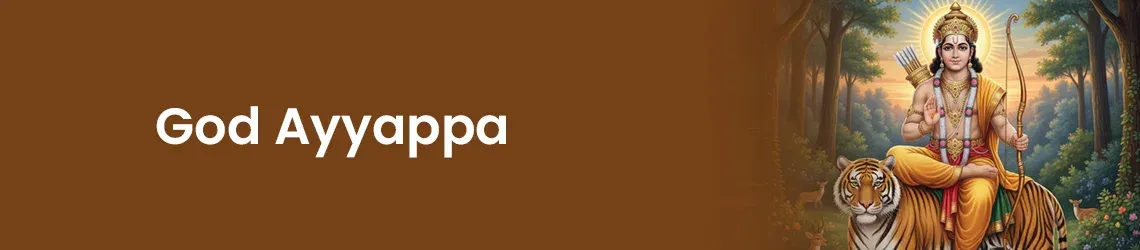
- Seated in Yoga Position: He's almost always shown sitting in a meditative pose with one leg crossed over the other. This represents his mastery over desires and his status as someone who's achieved spiritual control.
- Wearing a Bell Around His Neck: The bell is called Maṇikaṇṭhal. The name "Manikantha" literally means "one with a bell around the neck. " It represents divine sound and his power over both material and spiritual realms.
- Rudraksha Beads and Tulsi Garland: He wears both rudraksha (sacred to Shiva) and tulsi (sacred to Vishnu), showing he's the perfect blend of his divine parents' energies.
- Blue or Dark Complexion: Often depicted with a blue-black complexion, representing his divine nature and connection to both Shiva and Vishnu.
- Bow and Arrow: He carries these weapons because he's also a warrior deity who defeated demons.
- Simple Clothing: Unlike many elaborate deity costumes, Ayyappa wears simple attire, emphasizing austerity and renunciation over material display.
- Serene Expression: His face shows calmness and compassion, but with an underlying strength. He's approachable yet commands respect.
- Riding a Tiger: One of his most iconic depictions shows him sitting on or riding a tigress or tiger. This comes directly from the legend where he returned from the forest riding a tigress after defeating Mahishi.
His appearance itself teaches that power does not need excess. In a world drawn to display and status, Ayyappa’s simplicity speaks of a deeper strength
The Stories About Lord Ayyappa
The legends of Ayyappa Swami reveal his divine purpose and teach important life lessons.
The Birth of Ayyappa
The story starts with a powerful she-demon named Mahishi (sister of the demon Mahishasura, who was killed by Durga). She had a special boon that she could only be killed by a son born from the union of God Shiva and Vishnu. Since gods don't typically have children together, she figured she was invincible and started terrorizing the universe.
The gods realized they needed divine intervention. Vishnu transformed into Mohini, his stunning female form, and through divine play, a child was conceived with Shiva. This child was Ayyappa, born specifically to defeat Mahishi and restore balance.
After birth, the divine baby was found by the childless king of Pandalam, who adopted him and named him Manikantha (because of the bell around his neck). The king raised him as his own son.
The Quest for Tiger's Milk
Years later, the queen gave birth to a biological son. The palace minister, wanting the biological son to inherit the throne, plotted against Ayyappa. The queen pretended to be sick, and a fake doctor said only tiger's milk could cure her (knowing this was impossible and would get Ayyappa killed in the forest).
Young Ayyappa, being the dutiful son, went into the forest to get the tiger's milk. But here's the thing: he wasn't just some adopted prince. He was a god. In the forest, he encountered Mahishi, who had been waiting for exactly this moment. A fierce battle happened, and Ayyappa defeated her, fulfilling his divine purpose.
Then, instead of returning with tiger's milk, he rode back to the palace on a tigress, surrounded by other tigers he'd befriended. When the king and everyone saw this, they realized Manikantha was no ordinary child. He was divine.
The Revelation and Departure
Ayyappa revealed his true identity and explained he'd completed his earthly mission. He told the king that devotees would come seeking him and showed the king where to build his temple. Then he disappeared into the divine realm but promised his presence would always remain at that sacred spot for devotees who approached with sincere hearts.
The Tradition of 41 Days
Before going to Sabarimala, devotees observe a strict 41-day vow (vratham).
During these 41 days, pilgrims wear black or blue clothes, walk barefoot, sleep on the floor, eat simple vegetarian food, abstain from alcohol and tobacco, avoid negative speech, and treat everyone as "Swami".
How to Worship Lord Ayyappa?
Worshiping Ayyappa Swamy requires your commitment, discipline, and genuine devotion to following a sacred and time-honored process known as:
The 41-Day Vratham (Vow)
If you're planning to visit Sabarimala, the main temple of swami ayyapa, the 41-day preparation is mandatory. Here's what it involves:
What Devotees do for 41 days
- Wear only black, blue, or saffron clothes
- Wear a rudraksha or tulsi mala (sacred beads)
- Wake up early, bathe, and pray
- Eat only sattvic vegetarian food (no onion, garlic, or eggs
- Sleep on the floor
- Walk barefoot everywhere
- No shaving or haircuts
- No alcohol, tobacco, or intoxicants
- No movies, parties, or entertainment
- Maintain celibacy
- Address everyone as "Swami".
- Visit a temple daily
- Chant "Swamiye Saranam Ayyappa" 108 times a day
What they Avoid:
- Anger, harsh words, or negative speech
- Luxury and comfort
- All worldly pleasures
- Lies or dishonesty
- Impure thoughts
It's intense. The devotees become temporary monks, preparing their bodies and minds to receive Ayyappa's darshan.
Simple Ayyappa Mantras:
"Swamiye Saranam Ayyappa" (The most common chant, meaning "Oh Swamy, I surrender to Ayyappa") "Om Swami Ayyappane Saranam" "Saranam Ayyappa, Saranam Ayyappa" (Just keep repeating this; simplicity is key)
Daily Home Worship
Not everyone can do the full 41-day vow and Sabarimala trip, but you can still honor Ayyappa Swami at home:
- Set up a small altar with Ayyappa's picture or idol
- Light a lamp (preferably a ghee lamp) daily
- Offer simple food like rice, jaggery, and coconut
- Chant Ayyappa mantras
- Read Ayyappa stories or the Harivarasanam (evening prayer)
- Practice discipline in daily life.
Festivals Related to Lord Ayyappa
Lord Ayyappa's festivals draw millions of devotees annually, with Sabarimala becoming one of the world's busiest pilgrimage sites during these times.
Makaravilakku (January): Held on January 14th (Makar Sankranti), it marks the culmination of the pilgrimage season. The highlight is when a divine light (jyoti) appears on the Ponnambalamedu hill opposite the temple. Millions of devotees witness this phenomenon, believed to be a manifestation of Ayyappa himself. The energy at Sabarimala during this time is absolutely electric.
Mandala Pooja (November-December): This 41-day period, starting in mid-November mirrors the vratham period devotees observe. It's the opening of the main pilgrimage season. Lakhs of devotees make the trek during these days, and the temple stays incredibly busy throughout.
Vishu (April): The Malayalam New Year has special significance for Ayyappa devotees. Special pujas and offerings are made at Sabarimala and other Ayyappa temples.
Onam (August-September): During Kerala's harvest festival, Ayyappa temples conduct elaborate rituals and feasts. Many devotees begin their vratham during this period to prepare for the Mandala season.
This immense devotion leads us naturally to the sacred temples of Lord Ayyappa, where his divine presence is believed to be felt eternally.
Sacred Temples Dedicated to Lord Ayyappa
While Ayyappa Swami has temples across India, certain shrines hold special significance.
- Sabarimala Temple, Kerala: This is the mothership. Located in the Western Ghats, this ancient temple is where Ayyappa himself is believed to reside. The temple sits atop Sabari Hill, accessible only by trekking through dense forests. It's one of the largest annual pilgrimage gatherings globally, with an estimated 50-100 million visitors during the season. The 18 sacred steps leading to the sanctum represent the 18 spiritual mountains one must climb for enlightenment.
- Kulathupuzha Sastha Temple, Kerala: This is where Ayyappa is worshiped in his child form (Bala Ayyappa). It's considered one of the oldest Ayyappa temples and has a gentler, more family-friendly vibe compared to the intense Sabarimala pilgrimage.
Achankovil Sastha Temple, Kerala: Located where Ayyappa is believed to have killed the demoness Mahishi. The temple has a unique tradition; devotees offer prayers for protection from enemies and obstacles.
Aryankavu Sastha Temple, Kerala: Known for its healing powers, devotees visit seeking cures for ailments. The temple has a sacred pond believed to have medicinal properties.
Why Lord Ayyappa Matters Today
In a world obsessed with instant gratification, comfort, and shortcuts, Ayyappa Swamy stands as a counter-cultural force. The pilgrimage teaches that some achievements require preparation and discipline.
Modern devotees include everyone from students to tech professionals who take time off work to observe the vratham. They're not escaping life, but they're learning to live it with more discipline, compassion, and purpose. The lessons learnt during those 41 days, including self-control, humility, and treating others with respect, carry over into daily life long after the pilgrimage ends.
In our divided world, Ayyappa's message of unity (being born from both Shiva and Vishnu) and equality (everyone becoming Swami) feels urgent and necessary. He reminds us that spiritual progress isn't about your starting point; it's about your commitment to the journey.
Swamiye Saranam Ayyappa
Hindu Gods
- God Kartikeya
- God Annamalaiyar
- God Murugan
- God Dattatreya
- God Vishnu
- God Krishna
- God Jagannath
- God Hanuman
- God Ganesha
- God Surya
- Goddess Lakshmi
- God Shiva
- Goddess Tulsi
- Goddess Shakambhari
- Goddess Saraswati
- God Agni
- God Indra
- God Nandi
- God Ayyappa
- Goddess Durga
- God Kaal Bhairav
- Goddess Annapurna
- Maa Shailputri
- Maa Brahmacharini
- Maa Chandraghanta
- Maa Kushmanda
- Maa Skandamata
- Maa Katyayani
- Maa Kalaratri
- Maa Mahagauri
- Maa Siddhidatri