
Lord Jagannath
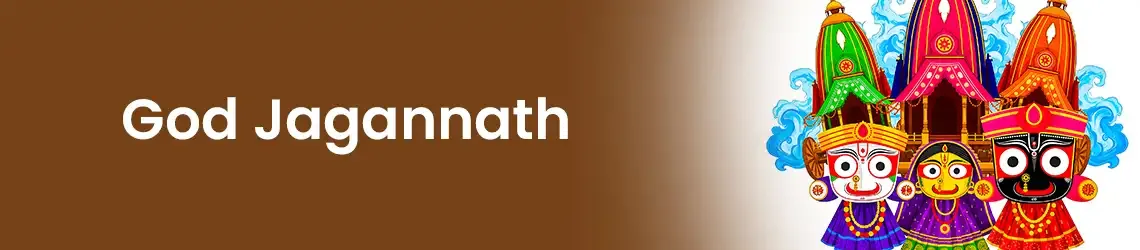
He is one of the most beloved deities in Hinduism. His story is as fascinating as his unique appearance. If you have seen wooden idols with big eyes and a gentle smile, that is Lord Jagannath.
Who is Jagannath God?
Lord Jagannath literally means "Lord of the Universe" with "Jagat" meaning universe and "Nath" meaning lord. He's primarily worshiped as a form of Lord Krishna, the eighth avatar of Lord Vishnu. What makes him special is that he's always been worshiped alongside his siblings: his elder brother, Balabhadra (Balarama), and his younger sister, Subhadra.
Lord Jagannath’s Unique Look
Here's what makes Lord Jagannath instantly recognizable:
- Wooden idols: instead of stone or metal.
- Large, round eyes: that seem to look right through you.
- No distinct hands or legs: just stumpy projections.
- Vibrant colors: Jagannath is black, Balabhadra is white, and Subhadra is yellow. People often wonder why the idols look "unfinished." Well, there's a beautiful story behind that.
Lord Jagannath Story
The story begins with God Krishna's death. When Lord Krishna left his mortal body and was cremated, something miraculous happened. While his entire body turned to ashes, his heart refused to burn. This divine heart, called 'Brahma Padartha' (the divine essence), remained intact because it was too sacred for earthly fire.
The Pandavas immersed this sacred heart in the holy river. It flowed through the waters and eventually reached the seashore of Puri, where it transformed into a Neem log carrying Krishna's divine essence within.
King Indradyumna's Divine Dream
Years later, Lord Vishnu appeared in King Indradyumna's dream with specific instructions: "Go to the Puri seashore. You will find a divine Neem log. From this sacred wood, create my idols, for it carries Krishna's heart."
The king found the log and invited Vishwakarma, the divine architect, to carve the idols. Vishwakarma agreed with one condition: he would work in complete privacy for twenty-one days without any disturbance.
But around the fifteenth day, the king's anxious wife couldn't bear the silence. She convinced the king to open the doors. The moment they did, Vishwakarma vanished, leaving behind three semi-finished wooden idols.
A divine voice reassured the devastated king: "Install these deities as they are. The Brahma substance, Krishna's heart, resides within them.
Their incomplete form represents the infinite, formless nature of God."
The Living Deity That Still Beats
Here's what makes Lord Jagannath truly extraordinary: devotees believe Krishna's heart still pulsates within the wooden idol today.
Typically, every 12 years (though it can range from 8 to 19 years based on the lunar calendar), during the "Nava Kalevara" ceremony, the old wooden idols are replaced with new ones, and the Brahma Padartha is transferred.
This is one of Hinduism's most mysterious rituals:
- The entire city of Puri's electricity is cut off
- Priests wear thick blindfolds and cover their hands with cloth
- Priests report feeling something like a rabbit jumping inside, the pulsating divine essence
Where People Worship Lord Jagannath
The Main Temple: Jagannath Puri, Odisha: The Jagannath Temple in Puri, built in the 12th century, is the primary shrine. This 65-meter-tall architectural marvel is one of the four Char Dham pilgrimage sites in Hinduism.
The temple's kitchen is legendary, employing about 600 cooks and 400 assistants who prepare 56 varieties of vegetarian dishes daily on 250 traditional earthen hearths.
This sacred food, called Mahaprasad, is distributed to everyone regardless of social status. Temples Around the World: While Puri remains the heart of Jagannath worship, you'll find temples across Indian states like West Bengal, Manipur, Gujarat, and beyond.
Thanks to ISKCON, Jagannath temples now exist worldwide, from London to Los Angeles.
Jagannath Rath Yatra
The Annual Rath Yatra (Chariot Festival) is Hinduism's most spectacular celebration. Three massive wooden chariots, freshly built each year, carry Jagannath, Balabhadra, and Subhadra through Puri's streets.
Thousands of devotees pull these chariots with ropes, chanting "Jai Jagannath!" with pure devotion.
What makes this festival truly special is its beautiful symbolism. While devotees usually go to temples to see God, during Rath Yatra, God comes out to see his devotees.
Lord Jagannath leaves his grand temple and travels through the streets so that everyone, regardless of caste, creed, or social status, can have his darshan (divine sight).
It's a powerful reminder that the divine is accessible to all.
Why Shree Jagannath Matters Today
The unfinished idols remind us that divinity transcends physical perfection. They teach us to look beyond appearances and recognize the divine essence in everything.
So, if you're chanting "Jai Jagannath" or simply curious about the mysterious story of Shree Jagannath, the tale is going to fill you with timeless wisdom about faith, humility, and the infinite nature of the divine.
Hindu Gods
- God Kartikeya
- God Annamalaiyar
- God Murugan
- God Dattatreya
- God Vishnu
- God Krishna
- God Jagannath
- God Hanuman
- God Ganesha
- God Surya
- Goddess Lakshmi
- God Shiva
- Goddess Tulsi
- Goddess Shakambhari
- Goddess Saraswati
- God Agni
- God Indra
- God Nandi
- God Ayyappa
- Goddess Durga
- God Kaal Bhairav
- Goddess Annapurna
- Maa Shailputri
- Maa Brahmacharini
- Maa Chandraghanta
- Maa Kushmanda
- Maa Skandamata
- Maa Katyayani
- Maa Kalaratri
- Maa Mahagauri
- Maa Siddhidatri