
Goddess Annapurna
Goddess Annapurna is one of the most important goddesses in Hinduism, worshiped as the goddess of food and nourishment. She’s also a form of Goddess Parvati, the wife of Lord Shiva
The name "Annapurna" comes from two Sanskrit words: "Anna", meaning food or grains, and "Purna", meaning complete or full. Together, the name means "she who is full of food" or "the giver of nourishment".
In Hindu philosophy, food is more than just something to fill your stomach. It runs life itself, gives warmth, and provides the divine grace that keeps everything running.
So let's break down what she symbolises, her stories, and how people honour her.
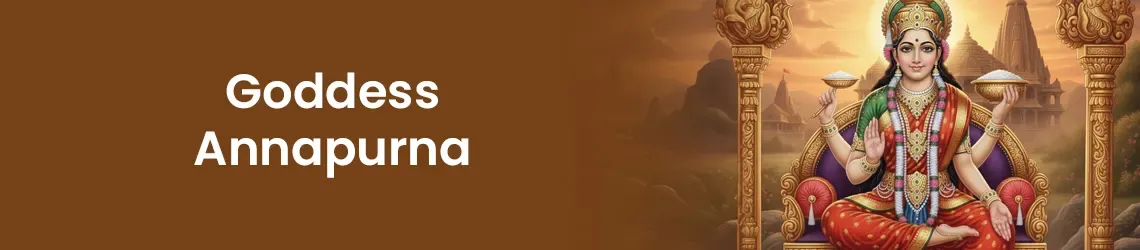
Annapurna Devi: What She Looks Like and What It Means
Every picture or statue of Goddess Annapurna has a purpose. Here's what you're looking at:
- Golden Ladle or a Cooking Pot: She's always holding a golden ladle or pot filled with food. It's her signature item, showing she's the one who feeds the entire universe.
- Bowl of Rice or Sweet Pudding: On the other hand, there's usually a bowl overflowing with rice or kheer (which is like a sweet rice pudding dessert). It's all about abundance, the idea that there's always more than enough.
- How She Sits or Stands: You'll see her either sitting on a throne or standing with grace. She's calm, radiating nourishing energy.
- Golden or Warm-Toned Skin: Her complexion is usually shown as golden or reddish, which symbolizes prosperity, warmth, and basically the life-giving energy of harvests and the earth.
- Fancy Jewelry and Crown: She's adorned in beautiful jewelry and wearing a crown. It represents both material wealth and spiritual richness, the fullness of life itself.
The Divine Role of Goddess Annapurna
Goddess Annapurna holds a unique and essential place among all Hindu deities. While other gods oversee cosmic forces, creation, or destruction, she governs the most fundamental need of all living beings, that is, nourishment.
- The Sustainer of Every Life: Without food, no life can exist. Annapurna Devi ensures that the cosmic kitchen remains full, providing sustenance to all the creatures across the universe.
- The Mother Who Never Refuses: True to her motherly nature, Maa Annapurna never turns down anyone who approaches her with hunger. She represents unconditional giving and upholds the belief that no living being should suffer from starvation.
- Balance Between Material and Spiritual Worlds: She teaches an important lesson. That is, physical nourishment and spiritual growth cannot be separated. Without proper food, the body lacks energy for spiritual practice. She shows that taking care of basic needs is essential for higher spiritual pursuits.
- The Source of Universal Energy: In Hindu philosophy, food is transformed into life energy (called prana) that powers every action, thought, and prayer. By providing food, Annapurna essentially fuels the entire cycle of life and all spiritual activities.
The Stories About Maa Annapurna
Maa Annapurna’s stories quietly ask a deep question: ‘‘what if food disappeared from the world, even for the gods?’’
When Shiva Learned He Was Wrong
The most famous story involves Lord Shiva, and it was in Kashi (also called Varanasi), one of India's holiest cities. Shiva once declared that the material world, including food, was just an illusion (maya) and is not of much significance.
To teach him a lesson, Goddess Parvati (who sustains the universe as Annapurna) decided to disappear. The moment she left, everything went sideways. Crops died, kitchens went empty, and famine hit everywhere. Even the gods in heaven couldn't find food. The entire universe started starving.
God Shiva understood that food is imperative for the livelihood of everyone. He went to Kashi and stood outside Annapurna's temple like a beggar, bowl in hand, asking for food. Goddess Annapurna showed up and filled his bowl, teaching him and everyone else that the material world and sustenance aren't illusions. They're sacred gifts that make life and spiritual practice possible.
That's why you'll sometimes see images of Shiva with a bowl in front of Annapurna, humbly accepting food. It's a reminder that everyone, even gods, depends on her.
The Kashi Promise
Another legend says that Goddess Annapurna made a promise: as long as her temple stands in Kashi, nobody in that city will ever die of hunger.
People still believe this strongly today, and the Annapurna Temple in Varanasi is considered super sacred for anyone worried about food security.
Three Types of Hunger
Ancient texts say Annapurna satisfies three kinds of hunger: the hunger for food, mental hunger for knowledge and emotional fulfilment, and spiritual hunger for connection with the divine.
Through her grace, you feel utterly fulfilled on every level: body, mind, and soul. These stories really drive home that food is sacred, the material and spiritual worlds are connected, and being grateful for sustenance is its own form of worship.
How Do People Worship Goddess Annapurna?
Worshiping Annapurna Devi is about treating food as divine and being grateful for what you eat. You can honor her daily in your kitchen or during special occasions.
Everyday Worship at Home
The easiest way to honor Maa Annapurna is right in your own kitchen. No temple required:
- Keep your kitchen clean and treat it like a sacred space.
- Before you start cooking, wash your hands and say a quick prayer.
- While cooking, keep positive thoughts and cook with love.
- Before eating, mentally offer a bit of your food to Annapurna (or literally set aside a portion for someone in need)
- Say a simple thank-you prayer before starting to eat.
Simple Prayers You Can Say: "Om Annapurnayai Namaha" (basically means "I bow to Annapurna") Or "Annapurne Sadapurne Shankara Prana Vallabhe, Jnana Vairagya Siddhyartham Bhiksham Dehi Cha Parvati"
Translation: "O Annapurna, who is always full, beloved of Shiva, grant me food along with knowledge and detachment."
If you want to do a proper Annapurna Puja, especially on special days or when you really need her blessings for abundance:
What to Do:
- Clean your worship area and lay down the cloth on a raised surface
- Put the Annapurna picture/statue in the centre.
- Set up the pot with water, add mango leaves, and place a coconut on top
- Light the lamp and incense
- First, invoke Lord Ganesha (he removes obstacles; it's in tradition to call him first)
- Apply the red powder and turmeric to the goddess's forehead (on the picture/statue)
- Offer flowers while saying Annapurna prayers
- Arrange food grains around the idol; it symbolizes abundance
- Offer the cooked food, sweets, and fruits
- Do aarti (waving the lit lamp in circles) while singing prayers
- Share the prasad (blessed food) with everyone there
- Give some food to people in need as part of your worship
Best Days to Worship Her
You can worship her anytime, but these days are considered auspicious:
- Annapurna Jayanti: Her "birthday", celebrated on the full moon in November-December
- Thursdays: Associated with abundance and prosperity
- Akshaya Tritiya: A super auspicious day for seeking lasting prosperity (usually in April-May)
- First cooking in a new home: People worship her to bless their new kitchen.
Sacred Temples Where People Visit
There are several ancient temples across India dedicated to Maa Annapurna. People visit these seeking prosperity and freedom from hunger.
- Annapurna Temple in Varanasi (Kashi): This is her main temple. It's near another famous temple called Kashi Vishwanath. According to legend, Annapurna promised nobody in Kashi would starve. The temple has a golden statue of the goddess, and they distribute free food daily.
- Annapurna Temple in Indore: A beautiful temple where they make elaborate food offerings every day, and you can join in community meals.
- Annapurneshwari Temple in Horanadu, Karnataka: Located in the mountains, this temple is famous for giving free meals to all its visitors. No matter who you are, where you're from, or what you believe. Feeding people is central to what they do.
- Sri Annapurneshwari Temple in Cherukunnu, Kerala: An ancient temple where the goddess is worshiped in a special form, and they do particular rituals during harvest times.
- Various Temples in Varanasi: Beyond the main one, there are several smaller shrines throughout the city, each important to local devotees.
Many of these temples run "Annapurna Bhandar" (free kitchens) where food gets distributed to anyone who needs it, truly living out the goddess's principle of feeding everyone without discrimination.
Inspired by Annapurna’s message of balance and gratitude, talk to an astrologer on Astroyogi today for gentle guidance and mindful clarity.
Why Goddess Annapurna Matters Today
In our modern world, where millions are hungry while others throw away tons of food, Goddess Annapurna's message feels more important than ever. She reminds us not to waste food, to respect it, and to remember that every meal is a gift. Taking even a moment to be grateful before eating connects us to centuries of tradition and makes us mindful about where our food comes from.
What's beautiful about Annapurna worship is its simplicity. You don't need fancy rituals or expensive items. Just treat your kitchen with respect, cook with love, eat with gratitude, share with those in need, and never waste food. That itself is worshiping Annapurna.
Hindu Gods
- God Kartikeya
- God Annamalaiyar
- God Murugan
- God Dattatreya
- God Vishnu
- God Krishna
- God Jagannath
- God Hanuman
- God Ganesha
- God Surya
- Goddess Lakshmi
- God Shiva
- Goddess Tulsi
- Goddess Shakambhari
- Goddess Saraswati
- God Agni
- God Indra
- God Nandi
- God Ayyappa
- Goddess Durga
- God Kaal Bhairav
- Goddess Annapurna
- Maa Shailputri
- Maa Brahmacharini
- Maa Chandraghanta
- Maa Kushmanda
- Maa Skandamata
- Maa Katyayani
- Maa Kalaratri
- Maa Mahagauri
- Maa Siddhidatri