
Maa Saraswati
Goddess Saraswati is one of the most important deities in Hinduism. She's the goddess of knowledge, wisdom, learning, music, arts, and speech. Her name means "one who flows," like how knowledge and ideas flow from one person to another.
In Hindu tradition, Saraswati Devi is married to Lord Brahma, the creator god. While Brahma made the universe, Maa Saraswati filled it with language, education, and culture.
Students pray to her before exams. Teachers ask for her help. Artists, musicians, and writers seek her blessings when they're creating something new or learning a skill. People believe her grace removes confusion and brings clear understanding.
Saraswati Devi: What She Looks Like and What It Means
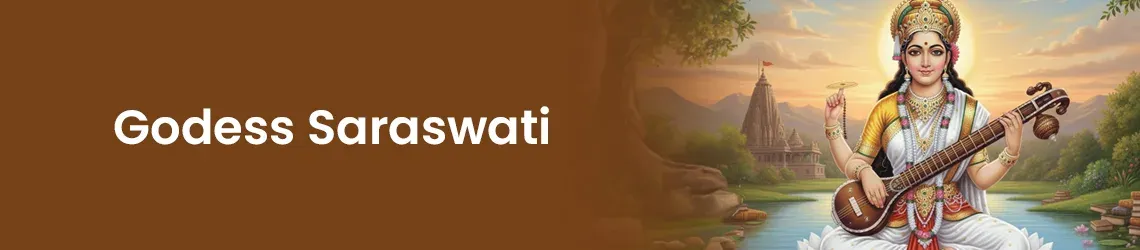
Every depiction of Maa Saraswati is loaded with symbolism. Here's what each element represents:
- Pure White Clothing: Saraswati Devi adorns white clothing. White is the color of light; it means knowledge that dispels the darkness of ignorance.
- Four Arms: Like many Hindu deities, she has four arms representing the four aspects of human personality in learning: mind, intellect, alertness, and ego. Each arm holds something significant.
- Veena (Musical Instrument): In her two front hands, she holds a veena, a classical Indian string instrument. This represents the arts, music, and harmony in knowledge. Plucking the strings symbolizes tuning the mind to achieve perfect harmony between thought and action.
- Book or Scriptures: One hand holds sacred texts (usually the Vedas), representing knowledge, learning, and wisdom passed through generations.
- Mala (Prayer Beads): Her other hand holds a mala made of crystals or pearls, representing meditation, contemplation, and spiritual knowledge
- White Swan: She's often shown sitting on or near a white swan (hamsa). Swans have a unique ability to separate milk from water when mixed; it symbolizes the ability to discriminate between good and bad, eternal and temporary, and right and wrong.
- Sometimes a Peacock: Occasionally depicted with a peacock, representing pride and beauty.
- Lotus Seat: This represents how knowledge and wisdom can flourish even in the material world without getting corrupted by it.
- Calm Expression: Her face is always serene, showing the tranquillity that comes from true knowledge and understanding.
- Flowing Water Nearby: Often shown near flowing water or rivers, connecting to her name's meaning and symbolizing the continuous flow of knowledge that never stops.
The Stories About Goddess Saraswati
The legends of Saraswati Devi reveal her importance in creation and the cosmic order.
Saraswati and the Creation of Language
One beautiful story tells how, in the beginning, Lord Brahma created the universe but found it silent and meaningless. Everything existed, but there was no way to describe it, no way to communicate, and no way to pass knowledge. The creation was still incomplete.
From Brahma's own being emerged Saraswati, radiant and pure. The moment she appeared, she held the veena and began to play. As her fingers moved across the strings, sounds emerged, the first sounds, the primordial vibrations. These sounds organized themselves into patterns, which became language, which became the Vedas.
The River That Disappeared
There's a connection between Goddess Saraswati and the ancient Saraswati River mentioned in the Vedas. This river once flowed through northwest India, but mysteriously disappeared or went underground thousands of years ago.
The river's disappearance is said to be because Saraswati chose to flow underground, becoming invisible to the material eye but still present spiritually.
Moreover, the confluence of three rivers at Prayagraj (Allahabad), which is the Ganga, the Yamuna, and the invisible Saraswati, is considered especially sacred because the third river represents the hidden spiritual knowledge that flows alongside visible material reality.
Saraswati and the Demon Shumbha
In one lesser-known story from the Devi Mahatmya, when the demon Shumbha troubled the gods, Goddess Parvati emanated several forms to fight him. One of these was Saraswati, who emerged to confuse the demon's mind and speech. She made him unable to think clearly or command his armies effectively, basically scrambling his brain before he could be defeated.
This shows that knowledge and clarity of thought are weapons. Taking them away from someone renders them powerless, no matter how strong they are physically.
How to Worship Maa Saraswati?
Worshiping Maa Saraswati is especially important for students, artists, and anyone seeking knowledge or creative inspiration.
Daily Home Worship
You can honor Goddess Saraswati regularly at home:
- Set up a small altar with her picture or idol.
- Place your books, musical instruments, or art supplies near the altar (basically, your tools of learning)
- Light a lamp (diya) and incense before studying or practicing
- Keep the space clean; clutter blocks the flow of knowledge
- Wear white or yellow clothes during worship (yellow represents learning)
- Offer white flowers, fruits (especially yellow fruits like bananas), and sweets
- Chant Saraswati mantras before starting your study or practice session
- Never place books on the floor or step over them (disrespectful to knowledge)
Simple Saraswati Mantras:
"Om Aim Saraswatyai Namaha" (The main Saraswati mantra; "Aim" is her seed sound)
"Jai Maa Saraswati" (Victory to Mother Saraswati)
"Ya Kundendu Tusharahara Dhavalaa..." (The famous Saraswati Vandana prayer)
Saraswati Puja Rituals
For a proper puja, especially during Basant Panchami or before exams: The Process of Puja
- Clean your study area or workspace thoroughly
- Lay the white or yellow cloth on a raised platform
- Place Saraswati's idol/picture at the center
- Arrange your books and instruments around her
- Light the lamp (diya) and incense
- Apply kumkum and turmeric tilak to the goddess
- Offer flowers while chanting mantras
- Place fruits and sweets as offerings
- Chant the Saraswati Vandana or read her thousand names (Sahasranama)
- Perform aarti with the diya
- Distribute prasad to everyone
- Touch your books and instruments to your forehead (taking blessings from them)
Important: On Saraswati Puja day, traditionally, you don't read or write. Since it's a day off from studies to honor the goddess. You resume the next day with renewed blessings.
Festivals Related to Goddess Saraswati
Goddess Saraswati has several festivals dedicated to her, with Basant Panchami being the most important.
Basant Panchami (Saraswati Puja): The main festival for Saraswati Devi, celebrated in January/February. People wear yellow clothes, students place their books at her feet for blessings, and small children write their first letters (Vidyarambham ceremony). Schools organize special pujas on this day.
Navaratri - Days 7, 8, 9: The last three days of Navaratri belong to Saraswati. People place their books and instruments before her idol, refrain from using them for these days, and retrieve them on the tenth day (Vijayadashami).
Vijayadashami/Dussehra: The most auspicious day to start learning anything new. Children are initiated into education (Aksharabhyasam ceremony), and parents help them write their first letters.
Ayudha Puja (South India): A day during Navaratri dedicated to worshiping all tools like books, computers, instruments, and vehicles. People clean and decorate them and offer prayers to Saraswati.
Sacred Temples Dedicated to Goddess Saraswati
While Goddess Saraswati is worshiped in homes and schools everywhere, these temples are specifically dedicated to her.
- Gnana Saraswati Temple, Basar, Telangana: This old temple is by the Godavari River. Parents bring their kids here for the Akshara Abyasam ceremony. That's when children start learning to write. Students also visit before their exams.
- Sri Sharadamba Temple, Sringeri, Karnataka: Built in the 8th century by the teacher Adi Shankaracharya. This temple has been a place for learning and prayer for more than 1,200 years.
- Panachikkadu Temple, Kerala: This temple is unique because of a special plant called Saraswathi Latha that grows around the goddess's statue. People call it Dakshina Mookambika, and it feels different from other Saraswati temples.
- Koothanur Maha Saraswati Temple, Tamil Nadu: This temple is just for Saraswati; no other gods share the space. Stories say that several holy rivers come together here, which makes it extra special.
- Mata Saraswati Temple, Mana, Uttarakhand: Located near the famous Badrinath temple, this spot is where the old Saraswati River is believed to start. It's a very sacred place for people who love knowledge.
Why Goddess Saraswati Matters Today
Saraswati isn't about having access to information. She represents wisdom, the ability to discern what's true from what's false and what's meaningful. In a world where anyone can post anything online, discrimination (viveka) is crucial.
She also reminds us that knowledge without creativity is sterile, and creativity without knowledge is chaos. The veena in her hands shows that learning should be harmonious, balanced, and beautiful, not just cramming facts for exams or churning out content for algorithms.
Modern students still place their books at her feet during Saraswati Puja, and tech professionals have been known to place their laptops on the altar too. So if you're reading ancient scriptures or coding the latest app, the pursuit of knowledge and the struggle against ignorance remain the same.
Jai Maa Saraswati
Hindu Gods
- God Kartikeya
- God Annamalaiyar
- God Murugan
- God Dattatreya
- God Vishnu
- God Krishna
- God Jagannath
- God Hanuman
- God Ganesha
- God Surya
- Goddess Lakshmi
- God Shiva
- Goddess Tulsi
- Goddess Shakambhari
- Goddess Saraswati
- God Agni
- God Indra
- God Nandi
- God Ayyappa
- Goddess Durga
- God Kaal Bhairav
- Goddess Annapurna
- Maa Shailputri
- Maa Brahmacharini
- Maa Chandraghanta
- Maa Kushmanda
- Maa Skandamata
- Maa Katyayani
- Maa Kalaratri
- Maa Mahagauri
- Maa Siddhidatri