
Maa Mahagauri
Maa Mahagauri is the eighth form of Navdurga and one of the most peaceful and divine manifestations of Maa Durga. Her name means "extremely fair," and her radiant appearance is compared to the moon and the white Kunda flower. Moreover, Maha Gauri Mata is also known for her forgiving nature and for blessing her devotees with wisdom, prosperity, and spiritual growth.
Iconography of Maa Mahagauri
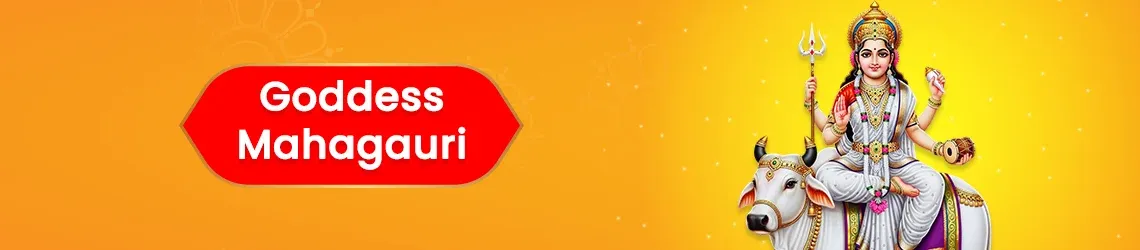
The visual appearance of Maa Mahagauri is depicted as very calm and beautiful. She is depicted wearing a white sari and white accessories, which enhance her radiant appearance.
Goddess Mahagauri is shown with four hands. In one hand, she holds a trident, which represents the power to destroy negativity, and in the other hand, she holds a damaru, symbolizing balance and harmony in the universe. Her other two hands are in Abhaya Mudra and Varada Mudra, which bless devotees with protection and fulfillment of wishes.
Because of her peaceful nature, Maa Mahagauri is considered the form of the Goddess who brings calmness, forgiveness, and spiritual purity.
Benefits of Worshiping Maa Mahagauri
Worshipping Maa Mahagauri is believed to bring peace, happiness, and purity in life. Devotees pray to her to remove past mistakes, negative thoughts, and obstacles, and to receive divine blessings for a better future.
Some of the benefits of worshiping Maa Mahagauri include:
Peace of mind and emotional stability
Removal of past sins and difficulties
Blessings for marriage and family happiness
Success in work and personal life
Improvement in confidence and clarity
Spiritual growth and inner purity
Protection from negative influences
Fulfillment of wishes and desires
Worshiping Maa Mahagauri
Worship of Maa Mahagauri is performed through various traditional prayers and rituals. Devotees recite Aarti, Chalisa, Strotam, and mantras to express devotion and to connect with the Goddess.
Maa Mahagauri Aarti
Maa Mahagauri Aarti “Aarti Devi Mahagauri Ji Ki” is sung by devotees to express devotion and respect to the eighth form of Navdurga. It is usually performed during Navratri, especially on the eighth day, and during daily prayers dedicated to Maa Durga.
You can read the complete Maa Mahagauri Aarti here.
Maa Mahagauri Chalisa
“Shri Mahagauri Chalisa” is a devotional hymn dedicated to Maa Mahagauri, the eighth form of Navdurga. Below is the full Maa Mahagauri Chalisa along with its meaning.
॥ Doha ॥
Man mandir mere aan baso, aarambh karun gun gaan, Gauri maa mateshwari, do charanon ka dhyan. Poojan vidhi na jaanti, par shraddha hai apaar, Pranam mera swikariye, he maa praan aadhar.
(Meaning: The devotee invites Maa Gauri to reside in the heart and humbly begins her praise. Even without knowing proper rituals, sincere devotion is offered, seeking acceptance and blessings from the divine mother.)
॥ Chaupai ॥
Namo namo he Gauri mata, aap ho meri bhagya vidhata,
Sharanagat na kabhi ghabrata, Gauri Uma Shankari mata.
Aapka priya hai aadar paata, jai ho Kartikeya Ganesh ki mata,
Mahadev Ganpati sang aao, mere sakal klesh mitaao.
(Meaning: Maa Gauri is praised as the creator of destiny and the mother of Ganesha and Kartikeya. Those who surrender to her find strength and seek her presence to remove life’s troubles.)
Sarthak ho jaaye jag mein jeena, satkarmon se kabhi hatu na, Sakal manorath poorn kijo, sukh suvidha vardaan mein dijiye. He maa bhagya rekha jaga do, man bhavan su-yog mila do, Man ko bhaaye vo var chahun, sasural paksh ka sneha mai paun.
(Meaning: The devotee seeks a meaningful life guided by good actions, along with fulfillment of desires, happiness, and favorable circumstances in personal and family life.)
Param aaradhya aap ho meri, phir kyon var mein itni deri,
Hamare kaaj sampoorn kijiyo, thode mein barkat bhar dijiyo.
Apni daya banaye rakhna, bhakti bhav jagaye rakhna,
Gauri mata anshan rehna, kabhi na khoyun man ka chaina.
(Meaning: The devotee expresses complete faith in the Goddess, asking her to complete pending tasks, grant prosperity, and maintain peace and devotion in life.)
Dev muni sab sheesh navate, sukh suvidha ko var mai paate, Shraddha bhav jo lekar aaya, bin maange bhi sab kuch paaya. Har sankat se use ubara, aage badh ke diya sahara, Jab bhi maa aap sneh dikhlave, niraash man mein aas jagave.
(Meaning: Even gods and sages bow before Maa Gauri. Those who approach her with devotion receive support, guidance, and renewed hope during difficult times.)
Shiv bhi aapka kaha na taale, daya drishti hum pe daale, Jo jan karta aapka dhyan, jag mein paaye maan samman. Sacche man jo sumiran karti, uske suhaag ki raksha karti, Daya drishti jab maa daale, bhav saagar se paar utaare.
(Meaning: Maa Gauri is deeply respected, even by Lord Shiva. Those who remember her with sincerity are guided in life and gain respect and stability.)
Jape jo Om Namah Shivay, Shiv parivaar ka sneha vo paaye, Jispe aap daya dikhave, dusht aatma nahi sataave. Sata gun ki ho data aap, har ek man ki gyata aap, Kaato hamre sakal klesh, nirog rahe parivaar hamesha.
(Meaning: The devotee highlights the connection with Lord Shiva and seeks protection, wisdom, and overall well-being for family and life.)
Dukh santap mita dena maa, megh daya ke barsa dena maa, Jab hi aap mauj mein aaye, hath jaay maa sab vipdaaye. Jispe dayal ho mata aap, uska badhta punya prataap, Phal phool main dugdh chadhau, shraddha bhav se aapko dhyaau.
(Meaning: Maa Gauri is requested to remove sorrow and shower kindness. The devotee expresses faith and offers prayers with sincerity and dedication.)
Avagun mere dhak dena maa, mamta aanchal kar dena maa, Kathin nahi kuch aapko mata, jag thukraya daya ko paata. Bin paau na gun maa tere, naam dhaam swaroop bahu tere, Jitne aapke paavan dhaam, sab dhaamon ko maa pranam.
(Meaning: The devotee seeks forgiveness and protection, acknowledging the divine presence of the Goddess in many forms and sacred places.)
Aapki daya ka hai na paar, tabhi to pooje kul sansar, Nirmal man jo sharan mein aata, mukti ki wo yukti paata. Santosh dhan se daaman bhar do, asambhav ko maa sambhav kar do, Aapki daya ke bhare, sukhi base mera parivaar.
(Meaning: The Goddess is described as limitless in compassion. A pure heart and surrender bring contentment, stability, and harmony in life.)
Aapki mahima ati niraali, bhakton ke dukh harne wali, Manokamna poorn karti, man ki duvidha pal mein harti. Chalisa jo bhi padhe sunaye, suyogya var vardaan mein paaye, Aasha poorn kar dena maa, sumangal saakhi var dena maa.
(Meaning: Maa Gauri’s divine nature is praised as one who removes difficulties and fulfills wishes. The Chalisa is seen as an expression of devotion and faith.)
॥ Doha ॥
Gauri maa vinati karun, aana aapke dwar, Aisi maa kripa kijiye, ho jaaye uddhaar. Heen heen heen sharan mein, do charanon ka dhyan, Aisi maa kripa kijiye, paun maan samman.
(Meaning: The devotee humbly prays for the Goddess’s grace, seeking guidance, dignity, and a meaningful path in life.)
॥ Stuti ॥
Ya Devi Sarvabhuteshu, Maa Mahagauri roopen sansthita, Namastasyai namastasyai namastasyai namo namah॥
(Meaning: Salutations again and again to the Goddess who resides in all beings in the form of Maa Mahagauri.)
Maa Mahagauri Strotram
The Maa Mahagauri Strotram describes the divine qualities of Maa Maha Gauri and praises her as the giver of knowledge, peace, and strength. Below is the full Maa Mahagauri Strotram along with its meaning.
॥ Strotram ॥
Sarva sankata hantri tvam hi, dhana aishwarya pradayini, Jnanada chaturveda mayi, Mahagauri pranamamyaham.
(Meaning: I bow to Maa Mahagauri, who removes all troubles and grants prosperity and wealth. She is the giver of knowledge and is the embodiment of the wisdom of the four Vedas.)
Sukha shanti datri, dhana dhanya pradayini, Damaru vadya priya aadya, Mahagauri pranamamyaham.
(Meaning: I bow to Maa Mahagauri, who gives happiness and peace and blesses with abundance. She is the eternal Goddess who loves the sound of the damaru and represents divine energy.)
Trailokya mangala tvam hi, tapa traya harini, Varadam chaitanya mayi, Mahagauri pranamamyaham.
(Meaning: I bow to Maa Mahagauri, who brings auspiciousness to all three worlds and removes suffering. She is full of divine consciousness and grants blessings to her devotees.)
Maa Mahagauri Mantra
The main mantra dedicated to Maa Mahagauri is:
ॐ देवी महागौर्यै नमः। (Om Devi Mahagauryai Namah।)
This mantra is associated with the Goddess Mahagauri and is recited as part of Navratri prayers and daily devotion. There are also other mantras dedicated to Maa Mahagauri that are chanted for different spiritual purposes. You can read all Maa Mahagauri mantras here along with their meaning and significance.
Stories Associated With Maa Mahagauri
There are multiple stories related to Maa Mahagauri in Hindu scriptures, and all of them are connected to different stages of Goddess Parvati’s divine journey.
The Penance of Parvati in the Himalayas
According to Hindu belief, Maa Mahagauri is a form of Goddess Parvati. It is said that Parvati performed a very difficult penance in the Himalayas to get Lord Shiva as her husband. She lived in the forest for many years, facing heat, cold, rain, and hunger without losing her devotion.
Because of this long and severe tapasya, her body became covered with dust, and her complexion turned dark. However, her faith and determination never changed. Lord Shiva was pleased with her penance and accepted her as his consort.
To restore her original form, Lord Shiva bathed her in the sacred water of the river Ganga. After this, her body became bright and radiant like the moon, and she came to be known as Maa Mahagauri, which means the one who is extremely fair and pure.
The Story of Kaushiki and Shumbha Nishumbha
Another story related to Maa Mahagauri is mentioned in the Devi Mahatmya and the Shiva Purana. When Goddess Parvati bathed in the holy Ganga, the dark layer of her body separated and took the form of a powerful goddess known as Kaushiki Devi.
Kaushiki later appeared as a fierce form of the Goddess to destroy the demons Shumbha and Nishumbha, who had become very powerful and troubled the gods. A great battle took place, and the Goddess defeated the demons and restored balance in the universe.
After these events, the Goddess returned to her calm and gentle form, which is known as Maa Mahagauri.
Story of the Peaceful Form of Mahagauri Mata
In the Navdurga tradition, Maa Mahagauri’s final form appears after her fierce manifestations. At different times, the Goddess takes powerful forms such as Durga, Kali, Chamunda, and Chandi to destroy demons and protect the universe.
After the battles are over, she returns to her serene and radiant form as Maa Mahagauri. This form shows the balance between strength and peace, where the same divine power that destroys evil also restores harmony.
For this reason, Maa Mahagauri is worshipped as the eighth form of Navdurga and is associated with purity, calmness, and the gentle aspect of the Goddess.
Symbolic Lessons from Maa Mahagauri
The stories of Maa Mahagauri are not only about divine events but also carry deep symbolic meaning. Each aspect of her story reflects important symbolic lessons mentioned below:
Purity as a Path to Transformation
Maa Mahagauri’s radiant white form represents purity of mind, heart, and actions. Her story shows that even after going through hardship and suffering, one can become calm, clear, and spiritually strong. This teaches that true growth happens when a person removes negativity and keeps their intentions pure.
Strength Through Determination
The story of her penance in the Himalayas shows the importance of determination and patience. Despite facing extreme difficulties, Goddess Parvati never left her path. This symbolizes that progress often comes after effort and discipline, and that strong willpower can overcome even the toughest situations.
Transformation After Struggle
In the legends where her dark form becomes Kaushiki and later returns as Mahagauri, the Goddess represents the cycle of change. Life often moves through phases of struggle, action, and calmness. Her story reminds that after every period of difficulty, a stage of peace and clarity follows.
Balance Between Power and Peace
Maa Mahagauri appears after the fierce forms of the Goddess, such as Kali and Chamunda. This shows that strength and gentleness are both parts of the same divine energy. The same power that destroys evil can also bring calmness and harmony when the purpose is complete.
Letting Go and Moving Forward
Another meaning associated with Maa Mahagauri is the idea of renewal. Her transformation into a bright and peaceful form represents leaving the past behind and beginning a new phase with clarity. This symbolizes that change is always possible, no matter how difficult the journey has been.
Maa Mahagauri represents purity, calmness, and new beginnings after difficult phases of life. If you are also going through emotional stress or any difficult phase in life, talk to an astrologer on Astroyogi to find the right guidance and remedies.
Hindu Gods
- God Kartikeya
- God Annamalaiyar
- God Murugan
- God Dattatreya
- God Vishnu
- God Krishna
- God Jagannath
- God Hanuman
- God Ganesha
- God Surya
- Goddess Lakshmi
- God Shiva
- Goddess Tulsi
- Goddess Shakambhari
- Goddess Saraswati
- God Agni
- God Indra
- God Nandi
- God Ayyappa
- Goddess Durga
- God Kaal Bhairav
- Goddess Annapurna
- Maa Shailputri
- Maa Brahmacharini
- Maa Chandraghanta
- Maa Kushmanda
- Maa Skandamata
- Maa Katyayani
- Maa Kalaratri
- Maa Mahagauri
- Maa Siddhidatri