

How Did Lord Krishna Die? The Story Behind Krishna's Final Departure
How did Lord Krishna die, the divine figure known as the eighth avatar of Lord Vishnu?
According to Hindu scriptures, including the Mahabharata and the Bhagavata Purana, Krishna’s earthly journey ended after the destruction of the Yadava clan.
His final moments are connected with a hunter named Jara and an arrow that changed everything. In Hindu traditions, Krishna’s death is also linked to destiny, his role on Earth, and the beginning of a new era.
So, what happened when Jara’s arrow struck Lord Krishna, and why is this moment considered part of a larger divine plan? Let’s take a closer look at the story behind Krishna’s final journey.
How Did Lord Krishna Die?
The story of how Lord Krishna died is mentioned in Hindu texts such as the Mahabharata and the Bhagavata Purana. After the Kurukshetra War, Gandhari was deeply saddened by the death of her sons and blamed Krishna for not stopping the war. She cursed Lord Krishna that the Yadava clan would also be destroyed the same way one day.
Years later, fights broke out among the Yadavas, and the clan was destroyed.
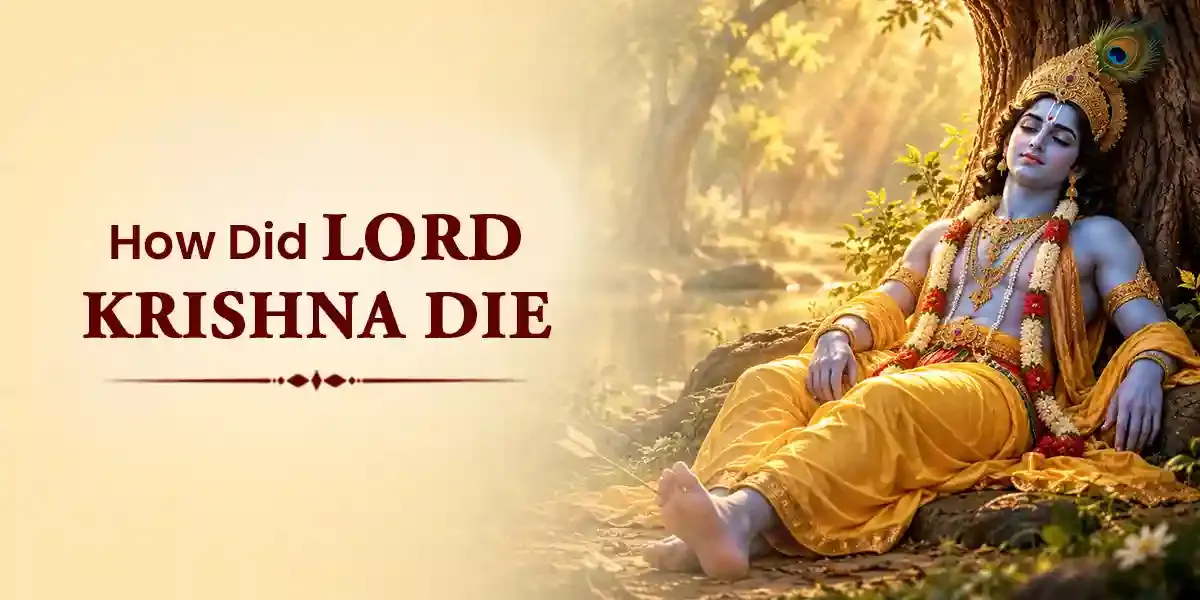
After this, Krishna went to a forest near Prabhasa and was resting under a tree while a hunter named Jara was searching for prey nearby. From a distance, he saw Krishna’s foot and mistook it for a deer and shot an arrow, which accidentally struck Krishna’s foot. When Jara came closer, he realized that he had accidentally shot Lord Krishna. Jara was feeling very sorry about it and begged for forgiveness for his mistake, but Krishna, however, comforted him and forgave him.
According to traditional belief, this was all part of his earthly mission that was completed. This is why many devotees describe the moment as Krishna leaving his mortal form rather than viewing it simply as an ordinary death.
Why Did Lord Krishna Leave His Mortal Body?
Lord Krishna’s earthly incarnation is believed to have had a divine purpose to protect dharma and guide humanity during an important period of the Dvapara Yuga.
Throughout his life, he played many roles. He protected his devotees, guided the Pandavas during the Mahabharata, and shared the teachings of the Bhagavad Gita with Arjuna on the battlefield of Kurukshetra.
By the time of his departure, the great events associated with his earthly life had come to an end. The destruction of the Yadava dynasty also marked the closing of another important chapter.
According to Hindu tradition, Krishna’s departure is also connected with the end of the Dvapara Yuga and the beginning of the Kali Yuga. Therefore, his departure is understood as the completion of his earthly role rather than a moment of defeat or helplessness.
At What Age, When, and Where Did Krishna Die?
According to traditional Hindu chronology, Lord Krishna died on February 18, 3102 BCE, when he was 125 years old. Also, it is traditionally believed that he spent his final moments in Prabhasa, near present-day Somnath, Gujarat, where the hunter Jara accidentally struck Krishna with an arrow.
Who Died First, Radha or Krishna?
According to devotional traditions, it is said that after the years of separation, Radha and Krishna met once again, and during that time Radha rested in Krishna’s arms and eventually died. Further, it is said that Krishna was deeply affected by Radha's death and played the flute only for Radha, and after her death, Krishna broke his beloved flute and never played it again.
Also read: 108 Names of Lord Krishna With Their Meanings
Final Words
The story of how Lord Krishna died is not just about the end of the divine god’s mortal life. In Hindu tradition, Krishna’s death represents the completion of his earthly mission and marks the transition from the Dvapara Yuga to the Kali Yuga, the age we are believed to live in today.
Though Lord Krishna died thousands of years ago, the Bhagavad Gita continues to guide people on dharma, duty, devotion, and the journey of life. His death is remembered not as an ending but as a moment that continues to shape Hindu thought and devotion.
Talk to Astrologers
View All




Team Astroyogi is an experienced in-house editorial team of passionate writers, researchers, and astrology enthusiasts dedicated to making ancient divination sciences more accessible and meaningful in everyday life. With years of collective experience in creating insightful astrology and spirituality content, the team specializes in simplifying complex spiritual concepts into practical guidance for readers seeking clarity, balance, and personal growth. The Astroyogi editorial team possesses expertise across a wide range of subjects, including Indian Astrology, Vedic Astrology, Planetary Transits, Horoscope Analysis, Vastu Shastra, Numerology, Tarot, Spiritual Wellness, and Ritual Practices. Every piece of content is carefully researched, fact-checked, and crafted with the intention of offering reliable, insightful, and easy-to-understand guidance rooted in traditional wisdom. Driven by a commitment to authenticity and reader trust, Team Astroyogi strives to create content that empowers individuals to navigate life’s opportunities and challenges with confidence, positivity, and inner peace. Their mission is to bridge ancient astrological knowledge with modern-day relevance, helping readers make informed decisions and lead more harmonious lives.