
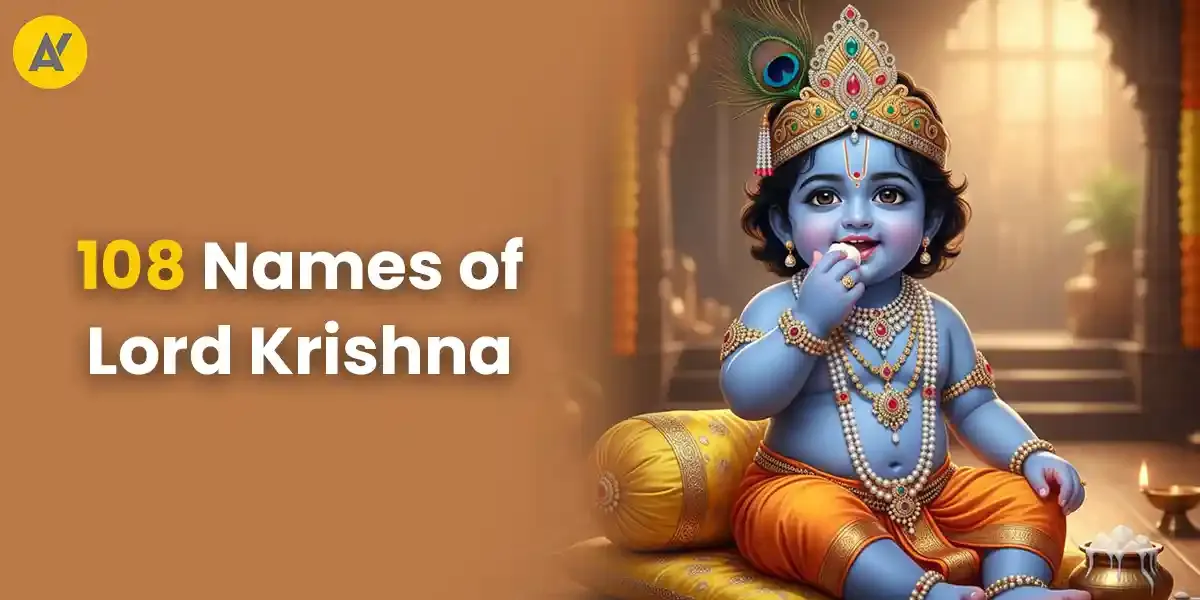

108 Names of Lord Krishna With Their Meanings
The 108 names of Lord Krishna reflect his divine qualities, childhood pastimes, relationships, and role in the Mahabharata. Each name has a special meaning, from Govinda and Gopala to Damodara and Parthasarathi. Known as Sri Krishna Ashtottara Shatanamavali, these names are recited by devotees during prayers, meditation, and festivals such as Janmashtami.
We have listened to many names of Lord Krishna, such as Govinda, Murli Manohar, or Damodar, in temples, during bhajans, or at home. But have you ever wondered what these names mean?
Every name reveals a different aspect of Lord Krishna. Some are associated with his childhood in Gokul, others with his loved ones, and many reflect his divine qualities and role in the Mahabharata.
Exploring the 108 names of Lord Krishna and their meanings helps us understand the stories, relationships, and qualities associated with him.
Table of Contents
Connection Between Lord Krishna's Names and the Number 108
108 Names of Lord Krishna With Their Meanings
Significance of Chanting Krishna’s 108 Names
How to Chant the 108 Names of Lord Krishna
Frequently Asked Questions
Connection Between Lord Krishna's Names and the Number "108"
108 is regarded as an auspicious and holy number in Hindu traditions; therefore, a traditional japa mala contains 108 beads. They are used by devotees to keep count of repetitions of mantras and the sacred names or forms of their god. Thus, the recital of Lord Krishna's names is called Sri Krishna Ashtottara Shatanamavali.
The combination of these names gives a beautiful way to understand Lord Krishna because they reflect his characteristics, divine deeds, and innumerable stories associated with him. Let’s explore the 108 names associated with Lord Krishna and their meanings.
108 Names of Lord Krishna With Their Meanings
The following table lists 108 names associated with Lord Krishna along with their simple meanings. You can use it to learn what each name represents and understand the different aspects of Krishna's life and divine stories.
| No. | Names of Lord Krishna | Simple Meaning |
|---|---|---|
| 1 | Krishna | The all-attractive one |
| 2 | Kamalanatha | Lord of Goddess Lakshmi |
| 3 | Vasudeva | Son of Vasudeva |
| 4 | Sanatana | The eternal one |
| 5 | Vasudevatmaja | Son of Vasudeva |
| 6 | Punya | The pure and sacred one |
| 7 | Lilamanushavigraha | One who took a human form for divine play |
| 8 | Shrivatsakaustubhadhara | One who bears the Shrivatsa mark and Kaustubha jewel |
| 9 | Yashodavatsala | Beloved of Mother Yashoda |
| 10 | Haraye | One who removes suffering |
| 11 | Devakinandana | Son of Devaki |
| 12 | Chaturbhujattachakrasi | One who appeared with four arms and divine weapons |
| 13 | Shankhadigadayudhadhara | One who holds the conch, mace and other weapons |
| 14 | Devakinandana | Joy of Devaki |
| 15 | Shrisha | Lord of Goddess Lakshmi |
| 16 | Nandagopanandana | Son of Nanda Gopa |
| 17 | Yashodavatsala | Dear to Mother Yashoda |
| 18 | Navanitaviliptanga | One whose body was covered with butter |
| 19 | Navanitatanahara | One who playfully steals butter |
| 20 | Navanitavinodavan | One who delights in butter |
| 21 | Navanitavaraha | One who enjoys butter |
| 22 | Padmahasta | One with lotus-like hands |
| 23 | Pankajalochana | One with lotus-like eyes |
| 24 | Govinda | One who knows and protects all beings, also beloved of cows |
| 25 | Gopala | Protector of cows |
| 26 | Gopagopishvara | Lord of the cowherds and gopis |
| 27 | Gopivallabha | Beloved of the gopis |
| 28 | Gopiganavrta | Surrounded by the gopis |
| 29 | Gopikanam | Beloved among the gopis |
| 30 | Gopavallabha | Beloved of the cowherds |
| 31 | Govardhanadhara | One who lifted Govardhan Hill |
| 32 | Govardhananatha | Lord of Govardhan |
| 33 | Govardhanoddhara | Uplifter of Govardhan Hill |
| 34 | Venuvadya | One who plays the flute |
| 35 | Venunada | One whose flute music enchants everyone |
| 36 | Yamal-Arjuna-Bhanjana | One who freed the twin Arjuna trees |
| 37 | Vatsapala | Protector of the calves |
| 38 | Vatsaharanasakshi | One who witnessed the disappearance of the calves |
| 39 | Bakasurabhanjana | Destroyer of the demon Bakasura |
| 40 | Dhenukasurabhanjana | Destroyer of the demon Dhenukasura |
| 41 | Ilapati | Lord of the earth |
| 42 | Kaliya-Mardan | One who subdued the serpent Kaliya |
| 43 | Yamunavihari | One who enjoys pastimes on the Yamuna |
| 44 | Vanamali | One who wears a forest-flower garland |
| 45 | Pitambaradhara | One who wears yellow garments |
| 46 | Sharadapurnachandravadana | One whose face shines like the autumn full moon |
| 47 | Murali Manohara | One whose flute is enchanting |
| 48 | Tribhangalalita | One who stands in a graceful three-bend posture |
| 49 | Madan Mohana | One who enchants even the god of love |
| 50 | Madhusudana | Destroyer of the demon Madhu |
| 51 | Murari | Enemy of the demon Mura |
| 52 | Kamsari | Enemy of Kamsa |
| 53 | Kamsanirmulana | One who brought an end to Kamsa |
| 54 | Mathuranatha | Lord of Mathura |
| 55 | Madhughne | Destroyer of Madhu |
| 56 | Mathuresha | Lord of Mathura |
| 57 | Dwarkanatha | Lord of Dwarka |
| 58 | Dwarkadhisha | Ruler of Dwarka |
| 59 | Rukminivallabha | Beloved of Rukmini |
| 60 | Satyabhama Priya | Beloved of Satyabhama |
| 61 | Syamantakamaniharta | One who retrieved the Syamantaka jewel |
| 62 | Narayan | The divine refuge of all beings |
| 63 | Parthasarathi | Charioteer of Arjuna |
| 64 | Geetacharya | Teacher of the Bhagavad Gita |
| 65 | Jagadguru | Teacher of the world |
| 66 | Vishvarupa | One who revealed the universal form |
| 67 | Yogeshvara | Lord of yoga and spiritual wisdom |
| 68 | Hrishikesha | Lord of the senses |
| 69 | Achyuta | The one who never falls from His nature |
| 70 | Janardana | One who guides and protects people |
| 71 | Madhava | Consort of Lakshmi; also one associated with sweetness |
| 72 | Krishnavyasanakarshaka | One who draws the mind toward Krishna |
| 73 | Shyamasundara | The beautiful one with a dark, enchanting complexion |
| 74 | Duryodhanakulantaka | One who brought an end to Duryodhana’s power |
| 75 | Pandavapriya | Beloved of the Pandavas |
| 76 | Pandavanamitra | Friend of the Pandavas |
| 77 | Arjunapriya | Dear friend of Arjuna |
| 78 | Subhadrapriya | Beloved of Subhadra |
| 79 | Sudarshanadhara | Bearer of the Sudarshana Chakra |
| 80 | Chakrapani | One who holds the discus |
| 81 | Gadadhara | One who holds the mace |
| 82 | Shankhadhara | One who holds the conch |
| 83 | Sharngadhanva | One who carries the Sharnga bow |
| 84 | Garudadhvaja | One whose banner bears Garuda |
| 85 | Aniruddha | The unconquerable one |
| 86 | Pradyumna | The radiant and powerful one |
| 87 | Vrishabhasuravidhvamsi | Destroyer of the demon Vrishabhasura |
| 88 | Banasurakarantaka | One who defeated Banasura |
| 89 | Narakasuravidhvamsi | Destroyer of Narakasura |
| 90 | Parijatapaharaka | One who brought the Parijata tree from heaven |
| 91 | Lakshmipati | Consort of Goddess Lakshmi |
| 92 | Pundarikaksha | One with lotus-like eyes |
| 93 | Vishnu | The all-pervading one |
| 94 | Trivikrama | One who measured the universe in three steps |
| 95 | Upendra | Younger brother of Indra |
| 96 | Vamana | The divine dwarf incarnation |
| 97 | Balagopala | Krishna as the playful cowherd child |
| 98 | Nandagopala | Beloved son of Nanda |
| 99 | Damodara | One whose waist was tied with a rope by Yashoda |
| 100 | Pannagashanavahana | One who has Garuda, the serpent-eater, as His vehicle |
| 101 | Gopikavastrahara | One associated with the playful water pastimes of the gopis |
| 102 | Rasakridakara | One who performed the divine rasa dance |
| 103 | Radharamana | Beloved of Radha |
| 104 | Radhikaramana | One who delights Radha |
| 105 | Vrindavanavihari | One who enjoys pastimes in Vrindavan |
| 106 | Vrindavaneshvara | Lord of Vrindavan |
| 107 | Sarvagraharupin | One who is present throughout creation |
| 108 | Parabrahma | The Supreme Divine Reality |
Significance of Chanting Krishna’s 108 Names
This is a practice of reciting the 108 names of Lord Krishna, as it allows devotees to remember and think about his qualities. Most of these names are chanted during prayers, meditation, or spiritual activities by many people. It can be done for occasions like Janmashtami to celebrate the birth of Krishna too.
Chanting the names is not a matter of reaching 108 but of knowing what each name means. This practice becomes more personal when it involves learning what the names mean, as it allows one to be closer to Krishna and resonates with his stories and qualities.
How to Chant the 108 Names of Lord Krishna
Devotees can include the 108 names of Lord Krishna in their daily prayer or meditation according to their family traditions and personal practices. If you wish to begin, the following simple approach can help:
Choose a quiet place: Sit comfortably in a place where you can focus on your prayer.
Begin with a prayer: Remember Lord Krishna and set an intention for your practice.
Read the names slowly: Recite each name mindfully and reflect on its meaning.
Use a japa mala if you wish: A traditional mala with 108 beads can help you keep count while reciting the names.
Focus on the meaning: Rather than rushing through the list, take time to understand the qualities and stories associated with the names.
You can follow the practices customary to your family or spiritual tradition. The purpose of this section is to offer a simple starting point, not to prescribe a single ritual for everyone.
Frequently Asked Questions About the 108 Names of Lord Krishna
1. Do I need to know Sanskrit to chant the 108 names of Lord Krishna?
You can begin by reading the names in a transliteration you understand and learning their meanings. If you wish to recite a traditional Sanskrit Namavali, use a reliable text and check the pronunciation with a knowledgeable teacher or trusted source.
2. Can I chant the 108 names of Lord Krishna every day?
Devotees may include Krishna's names in their daily prayer or meditation. You can follow a routine that suits your practice and family tradition, focusing on understanding the names rather than rushing through them.
3. Do I need a 108-bead japa mala to recite Krishna's names?
A 108-bead japa mala can help devotees keep count, but the article's discussion of chanting does not make a mala a requirement. You can read or recite the names without one, according to your personal practice and tradition.
4. Can children learn the 108 names of Lord Krishna?
Yes. The list can be used as a learning resource for children and families. Starting with familiar names such as Govinda, Gopala, and Damodara and explaining their meanings can help children connect the names with Krishna's stories.
Conclusion
The 108 names of Lord Krishna bring together many different stories, relationships, and qualities associated with him. There is a different history behind each of his names, like his childhood in Gokul or guiding Arjuna. Learning about the meaning behind all his names can make family prayers and traditions more meaningful.
Whether you recite the 108 names during prayer, meditation, or festivals such as Janmashtami, this practice offers a simple way to pause, reflect, and remember what Krishna represents.
The 108 names continue to keep Lord Krishna's stories and teachings alive across generations.
Want to explore your spiritual questions or seek guidance on important aspects of life? Talk to an astrologer on Astroyogi for a personalised consultation. Connect with experienced astrologers through chat or call and find guidance based on your questions and concerns.
Talk to Astrologers
View All




Team Astroyogi is an experienced in-house editorial team of passionate writers, researchers, and astrology enthusiasts dedicated to making ancient divination sciences more accessible and meaningful in everyday life. With years of collective experience in creating insightful astrology and spirituality content, the team specializes in simplifying complex spiritual concepts into practical guidance for readers seeking clarity, balance, and personal growth. The Astroyogi editorial team possesses expertise across a wide range of subjects, including Indian Astrology, Vedic Astrology, Planetary Transits, Horoscope Analysis, Vastu Shastra, Numerology, Tarot, Spiritual Wellness, and Ritual Practices. Every piece of content is carefully researched, fact-checked, and crafted with the intention of offering reliable, insightful, and easy-to-understand guidance rooted in traditional wisdom. Driven by a commitment to authenticity and reader trust, Team Astroyogi strives to create content that empowers individuals to navigate life’s opportunities and challenges with confidence, positivity, and inner peace. Their mission is to bridge ancient astrological knowledge with modern-day relevance, helping readers make informed decisions and lead more harmonious lives.