


Saturday, September 19, 2026 Paksha:Shukla Tithi:Ashtami
Saturday, September 19, 2026 Paksha:Shukla Tithi:Ashtami
Saturday, September 19, 2026 Paksha:Shukla Tithi:Ashtami
Saturday, September 19, 2026 Paksha:Shukla Tithi:Ashtami
Tuesday, September 22, 2026 Paksha:Shukla Tithi:Ekadashi

Wednesday, September 23, 2026 Paksha:Shukla Tithi:Dvadashi

Wednesday, September 23, 2026 Paksha:Shukla Tithi:Dvadashi

Friday, September 25, 2026 Paksha:Shukla Tithi:Chaturdashi

Friday, September 25, 2026 Paksha:Shukla Tithi:Chaturdashi
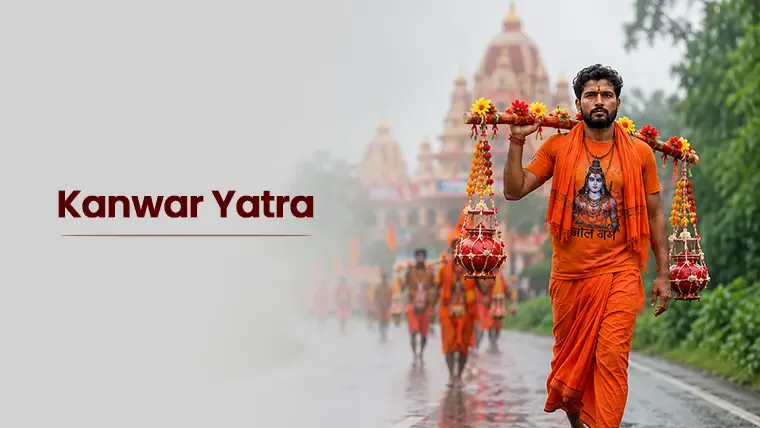
Millions of Shiva devotees travel to holy sites such as Haridwar, Gangotri, and Sultanganj during Kawad Yatra to collect Ganga jal for offerings at local temples.
Kawad Yatra 2026: Start and End Dates
Kawad Yatra Start Date: 30 July (Thursday), first day of Shravan (Sawan) Maas
Kawad Yatra End Date (Main Jal Abhishek): 11 August (Tuesday), Sawan Shivratri, the most important day for offering Ganga jal
Full Sawan Period: 30 July – 28 August (Sawan Purnima)
Auspicious Muhurat for Jal Abhishek
Performing Jal Abhishek during the right muhurat aligns your prayers with sacred cosmic energies. Choosing an auspicious time frame ensures your devotion is offered under the most favorable divine energies.
| Timing Type | Details |
|---|---|
| Sunrise | 5:48 am |
| Jal Abhishek Muhurat | 11 August, 04:54 am – 12 August, 01:52 am |
| Nishita Kaal Puja (Most Auspicious) | 12:05 am – 12:48 am (12 August); Duration: 43 minutes |
| Bhadra Kaal (Avoid if Observed) | Until 3:25 pm on 11 August |
| Labh Choghadiya | 10:47 am – 12:26 pm |
| Amrit Choghadiya | 12:56 pm – 2:06 pm |
| Auspicious Choghadiya | 3:35 pm – 5:25 pm |
| First Prahar Puja | 07:04 pm – 09:45 pm (11 August) |
| Second Prahar Puja | 09:45 pm – 12:26 am (12 August) |
| Third Prahar Puja | 12:26 am – 03:07 am (12 August) |
| Fourth Prahar Puja | 03:07 am – 05:49 am (12 August) |
| Shivratri Paran (Fast Breaking) | 12 August, after 05:49 am |
Note: Lord Shiva can be honored throughout the day. If you observe Bhadra, avoid Jalabhishek until after 3:25 pm and use the Choghadiya/Nishita Kaal windows above. Those who don't observe Bhadra can choose any auspicious slot across the full day, including the early Jal Abhishek Muhurat starting at 4:54 am. Timings are location-specific—cross-check against your local Panchang before finalizing.
Why Is Kanwar Yatra Observed? Meaning and Spiritual Significance
The Kawad Yatra holds immense spiritual and cultural importance, symbolizing profound faith, discipline, and devotion among millions of Lord Shiva’s followers.
What Is Kanwar Yatra? (Kanwar Yatra Meaning)
The term "Kanwar Yatra," sometimes spelled as Kawad Yatra or Kavad Yatra, refers to an annual religious ritual in which devotees of Lord Shiva undertake a pilgrimage in honor of their deity. Devotees, also known as Kanwariyas or Bhole, perform this ceremony with a kanwar. This is basically a wooden stick with two buckets of holy water from the River Ganga attached to its ends.
Devotees travel to places such as Haridwar, Gaumukh and Gangotri (Uttarakhand) and Sultanganj (Bihar) to fetch Gangajal. They return while carrying the Ganges water in two containers. They do so by walking long distances, sometimes even barefoot.
Religious & Mythological Significance
Samudra Manthan Connection: The Kanwar Yatra is linked to the legend of Samudra Manthan, the churning of the ocean. When the deadly poison Halahala emerged, Lord Shiva consumed it to save the universe, and his throat turned blue, earning him the name Neelkanth. Shravan is considered the month when this act is commemorated, and offering water to Lord Shiva is believed to cool his throat and honor his sacrifice.
First Kanwariya Tradition: Many traditions credit Lord Parashurama as the first to undertake a Kanwar-like journey, carrying Ganga jal to the Pura Mahadev Temple in Baghpat, Uttar Pradesh. Local folklore also speaks of a devotee named Bhagirath making a barefoot trek of roughly 105 km from Haridwar to Pura Mahadev, setting the template for the modern Kanwar Yatra.
Sawan 2026 – Full Calendar with Kawad Jal Dates
Looking for the right moments to offer your prayers this Sawan? Browse the full 2026 calendar below and talk to Astroyogi's trusted astrologers for customized ritual recommendations.
| Date | Event | Notes |
|---|---|---|
| 30 July | Sawan Maas Begins | Kanwar Yatra starts |
| 3 August | 1st Sawan Somvar | First Shravan Monday; many devotees perform Jal Abhishek |
| 10 August | 2nd Sawan Somvar | Second Shravan Monday |
| 11 August | Sawan Shivratri | Main Kanwar Yatra 2026 Jal Date |
| 17 August | 3rd Sawan Somvar | Third Shravan Monday |
| 24 August | 4th Sawan Somvar | Fourth Shravan Monday |
| 28 August | Sawan Purnima | End of Shravan month |
Kanwar Yatra Routes
There are two primary traditional Kanwar Yatra routes.
| Category | North Route (Uttarakhand–North India) | East Route (Bihar–Jharkhand) |
|---|---|---|
| Water Source | Haridwar (Har Ki Pauri) Gaumukh/Gangotri Rishikesh |
Sultanganj (Ajgaibinath Temple) Bhagalpur Bihar |
| Destination | Local Shiva temples across North India | Baidyanath Dham (Deoghar), Jharkhand — one of the 12 Jyotirlingas |
| Key States Covered | Uttarakhand Delhi Uttar Pradesh Haryana Punjab Rajasthan Himachal Pradesh |
Bihar Jharkhand Parts of West Bengal and Uttar Pradesh |
| Important Temples of Lord Shiva | Pura Mahadev (Baghpat, Uttar Pradesh) Augharnath (Meerut, Uttar Pradesh) Kashi Vishwanath (Varanasi) Neelkanth Mahadev (near Rishikesh) |
Baidyanath Dham (Deoghar) |
Popular Highways and Routes
Delhi–Moradabad (NH-24)
Delhi–Roorkee (NH-58, via Hapur, Muzaffarnagar)
Delhi–Aligarh (NH-91)
Ayodhya–Gorakhpur Highway
Prayagraj–Varanasi Highway
Kanwar Yatra History
Earliest Documented Form (1700s): Scholars trace the earliest recognizable form of the Kanwar Yatra to the 18th century, when pilgrims carried Gangajal from Sultanganj (Bihar) to the Vaidyanath Temple in Deoghar (Jharkhand).
Mythological Roots: The yatra is tied to the Samudra Manthan legend and Lord Shiva's consumption of the Halahala poison. Shravan is seen as the month to honor this act by offering cooling water to Lord Shiva.
First Kanwariya Legends: Tradition regards Parashurama as the first to perform a Kanwar-like pilgrimage, bringing Ganga jal to Pura Mahadev in Baghpat. Local folklore also credits a devotee named Bhagirath with a long barefoot trek from Haridwar to Pura Mahadev, establishing the pattern followed by devotees today.
Growth Over Time: What began as a small, localized practice grew into a mass pilgrimage through the 20th century. Today, Kanwar Yatra draws lakhs to crores of devotees across North and East India each year, making it one of the largest annual religious congregations in the country.
Tips for Kanwar Yatra & Rules
Satvik Living & Energy: Practice satvik methods and refrain from eating anything that can create an addiction tendency to maintain high-frequency spirituality and keep your chakras in balance in the month of Shravan.
Sankalp & Holy Water: Maintain the amount of kanwar water according to your Sankalp, and do not let the subtle divine energy in the holy water touch the ground.
Mantra Vibrations: Recite “Bol Bam” and “Har Har Mahadev” because Nadha (sound vibrations) will remove all obstacles from your way and put you into harmony with Lord Shiva’s consciousness.
Problem-free Journey: Follow all precautions and rules laid down by the police department.
Festival List
- Nag Panchami
- Raksha Bandhan
- Janmashtami
- Ganesh Chaturthi
- Onam
- Pitru Paksha
- Shardiya Navratri
- Durga Puja
- Dussehra
- Karwa Chauth
- Dhanteras
- Diwali
- Govardhan Puja
- Bhai Dooj
- Chhath Puja
- Tulsi Vivah
- Guru Nanak Jayanti
- Christmas
- New year
- Lohri
- Pongal
- Makar Sankranti
- Vasant Panchami
- Shivratri
- Ramadan
- Holi
- Good Friday
- Navratri
- Gudi Padwa
- Ugadi
- Vaisakhi
- Ram Navami
- Mahavir Jayanti
- Hanuman Jayanati
- Buddha Purnima
- Akshay Tritiya
- Shani Jayanti
- Guru Purnima
- Hariyali Teej