


Friday, September 4, 2026 Paksha:Krishna Tithi:Ashtami
Friday, September 4, 2026 Paksha:Krishna Tithi:Ashtami
Friday, September 4, 2026 Paksha:Krishna Tithi:Ashtami
Monday, September 7, 2026 Paksha:Krishna Tithi:Ekadashi

Wednesday, September 9, 2026 Paksha:Krishna Tithi:Trayodashi
Friday, September 11, 2026 Paksha:Shukla Tithi:Prathama
Saturday, September 12, 2026 Paksha:Shukla Tithi:Dvitiiya
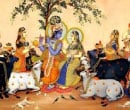
Janmashtami celebrates the birth of Lord Krishna in Mathura, observed on Krishna Paksha Ashtami, the eighth day of the waning moon, in the month of Bhadrapada. In 2026, according to the Gregorian calendar, Janmashtami falls on Friday, September 4, 2026.
Krishna Janmashtami 2026: Date, Puja Muhurat & Parana Timings
| Ritual / Tithi | Date | Time |
|---|---|---|
| 🪔 Janmashtami | September 4, 2026 | Friday |
| 🌙 Nishita Puja Muhurat | September 5 | 12:03 AM – 12:49 AM |
| ⏱️ Nishita Kaal Midpoint | September 5 | 12:26 AM |
| 🌕 Ashtami Tithi | Sep 4 – Sep 5 | 2:25 AM – 12:13 AM |
| ⭐ Rohini Nakshatra | September 4 | 12:29 AM – 11:04 PM |
| 🙏 Parana – Dharma Shastra | September 5 | After 6:10 AM |
| 🌙 Parana – Modern Tradition | September 5 | After 12:49 AM |
| 🪅 Dahi Handi | September 5, 2026 | — |
📍Location Note: The above timings are for Ujjain, Madhya Pradesh (Central India). Janmashtami Puja Muhurat, Tithi, Nakshatra, and Parana timings can vary by location. For the most accurate timings, check the local Panchang for your city.
Krishna Janmashtami Nishita Puja Muhurat in Different Cities
| City | Janmashtami Puja Muhurat | Date |
|---|---|---|
| Mumbai | 12:14 AM - 1:01 AM | September 5, 2026 |
| New Delhi | 11:57 PM - 12:43 AM | September 4-5, 2026 |
| Bengaluru | 11:55 PM - 12:42 AM | September 4-5, 2026 |
| Jaipur | 12:03 AM - 12:49 AM | September 5, 2026 |
| Kolkata | 11:13 PM - 11:59 PM | September 4, 2026 |
| Pune | 12:10 AM - 12:57 AM | September 5, 2026 |
| Hyderabad | 11:52 PM - 12:38 AM | September 4-5, 2026 |
| Chandigarh | 11:59 PM - 12:45 AM | September 4-5, 2026 |
| Chennai | 11:45 PM - 12:31 AM | September 4-5, 2026 |
| Ahmedabad | 12:16 AM - 1:02 AM | September 5, 2026 |
| Noida | 11:57 PM - 12:42 AM | September 4-5, 2026 |
| Gurgaon | 11:58 PM - 12:44 AM | September 4-5, 2026 |
Why Do Some Calendars Show Two Different Janmashtami Dates?
Every year, some calendars and temples observe Janmashtami a day apart. This isn't an error; it comes down to which tradition's rule is followed.
The Smarta tradition (Friday, 4 September 2026), followed by most householders, prioritizes the Ashtami Tithi prevailing at midnight.
The Vaishnava/ISKCON tradition (Saturday, 5 September 2026) prioritizes Ashtami Tithi combined with Rohini Nakshatra, shifting the observance a day if the two don't align.
So, what to do?
Follow the Smarta date for home traditions or your sampradaya's published date for ISKCON or Vaishnava observance.
Note: If Ashtami and Rohini overlap at midnight, that day works for both.
Astrological Significance of Janmashtami
Krishna was born in the Rohini Nakshatra on Ashtami Tithi during Krishna Paksha, in the Bhadrapada month. This combination is why Janmashtami's date and time are calculated each year astrologically instead of falling on a fixed Gregorian date. The Nakshatra Calculator can also be used to find the birth Nakshatra based on an individual's date, time, and place of birth.
His birth is seen as a moment dharma is restored whenever adharma rises unchecked, with the slaying of Kansa reflecting Vishnu's incarnation returning to reinstate it.
Sri Krishna Janmashtami Puja Vidhi
The exact Janmashtami puja procedure varies by regional and family tradition. A commonly followed sequence includes:
Puja Samagri (What You'll Need)
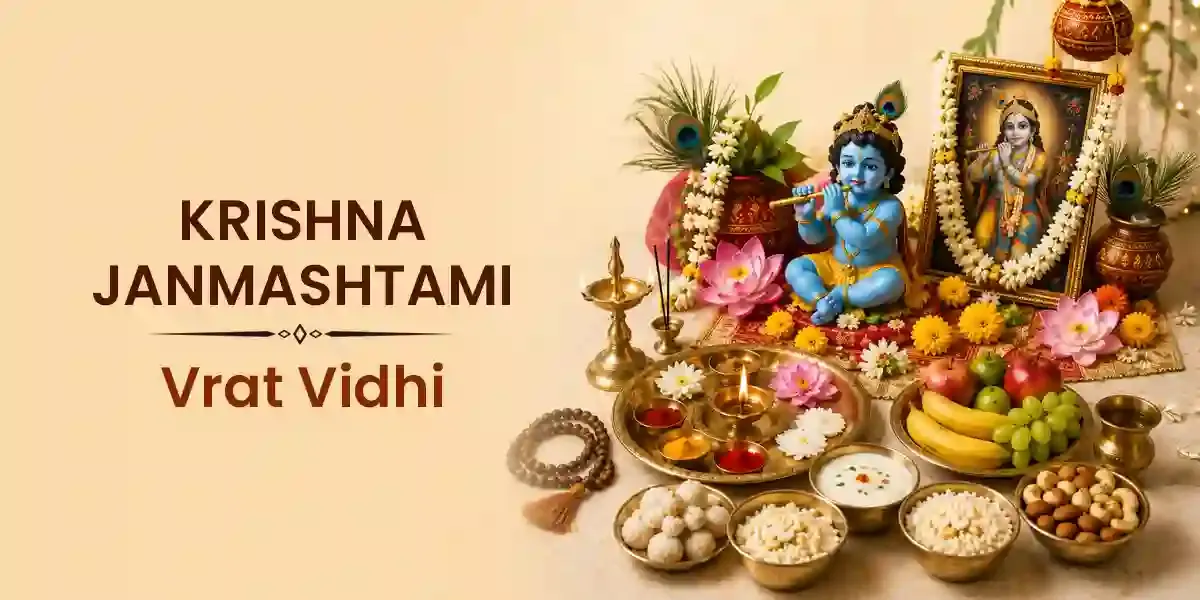
Idol of Bal Gopal, a palna or wooden chowki, Gangajal, Panchamrit ingredients, new clothes and jewelry, mor pankh, bansuri, chandan, kumkum, haldi, Tulsi leaves, flowers, incense, dhoop, an oil lamp, makhan, mishri, betel leaves and nuts, coconut, and dakshina.
Step-by-Step Puja
Bathe and wear clean clothes in the morning; the main rituals begin at night.
Decorate the palna (cradle) and clean the puja space with Gangajal, then begin with dhyana.
Place the idol on the palna, offer water at its feet (padya, arghya), then sip it (achaman).
Bathe the idol in Panchamrit, saving the mixture as prasad.
Dress the deity (shringaar), offer the janeu (a sacred thread), apply chandan, and adorn the Lord with jewelry, a crown, a mor pankh, and a bansuri.
Offer Tulsi leaves and flowers, then light incense, dhoop, and the oil lamp.
Offer bhog, especially makhan and mishri, followed by tambulam (coconut, paan, betel nuts, kumkum, and haldi) and dakshina.
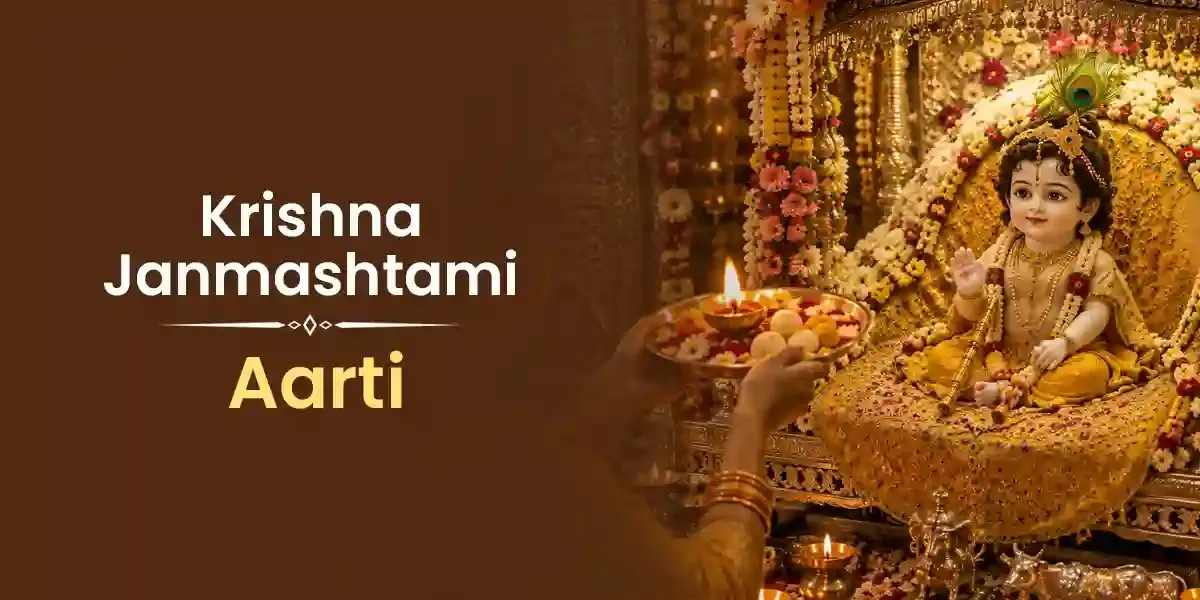
Sing the Kunj Bihari aarti, perform parikrama, and pray for your family's protection.
Vrat Vidhi: Fasting & Parana Guide
Devotees can choose their fasting method according to their health, age, and family tradition. Common forms of Janmashtami fasting include:
Nirjala vrat (no food or water, for those in good health)
Phalahar vrat (fruits, milk, and nuts through the day)
Anukalpa vrat (one sattvic meal, suited to the elderly, unwell, pregnant, or children)
Those observing the fast generally avoid grains, lentils, and other foods that are not permitted during vrat. Onion and garlic are also commonly avoided as part of a sattvic diet.
Devotees perform the main Janmashtami worship during Nishita Kaal (midnight), when Lord Krishna's birth is traditionally celebrated with prayers, offerings, and aarti. However, the fast does not necessarily have to be broken immediately after the midnight puja. In many traditions, Parana (breaking the fast) is observed on the following day after sunrise at the prescribed time. The exact Parana timing can vary according to the location, Panchang, and tradition being followed.
The Story of Krishna's Birth
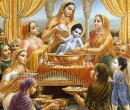
Krishna was born to Devaki and Vasudeva in Mathura, ruled at the time by Devaki's tyrant brother, Kansa. A prophecy warned Kansa that Devaki's eighth son would end his life, so he imprisoned the couple and killed each child at birth.
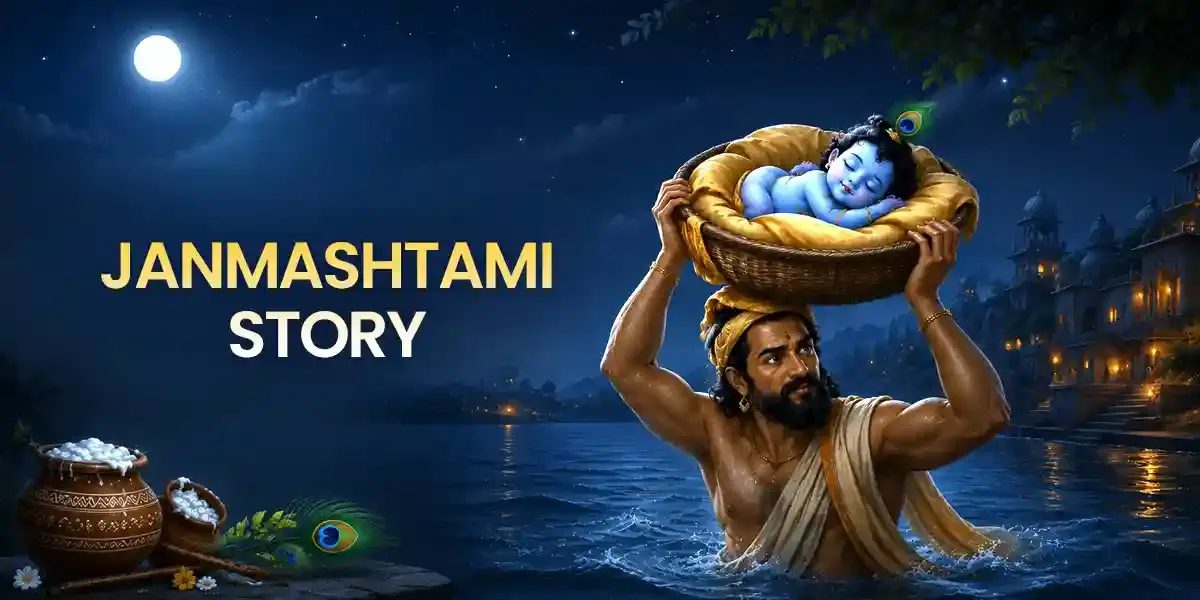
When the eighth son arrived, the palace fell into a mysterious sleep, letting Vasudeva carry the newborn through a storm to Nanda and Yashoda's home in Vrindavan, crossing the flooded Yamuna with the serpent king Shesnag shielding him from the rain.
Vasudeva swapped the infant for Yashoda's newborn daughter, believed to be Goddess Durga incarnate, tricking Kansa into thinking the prophecy had failed. Krishna grew up in Vrindavan and later returned to kill Kansa, ending his reign of terror.
What Janmashtami Teaches Us
Beyond the story, Janmashtami reflects ideas Krishna represents in the Bhagavad Gita: dharma over convenience, seen in his own birth; Nishkama Karma, acting without attachment to results, taught later to Arjuna; and bhakti as a path anyone can walk, seen in his childhood leelas of butter theft, raas leela, and the flute.
His peacock feather and flute are often read as symbols of humility and effortless surrender to the divine. Reading even a short passage from the Gita on this day is considered auspicious.
Rituals Associated with Janmashtami
Fasting: A day-long fast is commonly observed, with the method and Parana (breaking the fast) varying according to family tradition and the Panchang being followed.
Nishita Kaal Puja: The main worship takes place around midnight, known as Nishita Kaal, when the birth of Lord Krishna is traditionally celebrated with prayers, offerings, and aarti.
Bhajans and Chanting: Temples and homes resonate with devotional songs, Krishna bhajans, and chanting throughout the day and night.
Raas Leela: Performances depicting episodes from Lord Krishna's life are often organised, with children sometimes dressed as Krishna and the Gopis.
Bhog and Sweets: Makhan- and milk-based sweets, along with dry fruits and khoya, are commonly prepared and offered as bhog.
Scriptural Readings: The Bhagavad Gita, Bhagavata Purana, and other Krishna-related scriptures may be read or recited as part of the celebrations.
Janmashtami Across India & the World
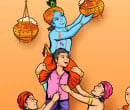
Maharashtra & Karnataka: Dahi Handi, where teams form human pyramids to break a pot of curd, re-enacting young Krishna's love of stolen butter.
Uttar Pradesh (Mathura & Vrindavan): The heart of the festival, with all-night temple celebrations and midnight aartis at Krishna Janmabhoomi and Banke Bihari Temple.
Gujarat (Dwarka): Grand celebrations at Dwarkadhish Temple, Krishna's later kingdom.
South India: Homes decorated with footprints leading to the puja area; Uriadi, a similar pot-breaking game, is popular in Tamil Nadu.
Odisha & West Bengal: Fasting rituals and readings from the Bhagavata Purana.
Outside India: ISKCON temples hold night-long kirtans and live-streamed celebrations.
Janmashtami Dates from 2027 to 2032
| Year | Day | Date |
|---|---|---|
| 2027 | Wednesday | August 25 |
| 2028 | Sunday | August 13 |
| 2029 | Saturday | September 1 |
| 2030 | Wednesday | August 21 |
| 2031 | Saturday | August 9 |
| 2032 | Saturday | August 28 |
| 2033 | Wednesday | August 17 |
To know the exact muhurat, the right vrat approach for your health, or what this Janmashtami means for your chart, connect with Astroyogi astrologers right away.
Festival List
- Nag Panchami
- Raksha Bandhan
- Janmashtami
- Ganesh Chaturthi
- Onam
- Pitru Paksha
- Shardiya Navratri
- Durga Puja
- Dussehra
- Karwa Chauth
- Dhanteras
- Diwali
- Govardhan Puja
- Bhai Dooj
- Chhath Puja
- Tulsi Vivah
- Guru Nanak Jayanti
- Christmas
- New year
- Lohri
- Pongal
- Makar Sankranti
- Vasant Panchami
- Shivratri
- Ramadan
- Holi
- Good Friday
- Navratri
- Gudi Padwa
- Ugadi
- Vaisakhi
- Ram Navami
- Mahavir Jayanti
- Hanuman Jayanati
- Buddha Purnima
- Akshay Tritiya
- Shani Jayanti
- Guru Purnima
- Hariyali Teej
Talk to Astrologers
View All




FAQ
Janmashtami 2026 will be celebrated on Friday, September 4, 2026. It falls on the eighth day of the waning moon, in the month of Bhadrapada. The exact timing may vary based on your location and the local Hindu calendar.
Devotees usually observe a strict fast on Janmashtami, which involves abstaining from food and sometimes water until midnight—the time when Lord Krishna was born. Some people may opt for a partial fast, consuming fruits or milk. The fast is broken after performing the midnight puja and singing devotional songs.
Janmashtami is celebrated with great enthusiasm across India and worldwide. Devotees fast, decorate temples, perform puja and aarti at midnight, and sing bhajans praising Lord Krishna. Dramatic reenactments of Krishna’s life called ‘Raas Leela’ are organized, and children often dress up as Krishna and Radha. In many places, the Dahi Handi event—breaking a pot of curd hung high—is held symbolizing Krishna’s childhood antics.
The Dahi Handi ritual celebrates Lord Krishna’s playful and mischievous nature as a child. Krishna loved stealing butter and curd, and the ritual involves hanging a pot filled with yogurt or butter high up, which teams try to break by forming human pyramids. It symbolizes unity, teamwork, and devotion, and is especially popular in Maharashtra and other parts of India during Janmashtami.