

Navratri Colours 2026: 9 Days Color, Dates and Goddess
Navratri colors are one of the most loved traditions of the nine-day festival. Every year, millions of people plan their outfits, jewelry, and even home decor around the color of the day.
Read ahead to learn about Navratri colors 2026 date by date, learn the significance of the Navratri colors, and answer the most common question asked during the festival: what is today's Navratri color?
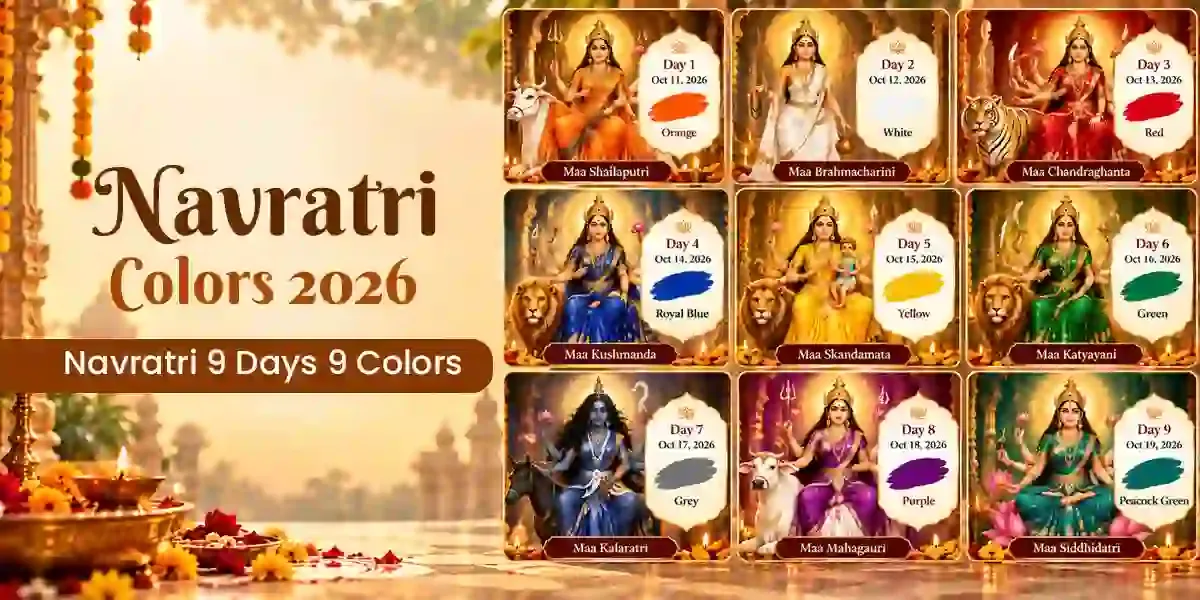
Navratri Colors 2026 With Date
Sharad Navratri 2026 begins on Sunday, October 11, and ends on Monday, October 19. Since the festival starts on a Sunday, the nine colors of Navratri follow a fixed weekday-based sequence this year.
| Day | Date & Day | Navratri Color | Goddess |
|---|---|---|---|
| 1 | October 11, Sunday | 🟠Orange | Goddess Shailputri |
| 2 | October 12, Monday | ⚪White | Goddess Brahmacharini |
| 3 | October 13, Tuesday | 🔴Red | Goddess Chandraghanta |
| 4 | October 14, Wednesday | 🔵Royal Blue | Goddess Kushmanda |
| 5 | October 15, Thursday | 🟡Yellow | Goddess Skandamata |
| 6 | October 16, Friday | 🟢Green | Goddess Katyayani |
| 7 | October 17, Saturday | ⚫Grey | Goddess Kalaratri |
| 8 | October 18, Sunday | 🟣Purple | Goddess Mahagauri |
| 9 | October 19, Monday | 🦚Peacock Green | Goddess Siddhidatri |
Vijayadashami, or Dussehra, falls the next day, on Tuesday, October 20, 2026.
How the Navratri 9-Day Color Sequence Is Decided
The Navratri days' color list is not random. It is tied to the weekday on which Ghatasthapana, the first day of the festival, falls. Each weekday has a planet and a color linked to it in Vedic tradition.
Sunday is ruled by the Sun and carries Orange. Monday belongs to the Moon and carries White. Tuesday is ruled by Mars and carries Red. Wednesday belongs to Mercury and carries Royal Blue. Thursday is ruled by Jupiter and carries Yellow. Friday belongs to Venus and carries Green. Saturday is ruled by Saturn and carries Grey.
Since Navratri runs for nine days across a seven-day week, the last two days pick up the two remaining shades from the traditional nine-color palette: Purple and Peacock Green. Because Sharad Navratri 2026 opens on a Sunday, the sequence naturally begins with Orange and moves through the week in order.
To understand how these planetary alignments impact your personal horoscope during the festive season, consider consulting with verified astrologers from Astroyogi for personalized guidance.
Meaning of Navratri Colors: Day By Day
Day 1: Orange, Date: 11th October (Sunday)
The first day of Navratri is dedicated to Goddess Shailputri. The color orange is symbolic of Ghatasthapana (the ritual to mark the beginning of the festival). This color represents enthusiasm and vibrancy, which is in sync with the ruling planet of the day, the Sun.
Day 2: White, Date: 12th October (Monday)
The second day is devoted to Goddess Brahmacharini. White color signifies peace and calmness and is related to the mind, which is governed by the Moon, the ruling planet of the day.
Day 3: Red, Date: 13th October (Tuesday)
The third day is celebrated in honor of Goddess Chandraghanta. The color red is symbolic of courage and power, which is related to the planet Mars, the ruling planet of the week.
Day 4: Royal Blue, Date: 14th October (Wednesday)
The fourth day is dedicated to Goddess Kushmanda. The color royal blue represents depth and sophistication, which is associated with Mercury, the planet governing Wednesday.
Day 5: Yellow, Date: 15th October (Thursday)
The fifth day is celebrated in honor of Goddess Skandamata. The color yellow signifies joy and positivity and is connected to Jupiter, the ruling planet of Thursday.
Day 6: Green, Date: 16th October (Friday)
The sixth day is devoted to Goddess Katyayani. The color green represents growth and harmony and is associated with Venus, the ruling planet of the day.
Day 7: Grey, Date: 17th October (Saturday)
The seventh day is celebrated in honor of Goddess Kalaratri. The color grey is symbolic of balance and protection, which is connected to Saturn, the ruling planet of Saturday.
Day 8: Purple, Date: 18th October (Sunday)
The eighth day is dedicated to Goddess Mahagauri. The color purple represents elegance and devotion, which is related to the planet Neptune, signifying the end of the cycle of nine days.
Day 9: Peacock Green, Date: 19th October (Monday)
The ninth day is celebrated in honor of Goddess Siddhidatri, which is known as Maha Navami. The color peacock green is a mixture of green and teal and is associated with completion and accomplishment.
Significance of Navratri Colors
The above-mentioned colors are related to the days of the week, the ruling planet, and the particular deity to which the day is dedicated. The significance of Navratri colors ranges from energy (symbolized by orange), peace (symbolized by white), power (symbolized by red), and so on. Moreover, the ruling planet of the day has also been related to the color spectrum in the human body. Hence, the significance of Navratri colors is not limited to fashion statements but extends to health and positivity.
The importance of wearing Navratri colors is immense, as they play a significant role in enhancing the positivity and power of an individual. Especially on the occasions of Navratri, it is essential to dress oneself according to the color of the day in order to channel one’s energy.
Why Navratri Colors Change Every Year
The starting color depends entirely on which weekday Pratipada falls on that year. Since Sharad Navratri 2026 begins on a Sunday, Orange opens the list. In another year, a different starting weekday would shift the entire nine-color sequence.
The Goddess order, known as the Navadurga sequence, never changes. Only the color list shifts based on the calendar, which is why checking the exact year and date matters more than memorizing a fixed color chart.
Quick FAQs on Navratri Colors 2026
Is wearing the Navratri color compulsory?
No. It is a popular cultural practice, not a mandatory ritual. Clothing, accessories, or home decor in the day's shade are all optional ways to join in.
What color is Ghatasthapana in 2026?
Orange, since Ghatasthapana falls on Sunday, October 11, 2026.
Do Navratri colors stay the same in every region?
Not always. Some regions and communities follow slightly different color traditions, though the weekday-based nine-color list is the most widely followed version.
Can men and children follow this tradition too?
Yes. A simple accessory, scarf, or bracelet in the day's color is enough to take part.
Final Thoughts
The nine colors of Navratri offer a simple, visual way to follow the festival day by day. From the Orange energy of Day 1 to the Peacock Green grace of Day 9, each shade tells its own small story tied to a Goddess, a planet, and a mood.
Keeping the Navratri 2026 colors with dates handy makes it easy to plan outfits and decor without any last-minute confusion.
Team Astroyogi is an experienced in-house editorial team of passionate writers, researchers, and astrology enthusiasts dedicated to making ancient divination sciences more accessible and meaningful in everyday life. With years of collective experience in creating insightful astrology and spirituality content, the team specializes in simplifying complex spiritual concepts into practical guidance for readers seeking clarity, balance, and personal growth. The Astroyogi editorial team possesses expertise across a wide range of subjects, including Indian Astrology, Vedic Astrology, Planetary Transits, Horoscope Analysis, Vastu Shastra, Numerology, Tarot, Spiritual Wellness, and Ritual Practices. Every piece of content is carefully researched, fact-checked, and crafted with the intention of offering reliable, insightful, and easy-to-understand guidance rooted in traditional wisdom. Driven by a commitment to authenticity and reader trust, Team Astroyogi strives to create content that empowers individuals to navigate life’s opportunities and challenges with confidence, positivity, and inner peace. Their mission is to bridge ancient astrological knowledge with modern-day relevance, helping readers make informed decisions and lead more harmonious lives.