
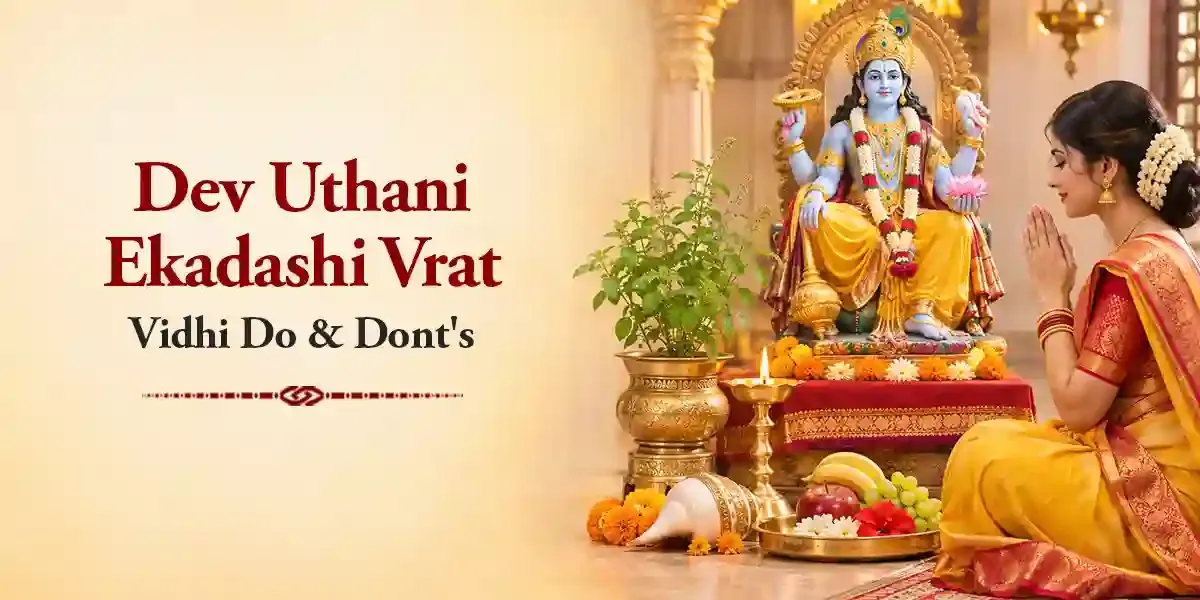

Dev Uthani Ekadashi Vrat Vidhi: Complete Fasting Rules, Do’s and Don’ts
Dev Uthani Ekadashi is observed to honor Lord Vishnu as he awakens after Chaturmas. The vrat includes a sankalpa, a fast kept according to personal capacity, worship of Lord Vishnu, devotional chanting, charity, a night vigil, and parana on Dwadashi.
Read ahead to learn more about the Dev Uthani Ekadashi fast and its rules in simple steps, along with the do's and don'ts for a correct and safe observance.
Fasting and ritual practices may vary by region, family tradition, and sampradaya. The guidance that applies to the family or lineage followed should be preferred.
How to Begin the Dev Uthani Ekadashi Vrat
The vrat starts a day early with simple preparation on Dashami.
- Take one light meal in the afternoon on Dashami.
- Avoid a grain-based meal at night so that the fast begins without residual grains from the previous day.
- Begin the fast at local sunrise on Ekadashi, not at the start time of the tithi.
- Bathe and wear clean clothes.
- Clean the puja space and the tulsi area.
- Decide the type of fast according to health and capacity.
Sankalpa for the Vrat
Sankalpa is a simple vow of intention. It marks the fast as a conscious spiritual observance and not just a break from food.
How to take the sankalpa
- Sit before an image, murti, or Shaligram of Lord Vishnu.
- Hold a little water in the right palm.
- State the intention to observe the Dev Uthani Ekadashi vrat.
- Name the type of fast to be followed.
- Offer the water respectfully and begin the vrat with devotion.
A simple line to begin with is "Om Shri Vishnave Namah."
Dev Uthani Ekadashi Fasting Rules
The Dev Uthani Ekadashi fasting rules allow four accepted forms of fasting. The choice should match health, routine, and physical strength. A strict fast is not compulsory for everyone.
The table below lists the four forms and who each one suits.
| Fast Type | What It Involves | Suitable For |
|---|---|---|
| Jalahar | Only water is consumed; no food is taken. | Healthy and experienced devotees |
| Ksheerbhoji | Milk and milk products | Those unable to keep a dry fast |
| Phalahari | Fruit-based fast; leafy vegetables are avoided. | A widely followed option for household observance |
| Naktabhoji | One grain-free meal before sunset | Beginners, working people, and those needing a lighter vrat |
The vrat is observed throughout Ekadashi, beginning at local sunrise. It is broken on Dwadashi at the prescribed parana time.
Also read: Dev Uthani Vrat Katha
What to Eat During the Dev Uthani Ekadashi Fast
Those not observing a water-only fast may eat simple sattvic, grain-free food according to the chosen vrat type.
For a phalahari fast
- Fresh fruits such as mango, grapes, and banana
- Dry fruits and nuts such as almonds and pistachios
- Leafy vegetables are avoided in a phalahari fast
Milk and milk products are primarily associated with a ksheerbhoji fast. Some households include them in a phalahari observance according to family tradition, but they are not a defining part of the phalahari fast.
For a naktabhoji fast
- One grain-free meal taken before sunset, according to family tradition
- Sabudana, singhara, potato, sweet potato, and groundnuts
- Makhana, which is also commonly used in many household vrat traditions
Foods with debated validity
Kuttu and samak are often used during Ekadashi. They are considered semi-grains or pseudo-grains, so their validity is debated. Avoiding them is the safer choice.
What Not to Eat During the Dev Uthani Ekadashi Fast
Avoiding grains is the most important food rule of Ekadashi. The following are avoided throughout the entire day:
- Rice
- Wheat and wheat products
- All other grains and cereals
- Beans
- Pulses and dals
- Leafy vegetables, in a phalahari fast
- Onion and garlic
- Meat, fish, and eggs
- Alcohol and tobacco
- Regular table salt, where sendha namak is used
- Honey, in many Ekadashi traditions
- Stale, impure, or tamasic food
Do's During the Dev Uthani Ekadashi Vrat
- Take a clear sankalpa before beginning the vrat.
- Begin the fast at local sunrise.
- Choose a fast that suits health and capacity.
- Worship Lord Vishnu with tulsi, flowers, a diya, and bhog.
- Chant Vishnu mantras or recite stotras.
- Listen to the Ekadashi katha or sing bhajans.
- Observe a night vigil if health and circumstances permit.
- Keep a calm, truthful, and sattvic mindset.
- Avoid anger, gossip, harsh speech, and conflict.
- Give daan of food, clothes, blankets, money, or other useful items.
- Break the fast only on Dwadashi, after sunrise and after Hari Vasara ends.
- Check the parana time for the local city.
Don'ts During the Dev Uthani Ekadashi Vrat
- Do not start the fast based only on the tithi start time.
- Do not break the fast during Hari Vasara.
- Avoid parana during Madhyahna; if Pratahkal is missed, perform parana after Madhyahna.
- Do not delay parana beyond Dwadashi as per the local panchang.
- Do not use another city's parana timing.
- Do not force a strict fast during illness, pregnancy, nursing, old age, or regular medication.
- Do not treat Tulsi Vivah and Dev Uthani Ekadashi as the same ritual.
Vishnu Puja During the Vrat
Puja is an important part of the vrat. Fasting discipline, devotional conduct, and correct parana are equally important.
What to do
- Light a ghee diya before Lord Vishnu.
- Offer water, flowers, akshat, and tulsi leaves.
- Offer bhog or prasad.
- Chant Vishnu mantras.
- Perform aarti and distribute prasad.
Simple mantras
- Om Namo Bhagavate Vasudevaya
- Om Shri Vishnave Namah
- Om Namo Narayanaya
Tulsi leaves should be plucked the evening before Ekadashi, since plucking them on the day itself is avoided.
Night Vigil and Devotional Practices
Many devotees observe jagaran through devotion. The night is spent in remembrance of Lord Vishnu.
What to do
- Listen to the Dev Uthani Ekadashi katha or Vishnu katha.
- Sing bhajans of Lord Vishnu or Lord Krishna.
- Chant Vishnu mantras.
- Read the Vishnu Sahasranama or another preferred scripture.
- Spend quiet time in prayer.
- Avoid unnecessary entertainment, arguments, and distractions.
If staying awake is not possible, the puja and prayers can be completed in the evening, followed by rest. Devotion matters more than physical strain.
Parana: How to Break the Dev Uthani Ekadashi Fast
Parana is the act of breaking the Ekadashi fast. It is one of the most important parts of the vrat.
Parana rules
- Parana is done after sunrise on the day after Ekadashi.
- It must be completed within Dwadashi, according to the local panchang.
- Parana is not done during Hari Vasara, the first one-fourth of Dwadashi.
- The most preferred time is Pratahkal, the morning period.
- Parana is avoided during Madhyahna; if Pratahkal is missed, it is done after Madhyahna.
- In case of urgency, parana may be done once Hari Vasara ends, though waiting a few hours after it is considered more appropriate.
How to break the fast
- Bathe or cleanse the body, if possible.
- Offer water and prayers to Lord Vishnu.
- Begin with a tulsi leaf and charanamrit, if customary.
- Eat a light, simple meal such as khichdi, rice and dal, or roti and sabzi.
- Avoid overeating right after the fast.
What to Do If the Fast Is Broken by Mistake
If the fast is broken unintentionally, seeking forgiveness from Lord Vishnu with sincere atonement is advised. The devotee should also resolve not to repeat the mistake.
The traditional prayer is:
Mantrahinam Kriyahinam Bhaktihinam Janardana,
Yatpujitam Maya Deva Paripurna Tadastu Me.
A short apology can also be offered: "Om Shri Vishnave Namah, Kshama Yachanam Samarpayami."
Sample Dev Uthani Ekadashi Vrat Routine
This routine gives a simple view of the vrat from Dashami to Dwadashi.
| Time | Observance |
|---|---|
| Dashami afternoon | One light meal, with no grain-based dinner at night |
| Ekadashi sunrise | Begin the vrat with sankalpa and Vishnu puja |
| Daytime | Follow the chosen fast: jalahar, ksheerbhoji, phalahari, or naktabhoji |
| Evening | Worship Lord Vishnu and Goddess Lakshmi, perform aarti, and offer bhog |
| Night | Katha, kirtan, Vishnu japa, and vigil if possible |
| Dwadashi | Break the fast after sunrise and after Hari Vasara, preferably in Pratahkal |
Break the fast after sunrise and after Hari Vasara, preferably in Pratahkal
FAQs
Can the vrat be observed while traveling?
Yes. A lighter vrat can be kept with a simple Vishnu puja and mantra chanting. The fast is then broken at the correct local parana time. A full puja setup is not required for sincere observance.
What if grains are eaten accidentally?
Forgiveness is sought from Lord Vishnu with sincere atonement. The prayer for unintentional fast breakage can be recited, along with a resolve not to repeat the mistake.
Can the vrat be observed without a full puja?
Yes. The essentials are sankalpa, fasting discipline, remembrance of Lord Vishnu, and correct parana. A simple puja is enough when a full ritual is not possible.
Is staying awake at night compulsory?
No. The night vigil is a devotional practice and not a requirement for everyone. The evening puja can be performed, followed by rest.
Is water allowed during the vrat?
Water is allowed in most forms of the vrat. In a jalahar fast, only water is consumed. The fasting type should be chosen according to health, routine, and capacity.
Can the fast be broken with tea or coffee?
A simple, traditional meal after the correct parana time is preferable. Tea or coffee alone is not considered an ideal parana.
What if the parana window is missed?
Parana should be completed within Dwadashi according to the local panchang. If the suitable window has passed, the fast is broken as soon as reasonably possible rather than extended unnecessarily. If Dwadashi has ended, the guidance of the local tradition applies.
Team Astroyogi is an experienced in-house editorial team of passionate writers, researchers, and astrology enthusiasts dedicated to making ancient divination sciences more accessible and meaningful in everyday life. With years of collective experience in creating insightful astrology and spirituality content, the team specializes in simplifying complex spiritual concepts into practical guidance for readers seeking clarity, balance, and personal growth. The Astroyogi editorial team possesses expertise across a wide range of subjects, including Indian Astrology, Vedic Astrology, Planetary Transits, Horoscope Analysis, Vastu Shastra, Numerology, Tarot, Spiritual Wellness, and Ritual Practices. Every piece of content is carefully researched, fact-checked, and crafted with the intention of offering reliable, insightful, and easy-to-understand guidance rooted in traditional wisdom. Driven by a commitment to authenticity and reader trust, Team Astroyogi strives to create content that empowers individuals to navigate life’s opportunities and challenges with confidence, positivity, and inner peace. Their mission is to bridge ancient astrological knowledge with modern-day relevance, helping readers make informed decisions and lead more harmonious lives.