



Wednesday, October 14, 2026 Paksha:Shukla Tithi:Chaturthi
Thursday, October 15, 2026 Paksha:Shukla Tithi:Panchami

Friday, October 16, 2026 Paksha:Shukla Tithi:Shashthi

Friday, October 16, 2026 Paksha:Shukla Tithi:Shashthi

Friday, October 16, 2026 Paksha:Shukla Tithi:Shashthi
Friday, October 16, 2026 Paksha:Shukla Tithi:Shashthi
Friday, October 16, 2026 Paksha:Shukla Tithi:Shashthi
Saturday, October 17, 2026 Paksha:Shukla Tithi:Saptami

Saturday, October 17, 2026 Paksha:Shukla Tithi:Saptami
Saturday, October 17, 2026 Paksha:Shukla Tithi:Saptami
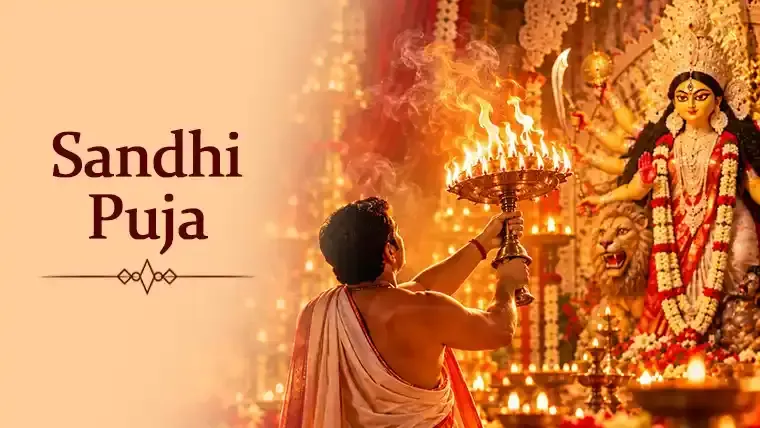
Sandhi Puja is one of the most precisely timed rituals of Durga Puja 2026. It takes place during a strict 48-minute window marking the exact alignment between Maha Ashtami and Maha Navami.
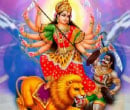
During this spiritually charged event of Sharad Navratri, devotees worship Goddess Durga in her fierce avatar as Goddess Chamunda—the slayer of the demons Chanda and Munda.
Because this brief shift is considered the most sacred and powerful moment of the festival, devotees prepare thoughtfully to observe it with absolute devotion and focus.
Sandhi Puja 2026 Date and Shubh Muhurat
Sandhi Puja follows the lunar tithi calendar rather than a fixed solar date, so its timing shifts every year and varies by location.
| Detail | Information |
|---|---|
| Sandhi Puja 2026 date | Monday, October 19, 2026 |
| Sandhi Puja muhurat (New Delhi) | Approximately 10:28 AM to 11:16 AM IST |
| Ashtami to Navami junction | Approximately 10:52 AM IST |
| Last 24 minutes of Ashtami | Approximately 10:27 AM to 10:52 AM |
| First 24 minutes of Navami | Approximately 10:52 AM to 11:15 AM |
Some panchang calculations show a slightly different range, such as 10:29 AM to 11:17 AM, due to differences in astronomical calculations, location coordinates, ayanamsa, and rounding.
The timing is not identical throughout India. A Sandhi Puja schedule prepared for New Delhi may differ from the timing observed in Kolkata, Mumbai, Bengaluru, Dhaka, London, or New York, since tithi timings depend entirely on the observer's location. Checking today's Panchang closer to the festival date helps confirm the exact local Muhurat.
What Is Sandhi Puja?
The Sanskrit word "sandhi" means "junction," "meeting point," or "transition." Sandhi Puja is the worship performed at the exact transition between Ashtami, the eighth lunar day, and Navami, the ninth lunar day. The total duration is traditionally described as two ghatis, equal to roughly 48 minutes. It is not a general evening prayer or an ordinary Navratri observance. Its defining feature is the precise lunar tithi transition, which sets it apart from other rituals of the festival.
In Durga Puja, this moment is regarded as especially powerful because it symbolizes the point where one phase ends and another begins. Ashtami changes into Navami, darkness gives way to light, fear is overcome by courage, and disorder is defeated by divine power. The devotee is understood to move from spiritual struggle toward victory during this brief interval.
Sandhi Puja Vidhi
The exact procedure differs between temples, households, and regional traditions, but a general structure is widely followed.
Cleaning the puja area and altar before the muhurat begins.
Bathing and wearing clean or traditional clothing.
Placing a clean red or yellow cloth on the altar and arranging the image of Goddess Durga or Goddess Chamunda.
Keeping lamps, incense, flowers, fruits, rice, vermilion, sandalwood, and naivedya ready in advance.
Making a formal sankalpa that states the devotee's name, place of worship, date, tithi, and purpose of the puja.
Invoking Lord Ganesha, the guru or lineage, and Goddess Durga before the main worship begins.
Invoking the Goddesses Durga, Chandika, Kali, and Chamunda.
Lighting 108 earthen lamps, known in Bengal as pradip, where practical.
Offering 108 lotus flowers where available, along with red hibiscus, bel leaves, and other seasonal flowers.
Reciting the Navarna mantra or listening to the Chanda Munda episode from the Devi Mahatmya.
Performing a homa or fire offering only where a trained priest and proper ventilation are available.
Concluding with arati, conch blowing, bell ringing, and distribution of prasad.
Note: Some Shakta temples also include a symbolic Bali using items such as pumpkin, sugarcane, coconut, or lemon. This practice is not universal, and many households and temples rely entirely on symbolic offerings rather than any form of sacrifice.
Sandhi Puja Mantra
The mantra most closely associated with Sandhi Puja is the Navarna Mantra, also called the Navakshari mantra.
ॐ ऐं ह्रीं क्लीं चामुण्डायै विच्चे
Om Aim Hreem Kleem Chamundayai Vichche.
This mantra invokes Goddess Chamunda to destroy ignorance, fear, and negative forces. Because its core syllables are sacred sounds (bijas), they are meant to be chanted rather than literally translated.
Other common chants for protection and wisdom include "Om Dum Durgayai Namah" and "Om Aim Hreem Kleem Chamundayai Namah." Devotees without formal initiation can also recite the Durga Saptashati, Devi Kavacham, or the simple "Om Durga Namah."
Why Is Sandhi Puja Celebrated?
Sandhi Puja celebrates the manifestation of Goddess Durga's fierce form, Goddess Chamunda, and the destruction of the demons Chanda and Munda. According to the Devi Mahatmya, also known as the Durga Saptashati, the Goddess was engaged in battle against the forces of Shumbha and Nishumbha.
A terrifying form of divine energy, commonly identified as Goddess Kali, emerged from the brow of the Goddess and destroyed the demon generals Chanda and Munda. After this victory, the Goddess became known as Chamunda, a name formed by combining Chanda and Munda.
Sandhi Puja therefore reflects the victory of divine consciousness over destructive forces. In devotional meaning, the demons may also represent inner difficulties such as anger, pride, aggression, fear, attachment, ignorance, and uncontrolled desire. The ritual asks the Goddess to remove weaknesses within the devotee, not only to defeat obstacles from the outside.
Significance of Sandhi Puja
Sandhi Puja is performed on the junction where two states meet. Since the existing state has ended and the next has not begun yet, this short time is considered highly auspicious for meditation, worship, and making offerings.
In fact, the rite is believed to have been performed by the Goddess when she took the form of Chamunda to slay the demons Chanda and Munda. Additionally, the invocation of Chamunda during Sandhi Puja is supposed to protect the believer from dangers and misfortunes.
Furthermore, through the worship of Chamunda, the devotee gains the strength to slay inner demons and ego by undergoing intense meditation and offering complete devotion to the Goddess.
Moreover, due to the precise and narrow time window when the Sandhi Puja needs to be performed, it is believed to take the worshipper to a different plane of consciousness.
Sandhi Puja History and Legends
The ritual of Sandhi Puja has been derived from the Devi Mahatmya, where the stories of the Goddess slaying the demons have been narrated. In fact, it is the seventh chapter of the Devi Mahatmya that describes the appearance of Goddess Chamunda and her slaying of the demons Chanda and Munda. It is also this episode that is traditionally chanted or recited during the Sandhi period in the Shakta tradition of Bengal, where the Chandi Path is performed.
This story appears to have acquired great popularity over time since the very legend of the fight between the Mahishasura and the Devi came to be associated with the Ashtami to Navami transition. Indeed, Sandhi Puja came to be considered an integral part of the Durga Puja with its own specific rituals that fall between Maha Ashtami and Maha Navami and are followed by Vijayadashami (the day of victory) when the image of the Goddess is dismantled.
Sandhi Puja Benefits
Traditional beliefs attribute a number of benefits to Sandhi Puja. These are spiritual and devotional beliefs rather than medically or scientifically guaranteed outcomes.
Protection from danger and negativity.
Strength during periods of crisis.
Removal of obstacles.
Courage and confidence.
Peace within the family.
Health and general well-being.
Spiritual discipline and clarity of mind.
Freedom from fear and harmful habits.
From a practical and psychological perspective, participating in a structured ritual can create time for reflection, community connection, gratitude, and focused attention. Sandhi Puja should not be treated as a replacement for medical care, mental health support, legal advice, or other professional assistance.
How to Do Sandhi Puja at Home
A safe home Sandhi puja can be simple.
Before the 48-minute window, clean the puja area, place an image of Goddess Durga or Goddess Chamunda on a clean altar, and keep the lamps, flowers, fruits, water, incense, rice, and sweets handy. You will also have to learn the local Sandhi period in your city or town in advance from a panchang or priest.
Once the window opens, you can start with the sankalpa, chanting Lord Ganesha and Goddess Durga, and the Navarna mantra or simple mantras for Goddess Durga. You can also offer flowers and rice, sandal paste, and vermilion to the Goddess.
It is customary to light 108 lamps if possible, but even a single lamp with devotion, love, faith, and belief can also be effective. You can also give a lotus or red flower if available, some fruits and sweets, and water. The puja concludes with arati and prayers for the protection, power, knowledge, and welfare of all living beings, and distribute prasad. Remember not to leave burning lamps or incense unattended, and avoid indoor fire rituals without a trained priest with adequate ventilation and safety measures.
Sandhi Puja FAQs
When is Sandhi Puja in 2026?
The Sandhi Puja in New Delhi, India, in 2026 will be on Monday, October 19, at around 10:28 AM to 11:16 AM IST. The local muhurat may vary slightly in your city or town, so it is best to check with a panchang or priest.
Is Sandhi Puja done on Ashtami or Navami?
The Sandhi Puja falls on the last 24 minutes of Ashtami and the first 24 minutes of Navami, so it is observed on both days.
Why is Sandhi Puja 48 minutes?
The junction period is called "dwi ghati" in Hindu tradition, and so it is 48 minutes long because one ghati is equal to 24 minutes.
Do we need to light 108 lamps during the Sandhi Puja?
No, there is no rule that we have to light 108 lamps. But it is traditional for Bengalis to do so during the Durga Puja, and it may be symbolic and significant. But you can also offer a simple lamp with as much devotion and faith as you can.
Are 108 lotuses necessary?
No. Offering 108 lotus flowers is traditional where available, but any clean, available flower offered according to family custom is acceptable.
Is Sandhi Puja the same as Maha Ashtami Puja?
No. Maha Ashtami Puja can continue through much of the day and includes pushpanjali and Kumari Puja, while Sandhi Puja is a highly time-sensitive 48-minute ritual focused on Goddess Chamunda.
Is Sandhi Puja the same as Kanya Puja?
No. Kanya Puja worships young girls as manifestations of the Goddess, while Sandhi Puja is the time-specific Ashtami-to-Navami junction ritual. Both may occur during the same broader Durga Puja period but remain distinct observances.
Plan Your Sandhi Puja with Expert Guidance
Observing Sandhi Puja at the correct muhurat, with sincere preparation, is considered central to receiving its spiritual benefits. For a personalized muhurat suited to a specific city, guidance on the correct vidhi for a household setting, or any other puja-related question, Astroyogi's astrologers bring more than 25 years of trusted experience to draw on.
A quick way to get started is to consult an Astroyogi astrologer for tailored guidance ahead of the festival.