

Kali Mata Story: Goddess Kali's Battle with Raktabija and Her Divine Origins
The Kali Mata story is the tale of the fiercest form of the Divine Mother in Hinduism. Goddess Kali Mata is the goddess of time, death, and protection. Her story is told chiefly in the Devi Mahatmyam, a sacred text that narrates the victories of the Goddess over evil.
The Goddess Kali Story: Kali and the Demon Raktabija
The best-known Ma Kali katha is the battle against the demon Raktabija. It unfolds in these steps:
- The gods are losing to the demon Raktabija, who holds a terrible boon. Every drop of his blood that touches the ground creates a new Raktabija.
- Each wound only multiplies him. One cut makes two demons, and soon millions of identical demons fill the battlefield.
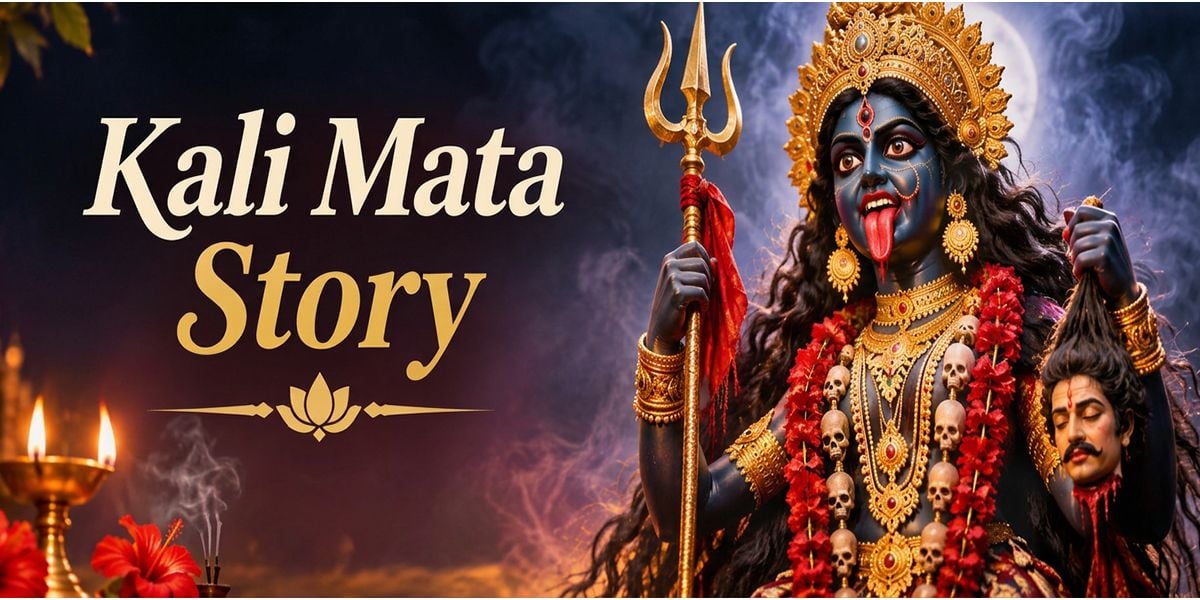
- Goddess Durga's fury darkens her face. From her brow springs Goddess Kali, dark and gaunt, with red eyes, a garland of skulls, and a sword and noose in hand.
- Goddess Kali spreads her vast mouth across the battlefield. She drinks every drop of blood before it can touch the earth and swallows the clones as fast as they appear.
- She seizes Raktabija and drains him completely. The demon falls, and his boon is defeated by the Mother's own strategy.
- Drunk on victory, Goddess Kali begins a dance of destruction that will not stop. The three worlds tremble.
- Lord Shiva lies down on the battlefield in her path. As she steps on his chest, she recognizes her husband. Shocked and ashamed, she bites her tongue, and her fury dissolves.
The universe is saved in that single moment of stillness.
Other Origin Stories of Goddess Kali
The Hindu scriptures describe more than one birth for Goddess Kali. Each story shows a different side of the Mother.
Devi Mahatmyam, Chanda, and Munda: The demons Chanda and Munda attacked Goddess Durga, and her anger turned her face dark. Goddess Kali burst from her brow and slew both demons. Goddess Durga then named her Chamunda, meaning the slayer of Chanda and Munda.
Devi Mahatmyam, Chapter 1: Goddess Mahakali appears as Yoga Nidra, the cosmic sleep of Lord Vishnu. She withdraws so that Lord Vishnu can wake and destroy the demons Madhu and Kaitabha.
Linga Purana: The demon Daruka could only be killed by a woman. Lord Shiva asked Goddess Parvati to help, and she entered his body. She emerged as Goddess Kali and destroyed the demon.
Vamana Purana: Lord Shiva teasingly called Goddess Parvati "Kali" because of her dark skin. Through hardships, she shed that dark sheath and became Goddess Gauri. The discarded sheath became Goddess Kaushiki, whose fury then gave rise to Goddess Kali.
Kerala tradition: Goddess Bhadrakali arises to slay the demon Darika. She is still honored through Mudiyettu and Theyyam performances.
If you would like to explore the deeper scriptural context and spiritual significance of these divine narratives, consider speaking with a verified astrologer for more information.
The Dance on Lord Shiva and Its Meaning
The image of Goddess Kali standing on Lord Shiva is among the most recognized in Hindu art. The scene carries several layers of meaning.
The story level: Goddess Kali feels modesty and shock upon realizing she has stepped on her husband. The tongue shown in her images captures that very moment.
The yogic level: Lord Shiva stands for still consciousness, and Goddess Kali stands for energy and time. Energy rests upon stillness, and the universe is born from their union. Without Shakti, Lord Shiva is said to be a shava, a corpse.
The devotional level: The Mahabhagavata Purana presents Lord Shiva as the greatest devotee. He lies at the Mother's feet and surrenders his ego to her grace.
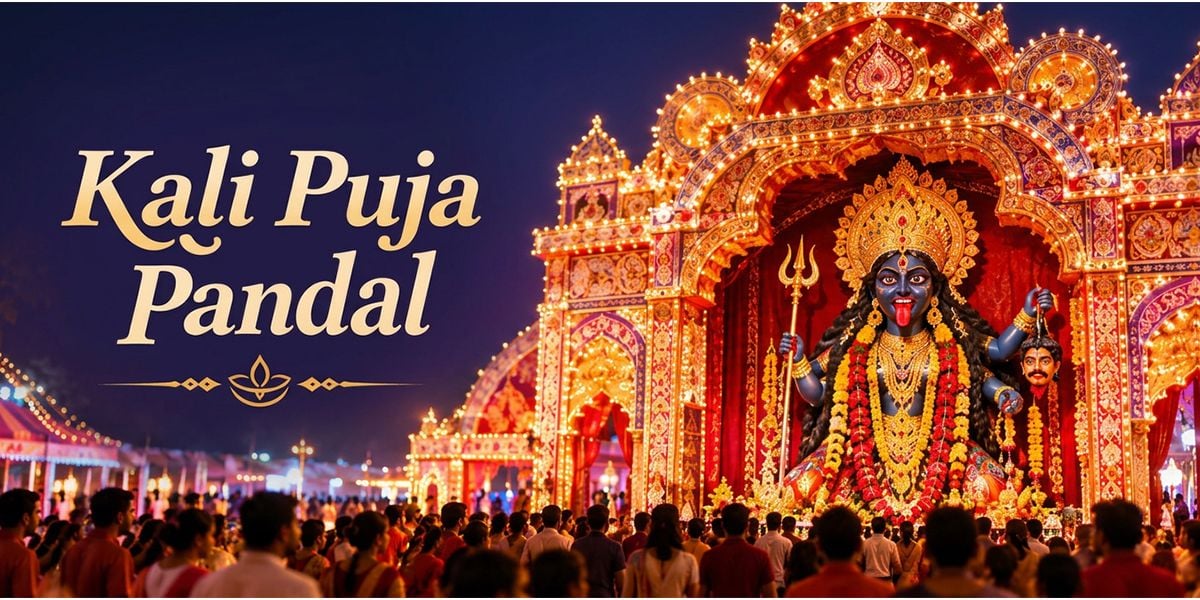
Also read: Kali Puja Pandal: Meaning, Rituals, Traditions & Famous Pandals
The Fierce Face and the Tender Mother
Beneath the skulls and the sword, Goddess Kali is the most motherly of goddesses. She destroys only what threatens her children, such as evil, ego, and ignorance. Her fearsome look is that of a mother who turns terrifying to protect her child.
Devotees approach her as a child approaches its mother. In Bengal, this bond fills the devotional songs known as Shyama Sangeet, composed by poets such as Ramprasad Sen.
Sri Ramakrishna Paramahamsa, the great saint of Dakshineswar, experienced Goddess Kali as a living Mother. His devotion made her one of the most beloved goddesses in India.
Lessons of the Kali Mata Story
The tale of Goddess Kali carries teachings that remain relevant today.
- Destruction is protection. What dies before her blade is only the false self.
- Evil grows from spilt blood. Negativity must be stopped at the source, just as Goddess Kali caught the blood before it touched the ground.
- Even divine fury ends in stillness. Her rage ceased the moment it met Lord Shiva.
- Time devours all but the eternal. Clinging to passing things leads to suffering.
- The severed head is the ego. The "I am the body" idea is offered up for freedom.
Goddess Kali Mata is the Mother who wears terror so that her children stop fearing the wrong things, such as time, death, and their own ego. Beneath the skulls and the sword is the same face that says, “Fear not, my child.”
Team Astroyogi is an experienced in-house editorial team of passionate writers, researchers, and astrology enthusiasts dedicated to making ancient divination sciences more accessible and meaningful in everyday life. With years of collective experience in creating insightful astrology and spirituality content, the team specializes in simplifying complex spiritual concepts into practical guidance for readers seeking clarity, balance, and personal growth. The Astroyogi editorial team possesses expertise across a wide range of subjects, including Indian Astrology, Vedic Astrology, Planetary Transits, Horoscope Analysis, Vastu Shastra, Numerology, Tarot, Spiritual Wellness, and Ritual Practices. Every piece of content is carefully researched, fact-checked, and crafted with the intention of offering reliable, insightful, and easy-to-understand guidance rooted in traditional wisdom. Driven by a commitment to authenticity and reader trust, Team Astroyogi strives to create content that empowers individuals to navigate life’s opportunities and challenges with confidence, positivity, and inner peace. Their mission is to bridge ancient astrological knowledge with modern-day relevance, helping readers make informed decisions and lead more harmonious lives.