

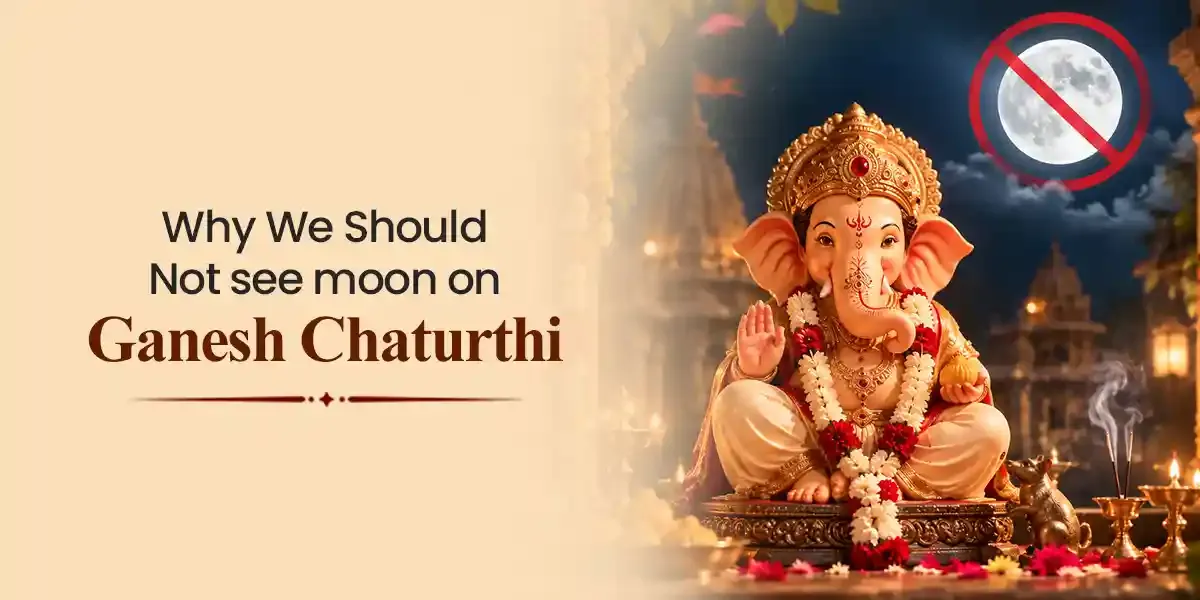

Why Should We Not See the Moon on Ganesh Chaturthi?
Hindu tradition warns devotees to avoid looking at the Moon during Bhadrapada Shukla Chaturthi, the day Ganesh Chaturthi falls on. Seeing the Moon at this time is believed to invite Mithya Dosha, also called Mithya Kalank: false accusations, blame, dishonor, or allegations of wrongdoing.
This is a religious belief rooted in Puranic stories, not a scientifically proven physical effect. The reasoning behind it, and what to do if it happens by accident, is worth understanding in full.
The Origin Legend
The story connects Lord Ganesha and Chandra, the Moon deity. On Ganesh Chaturthi, Lord Ganesha was returning home on His mouse vehicle after accepting many sweets at His celebration.
Because of His large stomach, Lord Ganesha reportedly fell from His vehicle. Chandra laughed at Him and mocked His appearance and difficulty.
Lord Ganesha grew angry and cursed Chandra, declaring that anyone who looked at the Moon on this day would suffer false blame or allegations for something they had not done. Chandra later repented, and Lord Ganesha softened the curse, though the prohibition remained.
The moral is simple: pride, ridicule, and judging others by appearance can lead to humiliation. This is also why the day is sometimes called Kalank Chaturthi, the Chaturthi connected with blame or stigma.
Curious how Chandra's cosmic influence shapes daily moods and decisions? Check today's horoscope
The Krishna-Syamantaka Story
The most cited example of this curse in action is the story of Lord Krishna and the Syamantaka Mani. Lord Krishna accidentally saw the Moon on Ganesh Chaturthi, and soon after, He was falsely accused of stealing the Syamantaka jewel.
The jewel had belonged to Satrajit. His brother Prasena took it and was later killed by a lion. Jambavan then defeated the lion and carried the jewel to his cave.
Because the jewel disappeared, suspicion fell on Lord Krishna. He investigated the matter, found the jewel with Jambavan, and proved His innocence, showing that even a respected and innocent person can temporarily face false allegations.
Mithya Dosha: Meaning and Possible Effects
Mithya means false, and dosha means an affliction. Mithya Dosha is the belief that Moon-sighting on this day can bring:
False accusations or allegations of theft and dishonesty
Unwanted criticism, slander, or gossip
Damage to personal or professional reputation
Misunderstandings in family or workplace relationships
Legal complications or blame for something not actually done
None of this means misfortune is guaranteed. It describes a symbolic risk tied to this one tithi, not a certain outcome.
Facing sudden workplace or legal hurdles right now? Consult Astroyogi's Expert Astrologers for personalized guidance.
Astronomical and Rational Perspective
There is no established scientific evidence that looking at the Moon on Ganesh Chaturthi causes false accusations, bad luck, illness, or social disgrace. The Moon is visible simply because it reflects sunlight, and ordinary moonlight carries no special physical danger on this date.
The real astronomical detail concerns the Moon's position in its cycle. Ganesh Chaturthi falls during the waxing fortnight, when the Moon sits close to the Sun and often appears low in the western sky right after sunset. Visibility depends on phase, altitude, and atmospheric conditions, not any hidden harmful property.
| Question | Traditional View |
|---|---|
| Why avoid the Moon? | To avoid Mithya Dosha from Lord Ganesha's curse on Chandra. |
| What may happen? | False blame, dishonor, or allegations are feared. |
| Is the Moon harmful that day? | Considered ritually inauspicious during the prescribed period. |
| What if seen accidentally? | Perform a traditional remedy if desired. |
The Mantra and Other Remedies
If the Moon is seen accidentally, there is no reason to panic. It is far less serious than intentionally searching the sky for it, and many families follow a remedy simply as an act of devotion rather than fear.
The most widely cited remedy is the Syamantaka Mani mantra, tied to the story of Lord Krishna clearing His name.
सिंहः प्रसेनमवधीत्सिंहो जाम्बवता हतः। सुकुमारक मारोदीस्तव ह्येष स्यमन्तकः॥
Transliteration: Simhah Prasenam Avadhit, Simho Jambavata Hatah, Sukumaraka Marodistava Hyesha Syamantakah.
Meaning: The lion killed Prasena, and Jambavan killed the lion. O child, do not cry; this Syamantaka jewel belongs to you.
Beyond the mantra, common remedies include:
Reciting the mantra three, eleven, or twenty-one times per family custom
Listening to or reading the Krishna-Syamantaka story
Praying to Lord Ganesha with flowers, durva grass, or modak
Completing the day's Ganesh Chaturthi worship with devotion
Chanting "Om Gam Ganapataye Namah"
Offering charity such as food, clothing, or money
Practicing restraint in speech, since the legend concerns false accusation and pride
A simple devotional routine after an accidental sighting: wash the hands and face, sit quietly before a Ganesha image, recite the mantra a few times, say a short prayer for protection from false blame, and continue the festival without anxiety.
Ganesh Chaturthi vs. Sankashti Chaturthi
Moon-sighting is avoided on Ganesh Chaturthi, yet the Moon is commonly worshipped during Sankashti Chaturthi. The table below shows the difference.
| Aspect | Ganesh Chaturthi | Sankashti Chaturthi |
|---|---|---|
| Lunar fortnight | Waxing (Shukla Paksha) | Waning (Krishna Paksha) |
| Moon-related practice | Moon-sighting avoided | Moon is worshipped and viewed |
| Fast-breaking | Not tied to moonrise | Fast breaks after moonrise, with Arghya offered |
| Associated belief | Mithya Dosha from Lord Ganesha's curse | No such prohibition |
This shows the Moon is not always considered inauspicious. The caution applies only to this one lunar day and its associated legend.
Why People Still Follow It
The tradition continues out of respect for Puranic stories and family customs, as a reminder to avoid arrogance and ridicule, and out of faith in prayer and divine protection. It also carries an ethical message: do not mock others for their appearance or circumstances, and do not rush to accuse someone without evidence.
Team Astroyogi is an experienced in-house editorial team of passionate writers, researchers, and astrology enthusiasts dedicated to making ancient divination sciences more accessible and meaningful in everyday life. With years of collective experience in creating insightful astrology and spirituality content, the team specializes in simplifying complex spiritual concepts into practical guidance for readers seeking clarity, balance, and personal growth. The Astroyogi editorial team possesses expertise across a wide range of subjects, including Indian Astrology, Vedic Astrology, Planetary Transits, Horoscope Analysis, Vastu Shastra, Numerology, Tarot, Spiritual Wellness, and Ritual Practices. Every piece of content is carefully researched, fact-checked, and crafted with the intention of offering reliable, insightful, and easy-to-understand guidance rooted in traditional wisdom. Driven by a commitment to authenticity and reader trust, Team Astroyogi strives to create content that empowers individuals to navigate life’s opportunities and challenges with confidence, positivity, and inner peace. Their mission is to bridge ancient astrological knowledge with modern-day relevance, helping readers make informed decisions and lead more harmonious lives.