
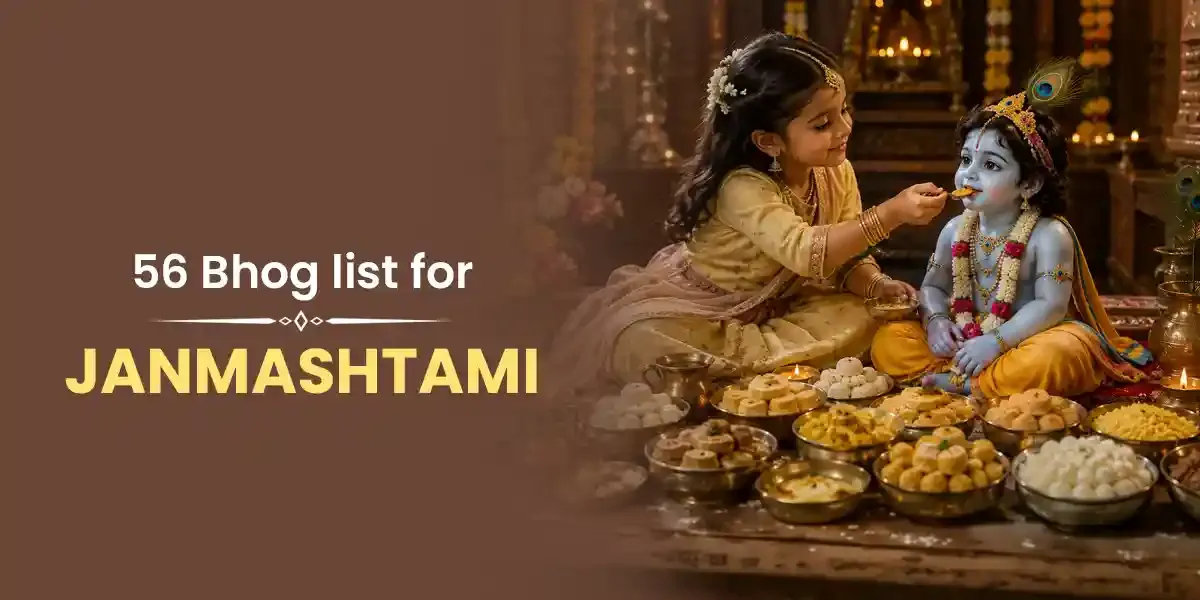

56 Bhog List for Janmashtami: Complete Chappan Bhog Menu
Janmashtami is celebrated with music, fasting, midnight prayers, and, most memorably, the famous Chappan Bhog offered to Lord Krishna.
The 56 bhog list for Janmashtami is one of the oldest traditions associated with this festival, observed in households and temples across the country.
Let’s go through the complete Janmashtami 56 bhog list, explain where the number 56 comes from, and offer a simpler Krishna Janmashtami prasad list for families short on time, whether they are searching for a full temple-style thali or a shorter Janmashtami list.
Complete 56 Bhog List for Janmashtami
The table below sets out a commonly used Janmashtami 56 bhog list, grouped by category, blending sweets, savories, grains, dairy, fruits, dry fruits, drinks, and accompaniments into a balanced offering.
| Category | 56 Bhog Items |
|---|---|
| 🍬 Sweets & Savouries | Makkhan Mishri, Kheer, Rasgulla, Peda, Gulab Jamun, Malpua, Rabri, Mathri, Pakoda, Kachori, Bhujia, Shakkarpara, Namak Para, Aloo Tikki |
| 🍚 Grains & Main Dishes | Poori, Roti, Khichdi, Pulao, Dal, Kadhi, Meetha Chawal |
| 🥛 Dairy Offerings | Panchamrit, Curd, Ghee, Butter, Malai, Honey, Paneer |
| 🍎 Fresh Fruits | Banana, Mango, Apple, Grapes, Pomegranate, Plum, Guava |
| 🥜 Dry Fruits & Nuts | Almonds, Cashews, Pistachios, Raisins, Dates, Walnuts, Dry Coconut |
| 🥤 Drinks | Shikanji, Coconut Water, Thandai, Almond Milk, Lassi, Aam Panna, Rose Sharbat |
| 🥭 Accompaniments & Pickles | Mango Pickle, Dhaniya Chutney, Imli Chutney, Papad, Murabba, Saunf Elaichi, Paan or Supari |
Unsure about the perfect rituals or timing for your offerings? Talk to verified astrologers on Astroyogi for personalized guidance on your festival preparation.
A Simpler Krishna Janmashtami Prasad List
Not every household has the time or kitchen space to prepare 56 separate dishes, and that is fine. Devotion has never really been about the volume of food; it is about the sincerity behind the offering.
A smaller Janmashtami list can carry the same devotional weight as a full spread when offered with genuine bhakti.
| Item | Why It Is Included |
|---|---|
| 🧈 Makkhan Mishri | Lord Krishna's favourite childhood offering |
| 🥛 Panchamrit | Symbol of purity and nourishment |
| 🍚 Kheer or Makhana Kheer | Represents sweetness and abundance |
| 🍬 Peda or Laddu | Traditional festive sweet |
| 🍯 Malpua or Puri | Common festive main dish |
| 🍎 Seasonal Fruits | Natural and easily available offering |
| 🥜 Dry Fruits | Adds richness without extra cooking |
| 🥣 Curd | Cooling and considered pure |
| 🥤 Lassi | Popular festive drink |
| 🥥 Coconut | Traditional auspicious offering |
| 🌿 Tulsi Leaves | Considered essential in offerings to Lord Krishna |
Note: Even a single bowl of fruit or a small cup of milk, offered with a sincere heart, is regarded as being just as meaningful as an elaborate 56 bhog menu list for Janmashtami. Intention matters far more than quantity.
After preparing the Chappan Bhog, devotees can follow the complete Janmashtami Puja Vidhi for the traditional worship rituals and read the Krishna Aarti for the prayers performed during the celebration.
What Does Chappan Bhog Actually Mean?
The word "chappan" means 56 in Hindi, and "bhog" refers to food offered to a deity before it becomes prasad. So the 56 bhog menu list for Janmashtami is a spread of 56 dishes laid out before Lord Krishna, typically around midnight, the time he is believed to have been born. Before it is offered, the food is called bhog or naivedya. Once presented with devotion, it becomes prasadam, shared among everyone present.
There is no single official Janmashtami prasad list every temple or family follows. Menus differ by region and tradition; some are built around milk-based sweets, others include rice dishes, pickles, or accompaniments like paan and supari.
Note: What follows is a widely used version of the Janmashtami bhog list, best treated as a flexible template.
Why Are 56 Dishes Offered to Lord Krishna?
The most popular explanation for the 56 bhog list for Janmashtami comes from the story of Lord Krishna and Govardhan Hill. The people of Braj used to worship Lord Indra, the god of rain, hoping for good harvests.
Lord Krishna, still a young boy, redirected their devotion toward Govardhan Hill, the cows and the land itself, arguing that these were what actually sustained their lives. Lord Indra took this as an insult and sent torrential rain over Braj, threatening to flood the region.
To shelter the villagers and their cattle, Lord Krishna lifted Govardhan Hill on the tip of his little finger and held it aloft like a giant umbrella for seven days and nights, reportedly going without his usual eight meals a day throughout that time.
Once the rains stopped, the grateful residents prepared eight dishes for each of the seven missed days. Eight multiplied by seven gives exactly 56, which is how the chappan bhog list for Janmashtami is said to have originated.
Other explanations link the number 56 to the eight pahars of a traditional day or to the six classical tastes: sweet, sour, salty, pungent, bitter, and astringent. None should be treated as the single correct version.
Regional Variations Worth Knowing
Since India is culturally diverse, the Janmashtami bhog list changes noticeably from region to region.
In Braj, Mathura, and Vrindavan, the thali leans heavily on milk-based sweets such as peda, rabri, malpua, and ghevar, fitting Lord Krishna's pastoral upbringing there.
In Odisha, tied to the Jagannath tradition, offerings often shift toward rice preparations, pitha, and dal-based dishes.
Bihar and other parts of eastern India tend to add makhana kheer, pua, and khaja into the mix.
Fasting households approach the chappan bhog list for Janmashtami a little differently, typically swapping regular grains and pulses for sabudana, kuttu flour, singhara flour, and sama rice, along with generous fruit and dairy, a reminder that the Janmashtami prasad list is meant to adapt to a family's needs.
Preparation and Offering Guidelines
Cooking for Lord Krishna's bhog is treated as a sacred task, and a few guidelines are followed almost everywhere. The food is prepared as sattvik, cooked without onion, garlic, or meat, since these are considered to disturb the purity of a deity's offering. Fresh ingredients and clean utensils are non-negotiable, and each dish is usually kept in its own separate bowl.
A Tulsi leaf is almost always placed on sweets and cooked dishes before they are offered, and it is customary to avoid tasting the food beforehand, since the first portion is meant to go to Lord Krishna alone. The full thali is usually presented during the midnight puja, after which aarti is performed, and the food is distributed as prasad.
But for larger celebrations, people usually make use of 56 katoris arranged in a circle around the idol of Lord Krishna to create an interesting visual of the chappan bhog list for Janmashtami and, at the same time, to reduce the wastage of food.
Wrapping Up Your Janmashtami Feast
The chappan bhog list for Janmashtami is not just a to-do list of the sweets and fruits to be served to Lord Krishna before midnight. This list is a symbol of your gratitude to the Lord and the immense love you have for him.
Whether your family cooks the whole chappan bhog list for Janmashtami or a limited list for Janmashtami prasad at your house, what counts is your devotion and nothing else. It is love that makes any food prasad.
Team Astroyogi is an experienced in-house editorial team of passionate writers, researchers, and astrology enthusiasts dedicated to making ancient divination sciences more accessible and meaningful in everyday life. With years of collective experience in creating insightful astrology and spirituality content, the team specializes in simplifying complex spiritual concepts into practical guidance for readers seeking clarity, balance, and personal growth. The Astroyogi editorial team possesses expertise across a wide range of subjects, including Indian Astrology, Vedic Astrology, Planetary Transits, Horoscope Analysis, Vastu Shastra, Numerology, Tarot, Spiritual Wellness, and Ritual Practices. Every piece of content is carefully researched, fact-checked, and crafted with the intention of offering reliable, insightful, and easy-to-understand guidance rooted in traditional wisdom. Driven by a commitment to authenticity and reader trust, Team Astroyogi strives to create content that empowers individuals to navigate life’s opportunities and challenges with confidence, positivity, and inner peace. Their mission is to bridge ancient astrological knowledge with modern-day relevance, helping readers make informed decisions and lead more harmonious lives.