

Who Can Tie Rakhi to Whom? Know the Rules & Traditions
Raksha Bandhan is usually pictured as a sister tying a thread on her brother's wrist, but the festival's real meaning is broader than that single image. The word itself means "the bond of protection," so the real question of who can tie rakhi to whom comes down to one thing: does the bond carry genuine care and protection, not romance?
Here is a simple breakdown of the accepted relationships, along with the two questions that come up most often: Can a wife tie rakhi to her husband, and can I tie rakhi to my boyfriend?
What Rakhi Actually Represents
A Raksha Bandhan rakhi is more than a decorative thread. It is a prayer for safety combined with a promise of protection in return. Because the ritual centers on this idea of protection rather than a fixed family label, tradition leaves room for many relationships beyond just siblings.
The Classic Bond: Sister to Brother
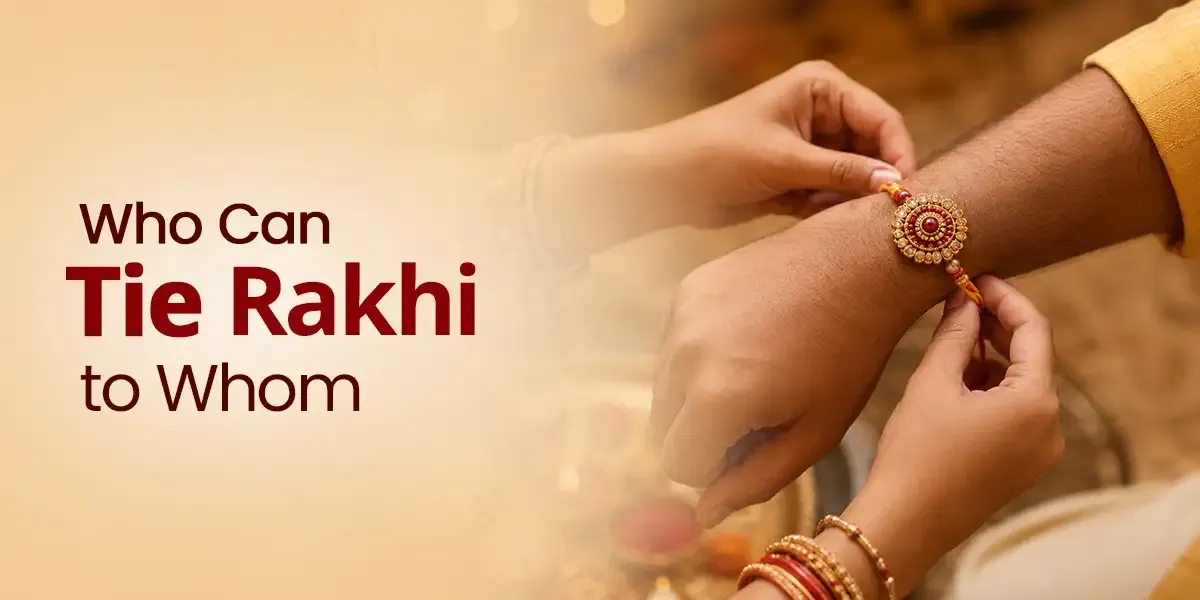
The most common and widely recognized form of Raksha Bandhan is a sister tying rakhi to her brother. The ritual typically includes tilak, tying the thread on the right wrist, a short aarti, sweets, and an exchange of gifts. This pattern is so dominant across North India that it has become the default image of the festival, though it is far from the only accepted version.
Other Relationships Beyond Siblings
Ancient texts describe rakhi being tied in situations well beyond siblings, including wives tying protective threads to husbands before battle, students tying them to teachers, and communities tying them to soldiers as thanks for protection.
This shows that rakhi historically worked as a general protective gesture, not something limited strictly to brothers and sisters. Here is a quick look at how modern practice treats different relationships:
| Relationship | Acceptance Level | Reason |
|---|---|---|
| Sister to Brother | Fully accepted everywhere | Core sibling protection bond |
| Sister to Sister | Increasingly accepted | Mutual protection among women |
| Mother to Son or Daughter | Accepted in many families | Maternal blessing and protection |
| Daughter to Father | Widely accepted | Honors the father's protective role |
| Cousins | Standard extension | Natural extension of sibling bonds |
| Close Friends | Common in urban practice | Chosen-family style bond |
| Student to Teacher or Guru | Historically attested | Mark of respect and well-being |
| Grandchild to Grandparent | Accepted in many families | Reverence and long life prayer |
| Wife to Husband | Conditional, varies by region | Spousal protection, debated |
| Girlfriend to Boyfriend | Generally discouraged | Romantic bond differs from sibling bond |
Also Read: 🪔 Raksha Bandhan Mantra: Meaning & Chanting Method
Can I Tie Rakhi to My Husband or Boyfriend?
This question comes up every year, whether framed as "Can a wife tie rakhi to her husband?" or "Can I tie rakhi to my boyfriend?" There is scriptural precedent for a wife tying a rakhi to her husband, most notably Goddess Indrani tying a protective thread to Lord Indra before battle, and many modern families accept it on that basis.
Still, several traditionalists argue that marriage and Raksha Bandhan represent different bonds, one a partnership and the other sibling-like, so many guides advise against it for a husband, despite regional exceptions.
The same caution applies more strongly to boyfriends, since rakhi is meant for non-romantic bonds and dating does not fit that spirit. So can we tie rakhi to husband or boyfriend? It depends on family custom. When unsure, couples can exchange gifts instead or simply ask a family elder or priest.
Who Should Avoid Tying Rakhi
Traditional advice generally discourages a wife tying rakhi to her husband in orthodox households and a girlfriend tying rakhi to her boyfriend in most settings, since both risk blurring the line between a romantic bond and the sibling-style protection the festival represents. Any relationship where the gesture could be misread as romantic is usually best avoided.
Unsure if tying a rakhi fits your specific relationship, or looking for the right protective ritual aligned with your Kundali? Talk to verified astrologers on Astroyogi for personalized guidance on auspicious timings, traditions, and astrological remedies.
To understand the festival, its rituals, traditions, and significance in greater detail, read our guide to Raksha Bandhan.
Final Thoughts
Who can tie rakhi to whom ultimately depends on the nature of the bond and the family's own customs. Sisters and brothers remain the classic pair, but mothers, daughters, cousins, friends, and even teachers all have an accepted place in the tradition.
For trickier cases like a wife tying rakhi to her husband or a girlfriend tying it to a boyfriend, there is no single right answer, only what feels appropriate within a family's own values. When unsure, asking an elder or priest remains the simplest way forward.
Team Astroyogi is an experienced in-house editorial team of passionate writers, researchers, and astrology enthusiasts dedicated to making ancient divination sciences more accessible and meaningful in everyday life. With years of collective experience in creating insightful astrology and spirituality content, the team specializes in simplifying complex spiritual concepts into practical guidance for readers seeking clarity, balance, and personal growth. The Astroyogi editorial team possesses expertise across a wide range of subjects, including Indian Astrology, Vedic Astrology, Planetary Transits, Horoscope Analysis, Vastu Shastra, Numerology, Tarot, Spiritual Wellness, and Ritual Practices. Every piece of content is carefully researched, fact-checked, and crafted with the intention of offering reliable, insightful, and easy-to-understand guidance rooted in traditional wisdom. Driven by a commitment to authenticity and reader trust, Team Astroyogi strives to create content that empowers individuals to navigate life’s opportunities and challenges with confidence, positivity, and inner peace. Their mission is to bridge ancient astrological knowledge with modern-day relevance, helping readers make informed decisions and lead more harmonious lives.