

Second Solar Eclipse 2026 in India: Date, Time, Sutak Rules & Significance
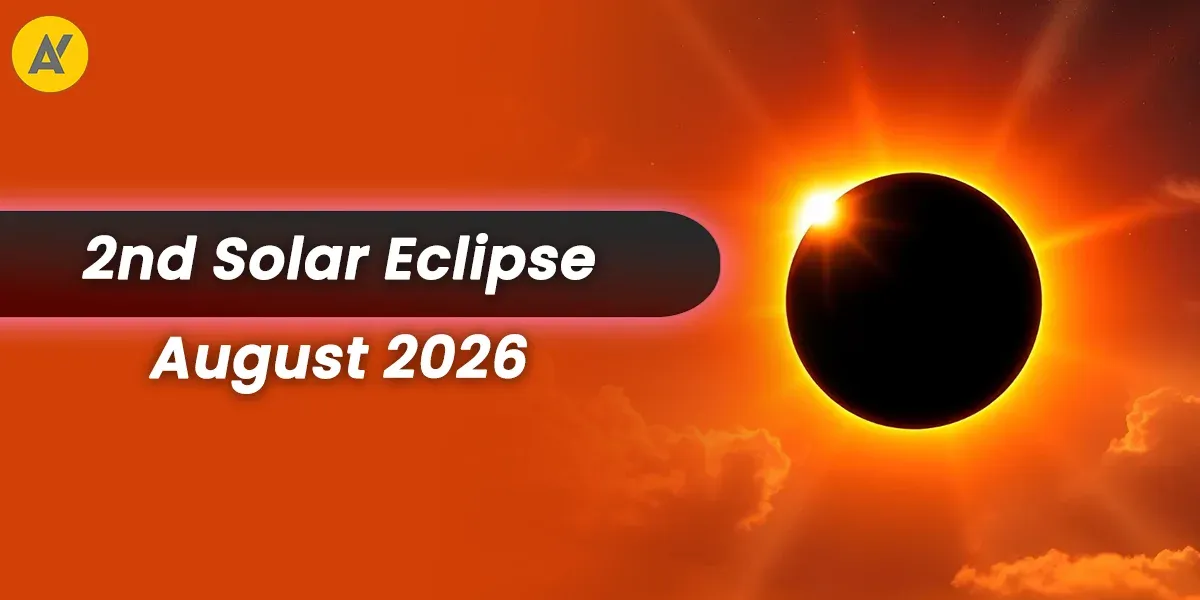
Get ready for one of the most powerful celestial events of the year: the Second Solar Eclipse of 2026. Unlike the First eclipse in February 2026, this one is a total solar eclipse, making it far more powerful, rare, and spiritually significant.
This second solar eclipse of 2026 will completely cover the Sun for a brief period, creating an awe-inspiring moment in the sky. Whether you’re a skywatcher or spiritually inclined, this eclipse carries deep meaning and transformative energy worth understanding.
When Is the Second Solar Eclipse 2026 Date and Time?
Here are the key details for the Second Solar Eclipse 2026 date and time:
2nd Solar Eclipse 2026 Date and Timings (IST)
| Event | Date & Time (IST) |
|---|---|
| Eclipse Date | 12 August 2026 (Wednesday) |
| Partial Eclipse Begins | 12 August 2026, 09:04:15 PM |
| Full Eclipse Begins | 12 August 2026, 10:28:09 PM |
| Maximum Eclipse | 12 August 2026, 11:16:06 PM |
| Full Eclipse Ends | 13 August 2026, 12:04:07 AM |
| Partial Eclipse Ends | 13 August 2026, 01:27:57 AM |
*Note: Timings may vary depending on your geographical location.
This solar eclipse on 12 August 2026, will unfold over several hours, but the total eclipse phase (complete darkness) will last only a few minutes in regions where it is visible.
Will the Second Solar Eclipse 2026 Be Visible in India?
No.
The second Solar Eclipse of 2026 will not be visible anywhere in India. Since the eclipse will occur over parts of Europe, the Arctic, and the Atlantic region, Indian skywatchers will not be able to witness it.
Total Eclipse Path (Full Blackout Visibility)
Countries Where the Total Solar Eclipse Will Be Visible
- Greenland
- Iceland
- Spain
- Parts of Russia
Regions Where the Partial Eclipse Will Be Visible
- Most of Europe
- Parts of North Africa
- Parts of North America
- Atlantic Ocean regions
- Arctic regions
*Note – Since India falls outside the eclipse's visibility path, this solar eclipse cannot be observed from the country.
What Does a Total Solar Eclipse Mean?
A solar eclipse occurs when the Moon passes between the Earth and the Sun, blocking sunlight either partially or completely. In the case of the solar eclipse in August 2026, it will be a total solar eclipse, meaning the Moon will completely cover the Sun for a short duration.
During totality, the sky darkens as if it were twilight, stars may become visible, and the Sun’s outer atmosphere, called the corona, shines beautifully around the Moon. This makes it one of the most breathtaking astronomical events.
This is what makes the Total Solar Eclipse August 2026 especially significant compared to an annular eclipse; it offers a full blackout of the Sun, symbolizing deeper transformation and powerful energetic shifts.
Why is the 2nd Solar Eclipse 2026 Special?
The August 2026 eclipse is considered significant because:
- It is the second solar eclipse of 2026.
- It is a Total Solar Eclipse, unlike the earlier annular eclipse of the year.
- Millions of people across Europe will witness complete darkness during totality.
- It is one of the most anticipated astronomical events of the decade for eclipse enthusiasts.
Both scientists and skywatchers are expected to closely observe this eclipse because of its spectacular visibility across several countries.
Is Sutak Kaal Applicable During the Second Solar Eclipse in India?
No.
In Hindu tradition, Sutak (the 12-hour inauspicious period before solar eclipse) is observed only when the eclipse is visible in your location. Since this second solar eclipse 2026 is not visible in India, it holds no ritual restrictions.
What does this mean?
- No restriction on cooking or eating
- Temples will generally remain open
- Daily puja rituals and prayers can continue normally
- No need for post-eclipse cleansing rituals
However, if you are spiritually inclined, you can still choose to observe the eclipse mindfully for personal growth, but it is not mandatory.
Spiritual Significance of the Second Solar Eclipse
In Hindu traditions, a solar eclipse is often viewed as a period of reflection and spiritual awareness.
Many devotees choose to spend eclipse hours in:
- Meditation
- Prayer
- Mantra chanting
- Self-reflection
- Charity and donations
Although this eclipse is not visible in India, many people still use the occasion to reconnect with their spiritual practices and cultivate inner peace.
Dos and Don’ts During Solar Eclipse 2026
Even though the second solar eclipse 2026 is not visible in India, many people still follow general spiritual precautions.
Do's During the Solar Eclipse
- Meditate and Reflect: Use this time for introspection and spiritual growth
- Chant Mantras: Reciting the Gayatri Mantra (108 times) can bring positivity and cleanse the energy
- Stay Calm: Observe your thoughts and emotions mindfully
- Take a Bath After Eclipse (Optional): Many follow this for spiritual cleansing
- Set intentions: Write three goals on paper, and burn them safely post-eclipse.
- Donate to charity: Eclipses amplify good karma.
Don'ts During the Solar Eclipse
- Avoid Looking at the Sun Directly: Without proper solar filters, it can harm your eyes
- Avoid Negative Thoughts or Talks: Eclipse energy amplifies emotions
- Avoid Major Decisions (Optional Belief): Many prefer waiting until the eclipse passes
- Avoid Overthinking: Stay grounded and balanced
How to Watch the Solar Eclipse Safely
If you’re traveling to see the solar eclipse in August 2026, remember:
Use certified solar eclipse glasses or pinhole projectors for safe viewing (if visible).
- Never look at the Sun with your naked eyes
- Use solar filters for cameras or telescopes
- Avoid regular sunglasses; they are not safe
Final Words
The solar eclipse on 12 August 2026 will be a visual spectacle as well as a deeply meaningful cosmic event. As the second solar eclipse of 2026, it can bring themes of transformation, clarity, reflection, and renewal. Even though it won’t be visible in India, its spiritual energy can still be felt.
Whether you choose to observe it scientifically or spiritually, take this moment as a reminder to pause, reflect, and realign with your life’s direction. Sometimes, it’s in the temporary darkness that we find our brightest clarity.
Team Astroyogi is an experienced in-house editorial team of passionate writers, researchers, and astrology enthusiasts dedicated to making ancient divination sciences more accessible and meaningful in everyday life. With years of collective experience in creating insightful astrology and spirituality content, the team specializes in simplifying complex spiritual concepts into practical guidance for readers seeking clarity, balance, and personal growth. The Astroyogi editorial team possesses expertise across a wide range of subjects, including Indian Astrology, Vedic Astrology, Planetary Transits, Horoscope Analysis, Vastu Shastra, Numerology, Tarot, Spiritual Wellness, and Ritual Practices. Every piece of content is carefully researched, fact-checked, and crafted with the intention of offering reliable, insightful, and easy-to-understand guidance rooted in traditional wisdom. Driven by a commitment to authenticity and reader trust, Team Astroyogi strives to create content that empowers individuals to navigate life’s opportunities and challenges with confidence, positivity, and inner peace. Their mission is to bridge ancient astrological knowledge with modern-day relevance, helping readers make informed decisions and lead more harmonious lives.