
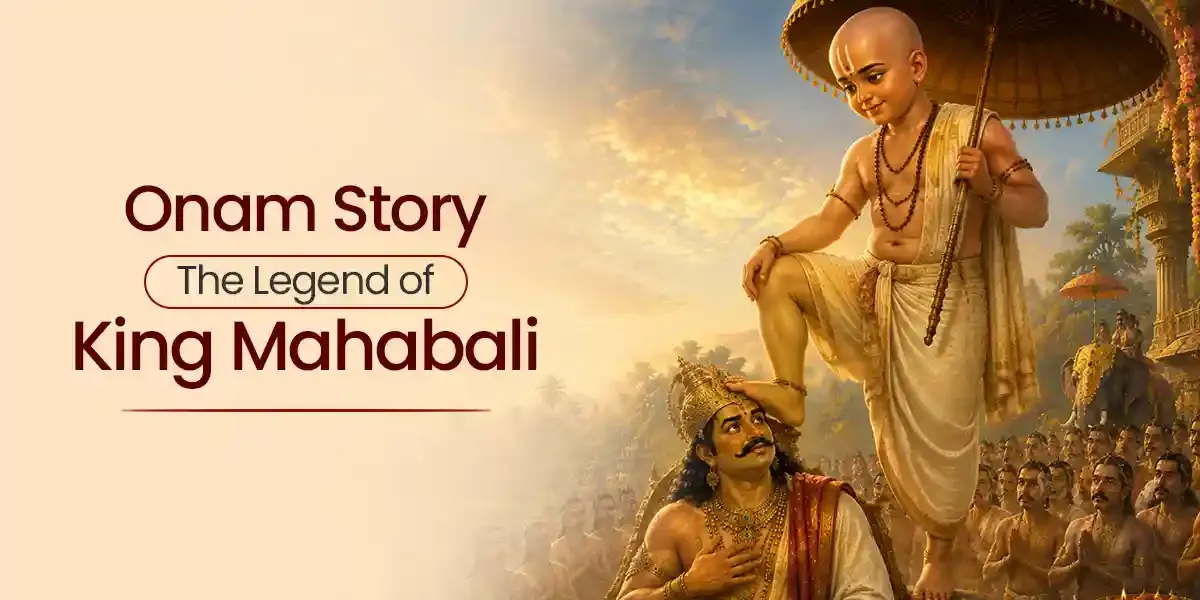

Onam Story: History, Significance and Why Onam Is Celebrated for 10 Days
The Onam story is one of Kerala's most cherished legends, bringing together devotion, prosperity, equality, and the memory of a beloved king. Celebrated with colorful pookalams, traditional feasts, boat races, music, and cultural performances, Onam is more than a harvest festival. It commemorates the annual return of King Mahabali, whose reign is remembered as a golden age of peace and abundance.
What is Onam?
Onam is a major annual festival celebrated primarily in Kerala and by Malayali communities around the world. It falls during the Malayalam month of Chingam, usually between August and September.
The festival is closely associated with King Mahabali, also known as Maveli, a generous and powerful ruler whose kingdom is believed to have enjoyed prosperity, equality, and happiness. According to tradition, Mahabali was so beloved by his people that even after being sent to the netherworld, he was granted permission to return to Kerala once a year and visit them.
This annual homecoming forms the heart of the Onam story.
Onam Story: The Legend of King Mahabali
According to Hindu mythology, King Mahabali was a powerful Asura (demon) ruler and the grandson of Prahlada, a celebrated devotee of Lord Vishnu. Despite belonging to the Asura lineage, Mahabali was known for his generosity, courage, humility, and commitment to his people.
Under his rule, the kingdom flourished. Traditional accounts describe a society where people lived without fear, hunger, discrimination, or significant hardship. Everyone was considered equal, and the king was deeply loved by his subjects.
However, Mahabali's growing influence concerned the Devas (Gods). They approached Lord Vishnu for help in restoring the balance of the worlds.
When Lord Vishnu Stepped In
Rather than confronting Mahabali with force, Vishnu chose humility as his weapon. He took his fifth avatar in the form of Vamana, a young, humble Brahmin dwarf boy, and approached the king while he was performing a sacred yajna.
As was customary, Mahabali offered his guest anything he desired. Vamana asked for something that sounded almost laughably modest; just three paces of land, measured by his own small feet.
Mahabali agreed instantly, even as his guru Shukracharya tried to warn him that this humble boy was no ordinary visitor. True to his generous nature, the king kept his word anyway.
What happened next has been retold in Kerala for generations. Vamana transformed into his cosmic form, Trivikrama, growing to a size that spanned the entire universe.
With his first step, he covered the earth. With his second, he covered the heavens. There was nowhere left for a third step, so Mahabali, recognizing the divine being before him, humbly offered his own head. Vishnu placed his final step there and sent the king down to Patala, the netherworld.
It could have ended as a tragic downfall. Instead, it became the reason Onam exists at all. Moved by Mahabali's devotion and selflessness, Vishnu granted him a boon: he would be allowed to return to his beloved kingdom once every year, to see his people again and know they were thriving. That annual homecoming is exactly what Kerala celebrates as Onam.
Why is Onam Celebrated for 10 Days?
This is where the Onam story turns into a living tradition. Mahabali's visit isn't treated as a single-day event; it's treated as an occasion worth preparing for, slowly and joyfully, over ten full days.
The festivities begin with Atham, the first day, when families lay out a simple floral carpet called the Pookalam, often using nothing more than humble white Thumba flowers. Each day after that, the Onam flower arrangement grows a little larger and more elaborate, with new colors and flower varieties added layer by layer. It's a visual countdown, mirroring the excitement building toward the king's arrival.
By the time Uthradam arrives, homes are bustling with preparation. And on the tenth day, Thiruvonam, everything comes together: the largest, most intricate Pookalam, the grand Onasadya feast served on banana leaves, and a genuine sense that Mahabali has, in spirit, returned to see his people happy and well cared for.
This is really why Onam is celebrated for 10 days; not because the myth demands it, but because the anticipation and preparation are just as meaningful as the day itself.
The ten days are traditionally known as:
Atham
Chithira
Chodhi
Vishakam
Anizham
Thriketa
Moolam
Pooradam
Uthradam
Thiruvonam
The Spiritual Message Behind Onam
The Onam story is ultimately a story about humility, devotion, generosity, and the bond between a ruler and his people.
Mahabali's willingness to honor his promise demonstrates the importance of keeping one's word, while Vamana's story highlights the idea that worldly power is temporary. The king's annual return, meanwhile, represents hope, remembrance, and the enduring connection between people and their traditions.
Onam also reminds us that prosperity has greater meaning when it is shared with others.
Team Astroyogi is an experienced in-house editorial team of passionate writers, researchers, and astrology enthusiasts dedicated to making ancient divination sciences more accessible and meaningful in everyday life. With years of collective experience in creating insightful astrology and spirituality content, the team specializes in simplifying complex spiritual concepts into practical guidance for readers seeking clarity, balance, and personal growth. The Astroyogi editorial team possesses expertise across a wide range of subjects, including Indian Astrology, Vedic Astrology, Planetary Transits, Horoscope Analysis, Vastu Shastra, Numerology, Tarot, Spiritual Wellness, and Ritual Practices. Every piece of content is carefully researched, fact-checked, and crafted with the intention of offering reliable, insightful, and easy-to-understand guidance rooted in traditional wisdom. Driven by a commitment to authenticity and reader trust, Team Astroyogi strives to create content that empowers individuals to navigate life’s opportunities and challenges with confidence, positivity, and inner peace. Their mission is to bridge ancient astrological knowledge with modern-day relevance, helping readers make informed decisions and lead more harmonious lives.