
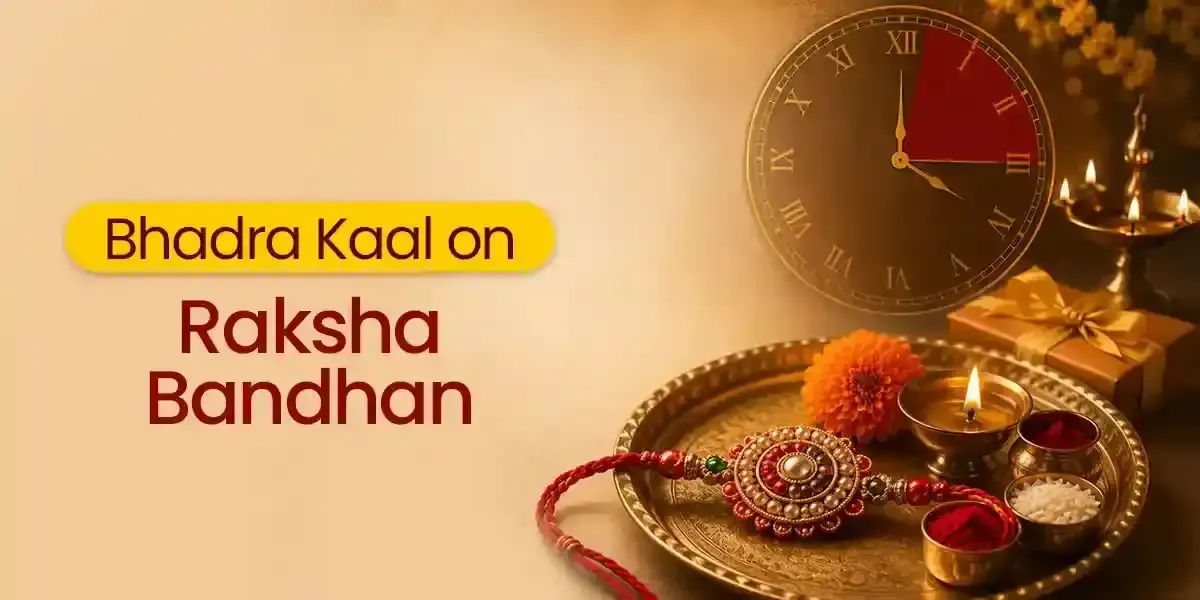

Bhadra Kaal on Raksha Bandhan: Why Is Bhadra Avoided?
Every year, as Raksha Bandhan approaches, the same question makes the rounds in families: is there Bhadra on Rakhi this time, and should the thread-tying wait?
Bhadra Kaal on Raksha Bandhan refers to a traditionally inauspicious astrological window that Hindu families have long steered clear of when performing the Rakhi ritual. This overview draws on panchang calculations, shastric references, and what contemporary astrologers generally agree on to explain what Bhadra actually is, why it has this reputation, and how it aligns with the festival's lunar calendar.
What Is Bhadra Kaal in Rakhi?
Bhadra, also known as Vishti Karana, is a lunar-based, inauspicious period recognized in Hindu astrology.
Below are some astrological aspects related to Bhadra:
Bhadra is associated with the positioning of the Moon, some particular karanas, and tithis, especially in relation to Purnima, or full Moon, on which Raksha Bandhan is celebrated.
According to ancient texts of Hindu astrology, such as Muhurta Chintamani and Brihat Samhita, Bhadra is not considered auspicious for starting auspicious acts, embarking on a journey, or performing rituals and rites.
There are two types of Bhadras. The first one is a general type of Bhadra that recurs in the daily karana cycle, and the second one is a tithi-specific type of Bhadra that occurs prominently during Purnima tithi.
The determination of Bhadra depends on karana, tithi, and lunar transition.
Its observance varies across regional traditions in North India and South India, as well as among diasporic Indians.
The Mythological Story Behind Bhadra Kaal
The custom of avoiding Bhadra isn't a modern habit; it's rooted in two legends still retold to explain why the period carries such weight.
Bhadra's fiery birth
Puranic lore names Bhadra as the daughter of Surya, the Sun God, and his wife Chhaya, making her sister to Shani Dev, the planet tied to strict, unbending justice. She's said to have inherited a similarly intense temperament.
From birth, stories describe her disrupting yajnas and sacred ceremonies, throwing rituals into chaos. Worried by this, Surya turned to Brahma, the creator, for help. Brahma is said to have channeled her volatile energy into a fixed, recurring window in the lunar calendar, rather than letting her interfere at will, on the condition she leave alone anyone who simply waited out her period. That window became known as Bhadra Kaal, seen ever since as a phase unsuited to new beginnings.
The cautionary tale of Ravan
The second story is set on a Shravan Purnima, when Shurpanakha is said to have tied a rakhi on her brother Ravan's wrist while Bhadra Kaal was active.
Ravan, though a skilled astrologer himself, reportedly brushed the timing aside, confident his power placed him beyond its influence. Legend holds that because the thread was tied during this unsettled window, its protection never took hold. The events that followed are said to have led toward his downfall in the war with Rama.
The lesson usually drawn: had the family simply waited for Bhadra to pass, things might have unfolded very differently.
Both accounts are folklore rather than verified history, but they're why Bhadra is still treated with such caution during Raksha Bandhan today.
Also Read: Rakhi Thali Decoration: Items, Ideas And How to Decorate
Why Is Bhadra Avoided During Rakhi?
Raksha Bandhan is seen as more than just a social custom. It's a samskara, a sacred vow in which a sibling ties a protective thread while affirming a bond of care and responsibility.
This is why the traditional practice is not to use Bhadra during the ritual:
The Muhurat Philosophy: In Hinduism, great emphasis is placed on shubh muhurat, where conducting rituals at auspicious times is considered to enhance their spiritual power and reduce the effects of doshas, or astrological disadvantages.
Reduced effect of protection: Bhadra Kaal is considered a shadow period when negative effects and unfavorable energies prevail. Conducting a holy ritual such as tying Rakhi during such time periods can make the protective purpose of the ritual ineffective.
Obstacle risk: According to tradition, ignoring Bhadra during the Rakhi ritual can bring unnecessary obstacles to the relationship between siblings.
Value and importance from psychological and cultural perspectives: Conducting rituals during muhurat periods fosters an attitude of respect and discipline within families, thereby making the entire process more mindful.
Not all families follow this practice. Some families consider convenience important, whereas some consider this practice religiously every year. Both practices have their own importance and relationship with the tradition.
How Bhadra Interacts With Raksha Bandhan's Tithi
Shravana Purnima, the tithi on which Raksha Bandhan is celebrated, often spans two calendar days rather than fitting neatly into a single sunrise-to-sunrise period.
The Udaya Tithi rule: the festival is observed on whichever day Purnima is present at sunrise.
Relation of Bhadra with Tithi: Bhadra depends on the combination of tithi and karana, not on clock time; hence, its appearance on the day of the festival varies from year to year.
Difference every year: While in some years Bhadra occurs in the morning of the festival, which means families have to wait before performing the ceremony, in other years, it is over even before the sun rises, so the entire morning is free for them.
This is the reason: there is no single rule that applies to all situations regarding Bhadra and Rakhi.
Common Misconceptions About Bhadra on Rakhi
A few misunderstandings tend to stick around on this topic:
Myth: Bhadra always falls on Raksha Bandhan morning.
Reality: Whether it does depends entirely on how the tithi and karana align for that specific year.Myth: If Bhadra is present, the whole day is inauspicious.
Reality: Only the Bhadra window itself is traditionally avoided. The rest of the day is generally considered fine for the ritual.Myth: Bhadra occurs at the same time every year.
Reality: Since it follows the lunar rather than the solar calendar, its timing shifts each year with Purnima.Myth: Ignoring Bhadra carries no consequence.
Reality: This comes down to faith rather than anything measurable. For those who follow tradition closely, sticking to Bhadra timing is seen as spiritually meaningful, even though belief in its effects varies from person to person and community to community.
How Families Can Approach Bhadra Without Overcomplicating Rakhi
A few practical steps make Bhadra easy to work around rather than something to stress over:
Consult a reliable panchang or priest. This remains the simplest way to figure out whether Bhadra Kaal affects a given year's celebration.
Adjust timing if needed. When Bhadra overlaps with the morning hours, families typically either wait and do a brief puja once Bhadra has ended or tie the Rakhi later in the day during another auspicious window.
Take into account where you live. Those who reside outside India may seek guidance from local panchang calculations based on sunrise or Indian muhurats, depending on their culture.
Make intent a priority. Sibling ties and pure intent are at the core of the festival of Raksha Bandhan. Adherence to Muhurat and Bhadra serves as an additional layer that enhances spirituality but is not mandatory.
The Significance of Bhadra During Raksha Bandhan Festival Celebrations
The Bhadra Kaal during Raksha Bandhan is nothing but an old precaution, developed through generations of astrological practice, which does not have any purpose to make life difficult during the festival.
Knowing why it is necessary to avoid Bhadra during Rakhi and why its date changes depending on the tithi and karana will help the family celebrate the ritual more informedly. As long as the intent behind the ritual remains intact, the presence or absence of Bhadra will only determine the timing of the celebration.
Team Astroyogi is an experienced in-house editorial team of passionate writers, researchers, and astrology enthusiasts dedicated to making ancient divination sciences more accessible and meaningful in everyday life. With years of collective experience in creating insightful astrology and spirituality content, the team specializes in simplifying complex spiritual concepts into practical guidance for readers seeking clarity, balance, and personal growth. The Astroyogi editorial team possesses expertise across a wide range of subjects, including Indian Astrology, Vedic Astrology, Planetary Transits, Horoscope Analysis, Vastu Shastra, Numerology, Tarot, Spiritual Wellness, and Ritual Practices. Every piece of content is carefully researched, fact-checked, and crafted with the intention of offering reliable, insightful, and easy-to-understand guidance rooted in traditional wisdom. Driven by a commitment to authenticity and reader trust, Team Astroyogi strives to create content that empowers individuals to navigate life’s opportunities and challenges with confidence, positivity, and inner peace. Their mission is to bridge ancient astrological knowledge with modern-day relevance, helping readers make informed decisions and lead more harmonious lives.