
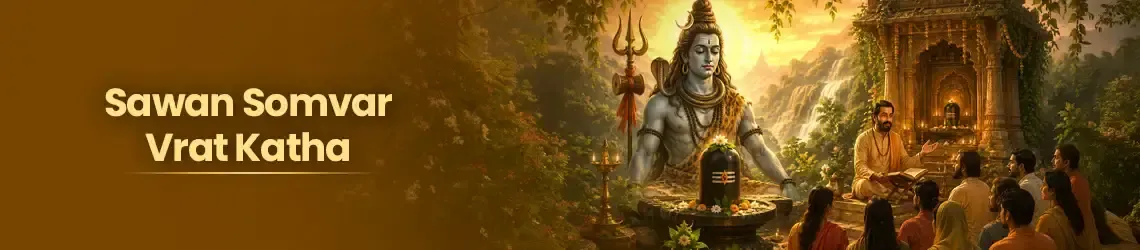
Sawan Somvar Vrat Katha: The Sacred Story of Lord Shiva
Households across the country fall silent on Monday evenings during Sawan to tell the tale of the vrat held during its month. A lamp is lit, incense burns, and everyone gathers to listen to a single story: the Sawan Somvar Vrat Katha. It holds a special place in the devotion of Lord Shiva's followers.
Understanding why this tradition carries so much weight requires looking at both the ritual and the tale behind it.
The Sawan Somvar Vrat Katha
This story has a different version in each region, but the essence remains the same. It is the story of the merchant of Amarapur, who was wealthy in all respects except the one he wanted the most.
The merchant was famous all over the country for his wealth and generosity, the kind other merchants used as a benchmark to assess their own worth. But even the largest fortune cannot fill the house lacking a child.
Why have all this wealth when the one thing desired is not forthcoming on demand? That is something that weighed upon him more heavily than any riches could. So, he decided to devote himself.
Each Monday, the merchant went to the Shiva temple, where, in the silence of the night, he lit a ghee lamp before the deity and sat in prayer, asking for nothing but sincerity to guide him. Month after month, year after year, he did not give up hope despite not having his desire fulfilled. Faith is tested by long periods when the wish turns into a ritual.
As Goddess Parvati witnessed all this, she felt an urge to help the merchant. So she spoke to Lord Shiva and pleaded on his behalf, realizing the devotion he had shown and that he had never asked for any favors in return. Lord Shiva explained to her that one has to reap what one has sown in terms of karma, meaning blessings cannot be distributed freely to anyone. It is a test of devotion, where both deities have their say: one asks for mercy, while the other sticks to the cosmic order.
Finally, swayed by the merchant’s unwavering devotion and also by Goddess Parvati’s mild persistence, Lord Shiva decided to bestow His blessings on him. The merchant remained undeterred in his fasting and worshipping, now including charitable deeds, as if devotion needed nourishment like any living plant. Soon, devotion gave its fruits. He was blessed with a baby, exactly what he had been longing for.
The story does not stop with the blessing bestowed on him; rather, it teaches us something passed down from generation to generation: that Lord Shiva always hears the prayers of devoted people and that the timing of life is beyond anyone’s control.
Note on Vrat Rituals: Devotees begin the day early with a cleansing bath, dressing in traditional white or blue clothing. The fast varies from consuming a single simple meal to a strict, waterless fast. Central to the ritual is a temple visit to perform an abhishek (pouring water, milk, curd, honey, or sugarcane juice over the Shiva Linga) and offering bilva leaves, dhoop, and a diya. The observance concludes with the chanting of Om Namah Shivaya and reciting the Sawan Somvar katha, observed by many for peace, prosperity, and family well-being.
The Mahamrityunjaya Mantra is one of the most powerful Shiva mantras, widely chanted during Sawan for good health, protection, and inner peace. Learn its meaning, benefits, and the correct chanting method.
How the Katha Is Traditionally Recited
Families gather together on Monday evenings during Sawan to hear this story, sometimes read aloud by an elder, sometimes narrated by a priest at the temple. It is common to pair the katha with chants like the Shiva Chalisa or the Shiva Tandava Stotram alongside offerings of milk, water, and bilva leaves on the Shiva Linga.
Some people observe the Solah Somvar vrat for sixteen successive Mondays, going beyond the month of Sawan in search of continuous blessings for marriage and children. Others observe several Mondays as per tradition followed by their family, either three, seven, or eleven.
The underlying message of the Sawan Somvar Vrat Katha is all about being patient enough to be rewarded for your devotion. Reciting the katha on a Somvar vrat is considered essential to completing the ritual properly, whether the fast is kept for a specific wish or for a deeper connection with Lord Shiva. The merchant of Amarapur remains proof that devotion, given time, always finds its way home.
Along with the vrat katha, many devotees recite the Shiv Namaskar Mantra to offer respectful salutations to Lord Shiva and seek His divine blessings.
Explore Every Sawan Somvar of 2026
Continue your Sawan journey with detailed guides for each Monday, including dates, puja muhurat, vrat vidhi, and spiritual significance.
First Sawan Somvar | Second Sawan Somvar | Third Sawan Somvar | Fourth Sawan Somvar 2026