
Krishna Paksha
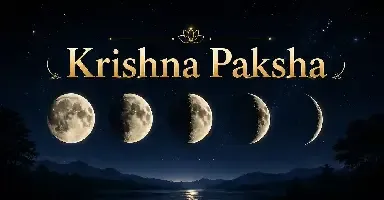
Krishna Paksha is the fifteen-day phase of the Hindu lunar month when the Moon gradually loses its illumination, traveling from the brilliance of full moon back into the silence of no-moon. The word itself combines Krishna (meaning dark) with Paksha (meaning side or wing), capturing the visual reality of a sky that dims a little more each night. This half of the month carries a reputation that surprises many modern readers: despite its darker imagery, it holds some of the most spiritually potent days in the entire Hindu calendar.
Check More Panchang Details











Talk to Astrologers
View All




Where the Dark Fortnight Sits in the Lunar Month
A Hindu lunar month contains two fortnights stitched together at the Moon's extreme points. The waxing half ends at Purnima, the full moon. The waning half begins the very next day and ends fifteen lunar days later at Amavasya, the moonless night. Krishna Paksha is this second half — the descent from fullness into darkness, from maximum light into complete absorption.
Different regional calendars mark the month's boundary differently. The Purnimanta system, followed across North India, ends each month on Purnima, which means Krishna Paksha opens the following lunar month. The Amanta system, followed across South India, Maharashtra, and Gujarat, ends each month on Amavasya, placing Krishna Paksha at the close of the current month. The festivals remain identical; only the month names shift.
The Spiritual Grammar of a Waning Moon
Vedic philosophy reads the lunar cycle as a rhythm of the mind itself. As the visible Moon shrinks, the outward-facing, expressive mental energy also contracts, and attention naturally turns inward. This is why Krishna Paksha days are traditionally associated with:
- Introspection and self-study (svadhyaya)
- Ancestral remembrance and gratitude rituals
- Dissolving unhealthy attachments and habits
- Meditation, silence, and nighttime sadhana
- Releasing what has completed its purpose
The dark fortnight is not inauspicious — this is a common misreading. It is contemplative. Light work happens in the waxing half; inner work happens here.
For guidance on aligning your spiritual practice with the current phase, consult an Astroyogi astrologer.
The Fifteen Tithis of Krishna Paksha
Each day in the dark fortnight is numbered from 1 to 15, with specific deities, observances, and traditional activities attached. Unlike the waxing half, several of these days are devoted to deities who preside over endings, transformations, and ancestral realms.
| Day | Tithi Name | Ruling Deity | Traditional Focus |
|---|---|---|---|
| 1 | Pratipada | Agni | Post-Purnima reflection |
| 2 | Dwitiya | Vidhatr | Continuity of duties |
| 3 | Tritiya | Vishnu | Maintenance, care |
| 4 | Sankashti Chaturthi | Ganesha | Fasting for obstacle removal |
| 5 | Panchami | Sarpa (serpents) | Naga worship, healing |
| 6 | Shashthi | Kartikeya | Protective rites |
| 7 | Saptami | Surya | Solar healing |
| 8 | Kalashtami | Kala Bhairava | Tantric Shiva worship |
| 9 | Navami | Durga | Shakti invocation |
| 10 | Dashami | Yama | Closure, endings |
| 11 | Ekadashi | Vishnu | Fasting for liberation |
| 12 | Dwadashi | Vishnu | Breaking the Ekadashi fast |
| 13 | Pradosh Trayodashi | Shiva | Twilight Shiva puja |
| 14 | Masik Shivaratri | Shiva | Monthly night of Shiva |
| 15 | Amavasya | Pitru (ancestors) | Tarpan, shraadh |
The Three Sacred Nights of the Dark Fortnight
Three tithis in Krishna Paksha carry extraordinary weight and are observed monthly with particular seriousness:
Sankashti Chaturthi — observed on the fourth day, devoted to Ganesha in his obstacle-removing form. Devotees fast from sunrise, break the fast only after sighting the Moon, and offer modaks or til-gud preparations. The word Sankashti itself means "deliverance from difficult times."
Masik Shivaratri — observed on the fourteenth day, a smaller monthly echo of Maha Shivaratri. Night-long jagran, abhishekam of the Shiva lingam with milk and bilva leaves, and recitation of the Rudram are traditional.
Amavasya — the final day, when the Moon is entirely absent from the sky. This is when ancestral tarpan and shraadh rituals are performed, and when some Tantric traditions conduct their most intensive practices.