
Vishwakarma Vrat Katha: Inspiring Stories, Significance & Benefits
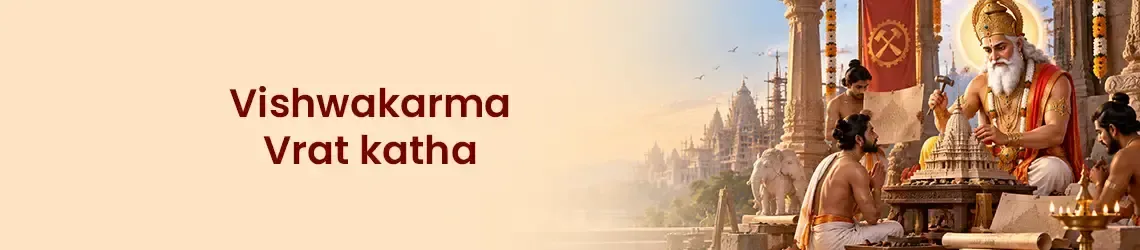
The Vishwakarma Vrat Katha is a sacred story that is recited by devotees who worship Lord Vishwakarma, the divine architect and engineer of the gods. The Vishwakarma Vrat Katha explains why the vrat is observed, how it should be performed, and what blessings it brings to those who follow it with devotion.
The Vishwakarma Vrat Katha is usually recited on Vishwakarma Puja, also known as Vishwakarma Jayanti, which is widely observed around Kanya Sankranti in mid-September. Many devotees also observe the Vishwakarma Vrat Katha on Amavasya, since the katha itself points to the new moon day as the most suitable time for this vrat.
The Vishwakarma Vrat Katha is not just one story. It is a collection of tales that show how devotees from different walks of life were helped by Lord Vishwakarma when they turned to him with sincere faith. These stories are simple, easy to follow, and carry lessons about patience, honesty, and devotion.
Who Is Lord Vishwakarma
Lord Vishwakarma, known as Devashilpi, is the divine architect and craftsman of the universe responsible for creating divine kingdoms, sacred weapons, and legendary cities.
Read more about Lord Vishwakarma here.
The Origin Story Behind the Vishwakarma Vrat Katha
The Vishwakarma Vrat Katha begins in an era when the sages were performing yajnas, sacred rituals involving fire. The demons began to trouble these yajnas and the devotees performing them. Concerned about this matter, the sages met to discuss ways to solve it.
The sages concluded that they should take help from Lord Brahma. Lord Brahma suggested that only the worship of Lord Vishwakarma could solve their problem and restore peace to them. Further, he advised them to go to a wise sage Angira, who was a follower of Lord Vishwakarma.
Sage Angira instructed the sages to fast on Amavasya day, not to perform any ordinary activities on that day, and to worship Lord Vishwakarma with complete devotion, along with listening to his katha. Thus, the sages followed his instructions and performed the yajna along with the Vishwakarma Vrat Katha and puja.
Hence, the demons were killed, and there was no disturbance during the yajna. This tale is the basis of the Vishwakarma Vrat Katha.
Story of King Pramangada
Another important part of the Vishwakarma Vrat Katha is the tale of King Pramangada. He ruled his kingdom with honesty and kindness, but at one point he developed an ailment in the form of an untreatable skin disease.
According to the Vishwakarma Vrat Katha, this disease was caused by some mistake in his previous life, during which the king had propagated the idea that there was no God who created everything. The wife of the king, Kamala, reminded her husband about their priest, who had once suffered from an eye ailment and recovered after observing the Amavasya vrat of Lord Vishwakarma.
King Pramangada then started worshipping Lord Vishwakarma daily and observed Amavasya vrat sincerely for the lord. The blessings of Lord Vishwakarma healed his skin disease, and he ruled the kingdom in good health and peace.
Story of the Chariot Maker of Kashi
Apart from this, the Vishwakarma Vrat Katha narrates the story of a chariot maker. This man was honest and proficient in his work, but unfortunately, he was a poor man without any progeny in Kashi.
The husband and wife met many sadhus and miracle men in their search for finding a solution for their problem, but it bore no fruit. An erudite Brahmin living near their house suggested that they discontinue their journey along these false paths and instead sincerely worship Lord Vishwakarma. He suggested that they should observe the Amavasya vrat, practice restraint, and donate to those in need.
The couple practiced all these things with full devotion. Soon after, they became prosperous and had a well-mannered son. From that day onward, the couple continued to worship Lord Vishwakarma every month.
Story of the Merchant Dhananjay
In the Vishwakarma Vrat Katha, there was another story about a benevolent merchant named Dhananjay who lived in Ujjain. Dhananjay used his money to help others, but when he had no money left, the people he had served started hating and criticizing him.
Feeling offended by such people, Dhananjay left the city and lived in the forest, where he survived on roots and fruits. There, he met a calm and peaceful sage named Lomasha. Lomasha explained to Dhananjay that the comfort and happiness of people come from Lord Vishwakarma and that Lord Rama and Lord Krishna worshipped Lord Vishwakarma for doing good.
Upon hearing this explanation from Lomasha, Dhananjay began worshipping Lord Vishwakarma. His sins were pardoned through his devotion, and finally, he found peace of mind.
Story of King Kritavirya
The Vishwakarma Vrat Katha also includes the story of King Kritavirya, whose sons kept passing away shortly after birth due to past karmic reasons. Deeply saddened, the king sought advice from his guru.
His guru told him to perform puja to Lord Vishwakarma and to donate clothes and ornaments to Brahmins as an act of charity. The king followed this guidance with full devotion. Soon after, his wife gave birth to a healthy son who lived a long life. The king continued his monthly worship of Lord Vishwakarma from that day forward. This story is often mentioned when families seek relief from repeated loss of children, ongoing illness in children, or general poverty in the household.
Benefits of Reciting the Vishwakarma Vrat Katha
According to tradition, sincere observance of the Vishwakarma Vrat Katha brings several benefits to those who follow it with devotion.
Removal of obstacles in work, business, and daily life
Relief from long-standing health problems
Blessings for couples hoping to have children
Protection of children from illness and harm
Relief from poverty and financial struggles
Growth and stability for artisans, engineers, and workers
Peace of mind and a sense of spiritual fulfillment
Final Thoughts
The Vishwakarma Vrat Katha is a set of stories that show how ordinary people overcame illness, poverty, childlessness, and hardship through devotion to Lord Vishwakarma.
Whether observed on Amavasya or during Vishwakarma Puja, the vrat is followed with simple steps that focus on faith, fasting, worship, and charity. The Vishwakarma Vrat Katha continues to be recited by families and communities who wish to honor the divine architect of the universe and seek his blessings for a better life.