
Mahalakshmi Vrat Katha
The Mahalakshmi Vrat, also known as Gajalakshmi Vrat, holds great significance in Hinduism. It begins on the Shukla Ashtami of the Bhadrapada month and is observed for 16 consecutive days. During this sacred period, devotees worship Goddess Mahalakshmi, seeking her blessings for wealth, prosperity, happiness, and abundance. It is believed that observing this vrat with devotion brings financial stability, family well-being, and lasting prosperity.
Several legends are associated with the Mahalakshmi Vrat, and the following are among the most popular.
Mahalakshmi Vrat Katha – The Mahabharata Legend
According to Hindu tradition, during the time of the Mahabharata, the great sage Ved Vyasa visited Hastinapura. King Dhritarashtra warmly welcomed the sage into his royal palace. Queen Gandhari and Queen Kunti respectfully asked Ved Vyasa how they could ensure that Goddess Lakshmi's blessings of wealth and prosperity always remained in their kingdom.
Ved Vyasa advised them that if they wished to maintain happiness and prosperity, they should observe the Mahalakshmi Vrat every year on Ashwin Krishna Ashtami according to the prescribed rituals.
Following the sage's advice, both Gandhari and Kunti resolved to observe the sacred fast.
Queen Gandhari ordered the construction of a magnificent elephant in the palace courtyard with the help of her one hundred sons and invited all the married women of the city to participate in the Mahalakshmi Puja. However, she deliberately did not invite Queen Kunti.
When Kunti saw all the women heading toward Gandhari's palace for the worship, she became deeply saddened. Seeing their mother upset, the five Pandava brothers asked the reason for her sorrow. Kunti explained what had happened.
Hearing this, Arjuna assured his mother, "Prepare for the Mahalakshmi Puja. I will bring an elephant for you."
Arjuna then traveled to Indraloka and brought back Airavata, Lord Indra's divine white elephant. News of Airavata's arrival quickly spread throughout the city, attracting crowds eager to witness the celestial elephant. Married women gathered at Kunti's palace and performed the Mahalakshmi Puja according to tradition.
According to this legend, the Mahalakshmi Vrat Katha is traditionally recited 16 times, and every offering made during the puja is also presented 16 times, symbolizing the sixteen-day observance of the vrat.
Mahalakshmi Vrat Katha – The Poor Brahmin's Story
Another popular legend tells of a poor Brahmin who was a devoted worshipper of Lord Vishnu.
Pleased with his unwavering devotion, Lord Vishnu appeared before him and offered to grant him any boon. The Brahmin humbly requested that Goddess Lakshmi should always reside in his home.
Lord Vishnu replied that his wish could indeed be fulfilled, but only if he made some effort. He told the Brahmin that every day, a woman came near the temple to make cow-dung cakes, and that he should invite her to his home. Lord Vishnu revealed that the woman was none other than Goddess Lakshmi herself. If she accepted the invitation, the Brahmin's home would forever be blessed with wealth and prosperity.
Having said this, Lord Vishnu disappeared.
The next morning, the Brahmin waited outside the temple before sunrise. When Goddess Lakshmi appeared in the form of the village woman, he respectfully invited her to his home.
Realizing that Lord Vishnu had arranged everything, Goddess Lakshmi smiled and said:
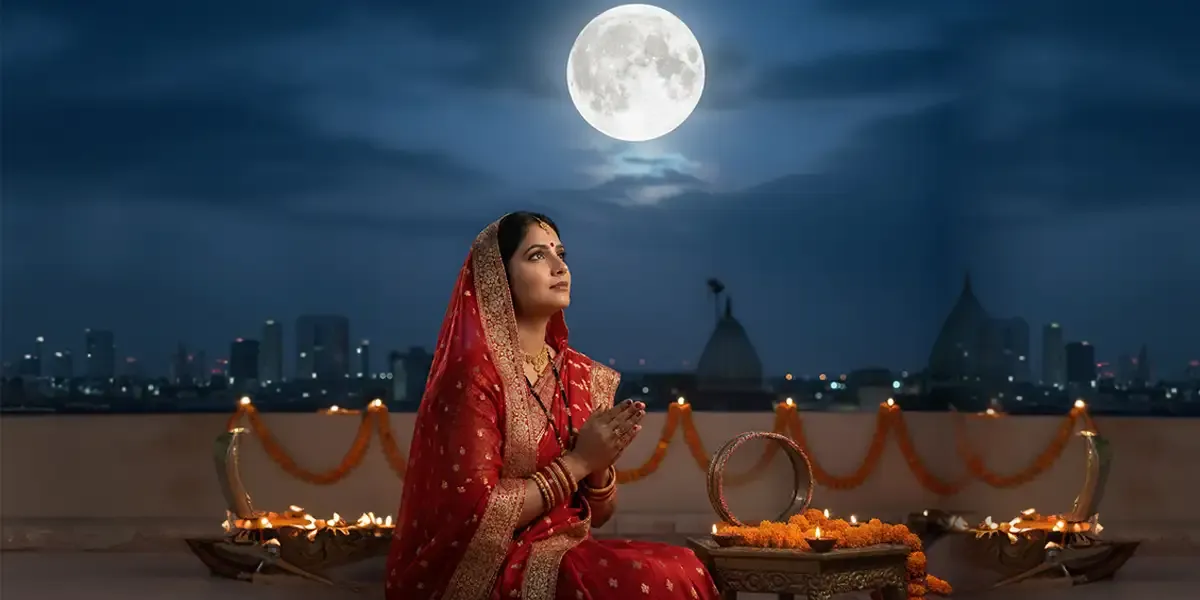
"Observe the Mahalakshmi Vrat for sixteen days with complete devotion and offer Arghya (water) to the Moon every day and night. Only then will I come to your home."
The Brahmin faithfully followed her instructions. After completing the sixteen-day vrat and worshipping the Goddess while facing the north, he sincerely prayed to her.
Honoring her promise, Goddess Lakshmi appeared before him, removed all his hardships, and filled his home with prosperity, happiness, and abundance.
Mahalakshmi Vrat Katha – Lord Vishnu and Goddess Lakshmi
According to another popular legend, Lord Vishnu once decided to visit Bhuloka (Earth). Goddess Lakshmi expressed her desire to accompany him.
Knowing her naturally curious nature, Lord Vishnu agreed on one condition.
He said, "You must obey whatever I ask without exception."
Goddess Lakshmi happily accepted the condition, and together they descended to Earth.
After traveling for some time, Lord Vishnu told her:
"I am going toward the southern direction. Please stay here and wait for me until I return."
After Lord Vishnu departed, Goddess Lakshmi became curious about why she had been asked to remain behind. Unable to control her curiosity, she began following him.
Along the way, she came across a beautiful field of blooming mustard flowers. Captivated by their beauty, she plucked a few flowers and adorned herself with them.
A little farther ahead, she noticed a sugarcane field. Tempted by the fresh sugarcane, she plucked some stalks and began chewing them.
Just then, Lord Vishnu returned and saw Goddess Lakshmi decorating herself with flowers taken from the farmer's field and eating the sugarcane.
Angered by her actions, Lord Vishnu said:
"You have broken your promise. Not only did you ignore my instruction to stay behind, but you also took flowers and sugarcane from a farmer's field without permission. You must now bear the consequences."
He cursed Goddess Lakshmi to remain on Earth and serve the farmer's family for twelve years, while he returned to Kshira Sagara, his celestial abode.
Unable to leave, Goddess Lakshmi stayed with the farmer's family. One day, she instructed the farmer's wife to worship an idol of Goddess Lakshmi, assuring her that sincere devotion would fulfill every wish.
The farmer's wife followed her advice, and within a short time, their home became filled with wealth, food, happiness, and prosperity.
Twelve years passed peacefully. When Lord Vishnu returned to take Goddess Lakshmi back, the farmer pleaded with her not to leave.
Goddess Lakshmi replied:
"If you worship me with proper rituals on Kartik Krishna Trayodashi (Dhanteras) every year, I will continue to bless your home, although you will not see me physically. Establish a sacred Kalash and place wealth within it, for wealth itself represents my presence."
The farmer followed her instructions faithfully. From that day onward, his household remained prosperous, and it is believed that this tradition gave rise to the custom of worshipping Goddess Lakshmi on Dhanteras, a practice that continues to this day.
Significance of Mahalakshmi Vrat
The Mahalakshmi Vrat is observed to seek the blessings of Goddess Lakshmi for wealth, prosperity, peace, and overall well-being. It teaches the importance of devotion, faith, discipline, and generosity. Devotees believe that sincerely observing this sixteen-day vrat removes financial difficulties, attracts abundance, and brings lasting happiness and harmony into the home.
Are you seeking guidance to overcome financial, career, or personal challenges? Connect with Astroyogi's experienced astrologers today and receive personalized insights based on your birth chart (Kundli).