

Annamalaiyar (Arunachaleswarar) Temple in Thiruvannamalai: History, Rituals, Spiritual Benefits & Festivals
The Thiruvannamalai Temple, widely known as the God Annamalaiyar Temple, located in Southern India in the state of Tamil Nadu, is one of the most revered Shiva temples in India. Many devotees visit this sacred pilgrimage site to seek peace, strength, and spiritual clarity. The temple links deep history, unique architecture, and strong devotional practices. It holds a special place in Vedic traditions and is known for its connection to the fire element. Let’s explore in detail.
Understanding the Power of Annamalaiyar Temple
The Annamalaiyar temple, also known as the Arulmigu Arunachaleswarar Temple Thiruvannamalai, is one of the holiest Shiva temples. It stands at the base of the sacred Annamalai Hill, symbolizing Agni (fire), one of the five elements that govern existence. Devotees believe that Lord Shiva manifested here as a towering column of infinite light to prove his supremacy over the gods Brahma and Vishnu.
When you visit the Arulmigu Arunachaleswarar Temple in Thiruvannamalai, you walk into a sacred space filled with strong spiritual energy that helps clear confusion and lift the mind.
History and Legend of Thiruvannamalai Temple
The Annamalaiyar Temple's history reveals more than a millennium of sacred tradition, royal patronage, and spiritual significance. The temple's origins are deeply ancient, with poetic references appearing in early Shaivite Tamil literature, such as the 7th-century Thevaram hymns by Saiva saint-poets known as Nayanars.
According to inscriptions and archaeological evidence, the earliest significant stone construction began under the Chola dynasty, between the 9th and 13th centuries. Kings from the Pallava, Hoysala, Pandya, and Vijayanagara dynasties expanded their grandeur over centuries.
Another fascinating layer in Arunachaleswarar Temple history involves saints like the noted Hindu sage, Ramana Maharshi, who attained realization at this very hill. He stated that the hill itself, Lord Shiva’s physical form, is an eternal center of consciousness radiating silence and wisdom.
Vedic traditions say Lord Shiva appeared here as a pillar of flame when Brahma and Vishnu argued about supremacy. Brahma took the form of a swan to find the top of the flame, and Vishnu became a boar to trace its root. Both failed, and Shiva revealed that truth itself cannot be measured.
That legend became the foundation of the Karthigai Deepam Festival, symbolizing enlightenment through humility.
Read more: 108 names of lord murugan
Architecture of Annamalaiyar Temple Thiruvannamalai
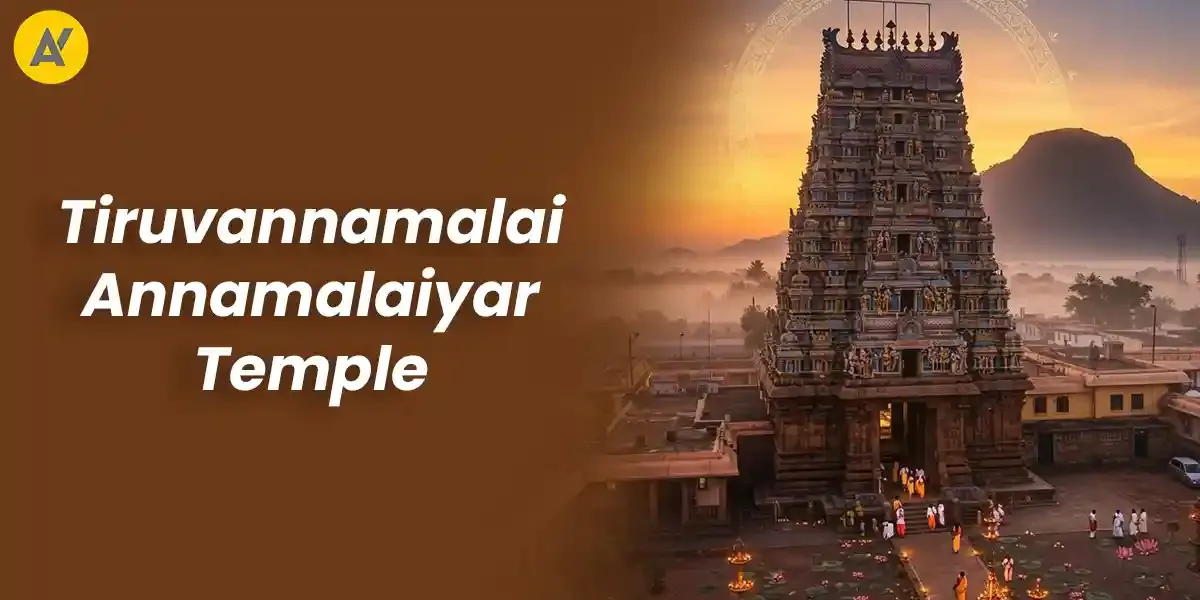
One of the largest Shiva temples in India, spread across 25 acres, the Thiruvannamalai temple showcases Dravidian architecture at its finest. With nine towers (gopurams), thousands of sculpted pillars, and intricately carved stones, every part of this grand monument holds symbolic meaning.
The temple also has a massive 110-story Eastern Rajagopuram, which was built by Vijayanagara ruler Krishna Deva Raya and stands approximately 217 feet tall, making it one of India's highest temple towers.
This temple represents elemental fire (Agni) among the five Panch Bhoota Sthalams (sacred temples) of Lord Shiva. The presiding deity here is Lord Arunachaleswarar (Shiva) and His consort Goddess Unnamalai Amman (Parvati).
Inside the temple, you’ll find:
- Five courtyards that symbolize the five basic elements of nature – Earth, Water, Fire, Air, and Ether.
- The main sanctum that houses the Shiva Lingam, which represents eternal fire.
- The Unnamalai Amman shrine, which represents the nurturing aspect of divine grace.
- Sacred water tanks, especially the Agni Tirtham, where pilgrims purify energy before entering.
Are you nurturing your spiritual energy daily? Explore our online shop at Astroyogi Store for authentic Rudraksha, gemstones, crystals, and other spiritual products that radiate divine spirit and energy.
Spiritual Significance and Benefits of Annamalaiyar Temple Thiruvannamalai
Every temple in India corresponds to a cosmic energy field. The Arulmigu Arunachaleswarar Temple Thiruvannamalai is said to resonate with fire and transformation, the very principles that astrology identifies as essential for spiritual rebirth.
- According to ancient seers, when you perform Girivalam or light a ghee lamp in Lord Annamalaiyar’s name, you activate your Agni energy.
- This inner fire supports self-realization and strengthens your Sun in the birth chart, which represents soul purpose and vitality.
Vedic experts interpret this temple as the living symbol of the Sun’s divine light residing on Earth. It supports solar consciousness, which governs clarity, willpower, and truth. In astrology, it’s said that meditating on Arunachala hill during sunrise can amplify the effects of the Sun’s grace and strengthen personal dharma (life path).
Spiritually, astrologers consider this a moksha sthala, a place for liberation from karmic cycles. Visiting during Karthigai Deepam, when a giant fire lamp is lit atop the hill, balances the Agni tattva (fire element) in your horoscope, which governs vitality, spiritual growth, and life force.
Festivals and Worship Rituals of Annamalaiyar Temple
Several sacred and powerful rituals are held throughout the year in honor of Lord Annamalaiyar. The temple features six daily rituals and twelve annual festivals.
One of the most revered rituals at the temple is the Karthigai Deepam festival. On this night, a massive flame is lit at the peak of the Arunachala hill, visible for miles, symbolizing Lord Shiva’s infinite light. Millions witness it, chanting the Lord’s name as the fire illuminates the sky.
Other important observances include:
- Pradosham – A bi-monthly Shiva worship for clearing karmic debts. The best time to worship the Lord on this day is believed to be during the auspicious three-hour window, 1.5 hours before and after sunset. - Girivalam Pournami – Millions of pilgrims perform a sacred circumambulation of the Arunachala or Annamalai hill, which covers about 14 km, done especially on full moons. Doing so is believed to remove karma and mental blockages. The procession includes five temple carriages known as thaer, which have wooden carvings. - Thiruvoodal – Another festival, which is held annually in mid-January during the first week of the Tamil month Thai. Garlands composed of fruits, vegetables, and candies are used to decorate Nandhi (bull vahana (mount) of Shiva) on the morning of Maatu Pongal. In the evening, the festival deities of Annamalaiyar and Unnamulai Amman are carried from the temple to Thiruvoodal Street to perform the oodal (love tiff) between the two. - Maha Shivaratri – All-night vigil with chanting, believed to please Lord Arunachaleswarar and awaken the Kundalini.
Simple worship practices you can follow:
- Begin with meditation facing the sacred hill.
- Offer ghee lamps or white flowers to Lord Annamalaiyar.
- Chant the ‘Om Namah Shivaya mantra’ or ‘Om Arunachaleshwaraya Namah’ for purification.
- Complete the Girivalam barefoot under the moonlight.
Thiruvannamalai Arunachaleswarar Temple Timings
Visiting Hours:
The Arunachaleswarar Temple is open year-round, with visiting hours ranging from 5:30 AM to 12:30 PM and 3:30 PM to 9:30 PM, allowing pilgrims to plan visits during auspicious muhurthas (timing windows).
Best Time to Visit: The best time to visit the Annamalaiyar temple Thiruvannamalai is October through March for pleasant weather and June through September for cooler temperatures. For a more vibrant experience, consider going around important festivals such as Maha Karthigai Deepam in November-December or Maha Shivaratri in February-March, though expect more crowds.
Curious how the energies influence your natal chart and destiny? Consult our expert astrologers on Astroyogi today and discover your divine power. Call or Chat now!
Team Astroyogi is an experienced in-house editorial team of passionate writers, researchers, and astrology enthusiasts dedicated to making ancient divination sciences more accessible and meaningful in everyday life. With years of collective experience in creating insightful astrology and spirituality content, the team specializes in simplifying complex spiritual concepts into practical guidance for readers seeking clarity, balance, and personal growth. The Astroyogi editorial team possesses expertise across a wide range of subjects, including Indian Astrology, Vedic Astrology, Planetary Transits, Horoscope Analysis, Vastu Shastra, Numerology, Tarot, Spiritual Wellness, and Ritual Practices. Every piece of content is carefully researched, fact-checked, and crafted with the intention of offering reliable, insightful, and easy-to-understand guidance rooted in traditional wisdom. Driven by a commitment to authenticity and reader trust, Team Astroyogi strives to create content that empowers individuals to navigate life’s opportunities and challenges with confidence, positivity, and inner peace. Their mission is to bridge ancient astrological knowledge with modern-day relevance, helping readers make informed decisions and lead more harmonious lives.