
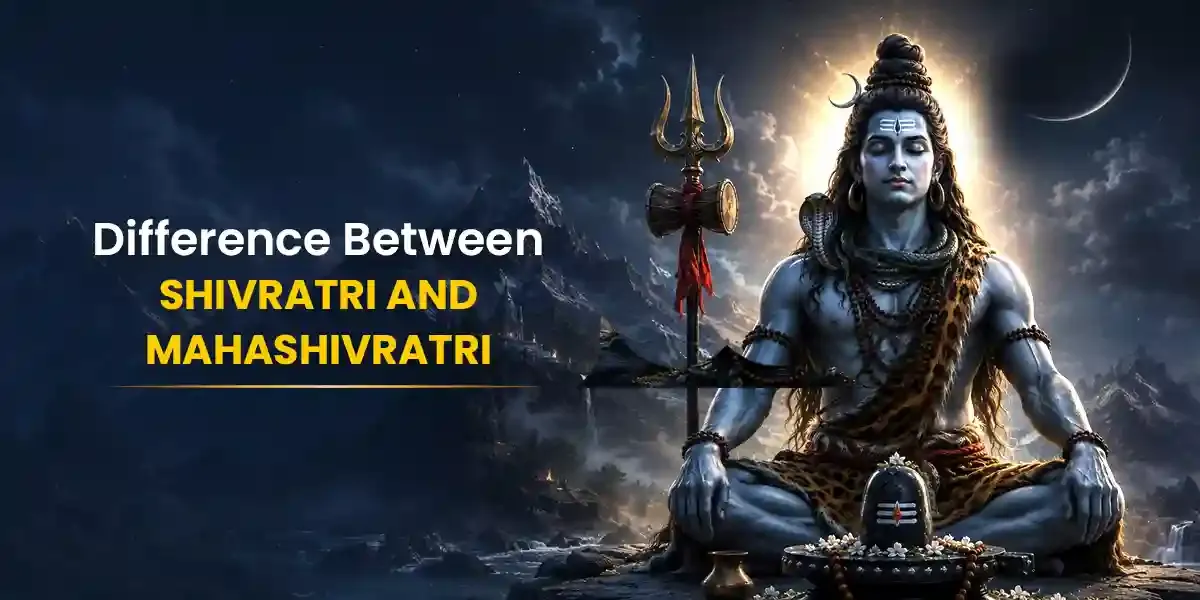

Difference Between Shivratri and Mahashivratri Explained
In many ways, people talk about Shivratri and Mahashivratri as though they are the same, using both terms in the same breath, implying that there is not much difference between the two.
However, these two concepts represent two different days in the Hindu calendar. There is one more variation—Sawan Shivratri, which is associated with the particular sacred month.
Shivratri is a monthly observance dedicated to Lord Shiva. Mahashivratri is the one grand, annual version of it, carrying far greater spiritual weight. Then there is Sawan Shivratri, which brings its own flavor tied to a specific holy month and complicates things further. Let's untangle all three, one thread at a time.
What Is Shivratri, Exactly?
Shivratri is best explained as a monthly meeting with Lord Shiva. It comes once every month during Krishna Paksha Chaturdashi, which is the fourteenth day of the moon’s waning period. This time is used by devotees for fasting, worship, and “spirit cleansing."
Shivratri does not have much magnificence attached to it. It is steady, repeated devotion, a monthly reset for the mind and the spirit, asked for and given without fanfare.
What Is Mahashivratri and How Is It Different from Shivratri?
Shivratri and Mahashivratri start to look less like twins here and more like a regular event besides their once-a-year counterpart. Mahashivratri is widely regarded as the most significant of all the Shivratris. It is often linked to the divine marriage of Lord Shiva and Goddess Parvati, symbolizing the union of masculine and feminine cosmic energies.
Some accounts also connect it to the samudra manthan, in which Lord Shiva swallowed poison to protect the universe, and to his victory over the demon Tripurasura, a tale that represents light triumphing over darkness.
The word "Maha" is not decorative. It means "great," and it signals scale, intensity, and priority. A regular Shivratri asks for quiet devotion. Mahashivratri asks for something larger: longer fasting, an all-night vigil, elaborate temple rituals, and a widespread belief that prayers offered on this night carry extra spiritual power. If Shivratri is a doorway walked through every month, Mahashivratri is the grand gate approached once a year, in full ceremony.
Mahashivratri's Astrological Edge Over Shivratri
Lunar Timing: Mahashivratri falls on the darkest night before the new moon in Phalguna. A regular Shivratri happens every month, but Mahashivratri comes just once a year, on the darkest night of the whole year, making it far more powerful.
Planetary Alignment: On this night, the Sun sits in Aquarius while the Moon wanes, a rare combination believed to support meditation and smooth prana flow. A basic Shivratri doesn't carry this specific alignment, which is why Mahashivratri is seen as astrologically stronger.
Psychological Meaning: The Moon represents the mind, and its weak state on this night is seen as a chance to strengthen it. Worshipping Lord Shiva is believed to bring mental stability and willpower, but the effect is considered far more amplified on Mahashivratri than on a regular Shivratri.
Where Sawan Fits In: Shivratri vs. Mahashivratri
Confusion often arises here, so it's worth addressing directly. Every month has its own Shivratri, since each one falls on Krishna Paksha Chaturdashi, the same lunar dating point in the cycle. Sawan Shivratri is simply the Shivratri that occurs during the month of Sawan (Shravan), and that placement is exactly why it gets singled out for special comparison against Mahashivratri.
Why Sawan matters in this comparison:
Sawan is widely regarded by devotees as Lord Shiva's favorite month, making the Chaturdashi that falls within it feel more significant than an ordinary monthly Shivratri.
Because the date Chaturdashi is identical in structure to Mahashivratri's dating system, Sawan Shivratri can look, at a glance, like a smaller version of Mahashivratri—which is precisely why the two are so often confused.
The real difference isn't in the date mechanics but in the source of the occasion's power: Mahashivratri draws its significance from mythology and cosmic events (Lord Shiva-Goddess Parvati's union, the churning of the ocean, and the triumph over darkness), while Sawan Shivratri draws its significance from the month surrounding it—it borrows its weight from Sawan's own sanctity rather than from a unique mythological event of its own.
Put simply, if Mahashivratri is the grandest night of the year for devotion to Lord Shiva, Sawan Shivratri is a monsoon season echo of that same devotion, wrapped inside an already holy month.
| Event | When It Is Observed | Why It Is Important |
|---|---|---|
| Shivratri | Every month on Krishna Paksha Chaturdashi | Monthly worship of Lord Shiva through fasting, puja, and meditation. |
| Mahashivratri | Once a year in Magha/Phalguna (February–March) | The most significant Shivratri, celebrating Lord Shiva's divine marriage and spiritual awakening. |
| Sawan Shivratri | Once a year during Shravan/Sawan (July–August) | A special Shivratri observed in the sacred month of Sawan, dedicated to Lord Shiva's worship. |
Shivratri and Mahashivratri: Bringing It All Together
The next time Shivratri and Mahashivratri get lumped into the same basket, the distinction will hold. Shivratri is the monthly gateway to Lord Shiva awareness, appearing silently each month. Mahashivratri is the annual gateway of transformation, union, and enlightenment, full of mythological and astrological significance in the scheme of things. Sawan Shivratri falls midway between these two, a seasonal observance that derives its sanctity from the Shravan month instead of celestial mythology.
There is far more to knowing the distinction between Sawan Shivratri and Mahashivratri, as well as how they relate to Shivratri itself. This helps people approach these events in a different way because knowing the purpose of a practice makes it all the more lived and not just practiced.
Team Astroyogi is an experienced in-house editorial team of passionate writers, researchers, and astrology enthusiasts dedicated to making ancient divination sciences more accessible and meaningful in everyday life. With years of collective experience in creating insightful astrology and spirituality content, the team specializes in simplifying complex spiritual concepts into practical guidance for readers seeking clarity, balance, and personal growth. The Astroyogi editorial team possesses expertise across a wide range of subjects, including Indian Astrology, Vedic Astrology, Planetary Transits, Horoscope Analysis, Vastu Shastra, Numerology, Tarot, Spiritual Wellness, and Ritual Practices. Every piece of content is carefully researched, fact-checked, and crafted with the intention of offering reliable, insightful, and easy-to-understand guidance rooted in traditional wisdom. Driven by a commitment to authenticity and reader trust, Team Astroyogi strives to create content that empowers individuals to navigate life’s opportunities and challenges with confidence, positivity, and inner peace. Their mission is to bridge ancient astrological knowledge with modern-day relevance, helping readers make informed decisions and lead more harmonious lives.